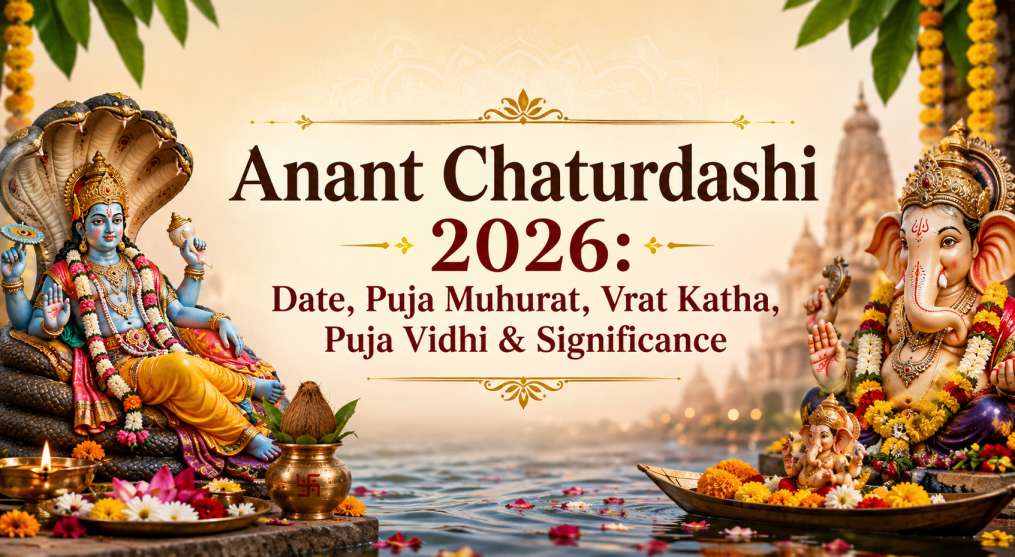
Anant Chaturdashi is an important Hindu festival observed on the Shukla Paksha Chaturdashi of Bhadrapada month. The day is dedicated primarily to Lord Vishnu in his Ananta form, symbolising infinity, continuity and the sustaining power of the universe. It is also closely associated with the conclusion of the 10-day Ganeshotsav, making it especially significant in Maharashtra and several other parts of India.
In 2026, Anant Chaturdashi will be observed on Friday, September 25, 2026. In New Delhi, Chaturdashi Tithi begins at approximately 6:10 AM and ends at 11:07 PM IST.
Devotees traditionally observe Anant Vrat, worship Lord Vishnu, recite the Anant Vrat Katha and tie the sacred Anant Sutra, generally consisting of 14 knots. The festival encourages devotion, discipline and reflection on the idea of maintaining stability through changing circumstances.
Anant Chaturdashi 2026 Date and Puja Muhurat
For New Delhi, the key timings are:
- Date: Friday, September 25, 2026
- Chaturdashi Tithi Begins: 6:10 AM IST
- Chaturdashi Tithi Ends: 11:07 PM IST
- Anant Chaturdashi Puja Window: Approximately 6:10 AM–11:07 PM IST
- Sunrise: 6:10 AM IST
- Sunset: 6:14 PM IST
Panchang calculations can vary slightly from city to city because sunrise, sunset and tithi calculations depend on geographical location. Therefore, devotees should verify the final local muhurat before performing an important ritual.
Why Is Anant Chaturdashi Celebrated?
The word Ananta means “endless” or “infinite”. Lord Vishnu’s Ananta form represents the eternal nature of existence and the sustaining principle of the universe.
The day is traditionally associated with:
- Worship of Lord Vishnu
- Observance of Anant Vrat
- Recitation of the Anant Vrat Katha
- Tying the 14-knotted Anant Sutra
- Seeking stability and protection for the family
- Ganesh Visarjan at the conclusion of Ganeshotsav
Anant Chaturdashi also marks the traditional culmination of the 10-day Ganesh festival, with devotees taking Ganesha idols for visarjan.
Anant Chaturdashi Puja Vidhi
A simple home puja can be performed with cleanliness, devotion and a focused mind.
Step-by-Step Puja
- Clean the puja space and take a bath before beginning the rituals.
- Place an image or idol of Lord Vishnu on a clean altar.
- Light a diya and offer flowers, akshat, sandalwood and incense.
- Offer fruits and traditional naivedya according to your family tradition.
- Recite Vishnu mantras or the Anant Vrat Katha.
- Prepare or obtain an Anant Sutra with 14 knots.
- Offer the thread to Lord Vishnu during the puja.
- Tie the sacred thread on the appropriate arm according to your family tradition.
- Complete the puja with Vishnu Aarti and prayers.
- If observing a fast, break it according to your family’s vrat tradition and local Panchang guidance.
The 14 knots of the Anant Sutra are traditionally understood as representing the 14 worlds (lokas), giving the ritual a symbolic connection with the broader Hindu cosmological tradition.
Anant Chaturdashi Vrat Katha
The traditional Anant Vrat Katha is associated with Kaundinya and Sushila. According to the popular narrative, Sushila learned about the Anant Vrat and began observing it with devotion. Her family’s circumstances subsequently improved.
Kaundinya, however, questioned the significance of the sacred thread and eventually discarded it. The story describes the difficulties that followed and his eventual realisation of the importance of faith, discipline and observance.
The deeper message of the Anant Vrat Katha is not simply about material prosperity. It highlights the importance of commitment, humility, faith and respecting one’s spiritual practices.
This makes the story relevant even today: rituals can serve as reminders to remain consistent with one’s responsibilities instead of looking for instant results.
Astrological Significance of Anant Chaturdashi
From an astrological perspective, Anant Chaturdashi is associated with Lord Vishnu and the principle of preservation and balance.
The observance can be viewed as a spiritually focused day for strengthening qualities associated with stability, patience and responsible decision-making.
The festival falls during Bhadrapada Shukla Chaturdashi, while the 2026 New Delhi Panchang shows Shatabhisha Nakshatra prevailing until around 11:22 AM. The day’s Panchang also records Shula Yoga, making it important to focus on disciplined spiritual practice rather than treating every muhurat as universally auspicious.
For those following Vedic astrology, the day can be used for:
- Vishnu mantra meditation
- Spiritual reflection
- Resolving unnecessary conflicts
- Practising financial discipline
- Seeking greater consistency in personal responsibilities
- Performing charity according to one’s capacity
Simple Remedies for Anant Chaturdashi
Rather than relying on exaggerated claims, devotees can follow simple traditional practices:
- Chant “Om Namo Bhagavate Vasudevaya” with concentration.
- Offer Tulsi leaves to Lord Vishnu, where permitted by one’s tradition.
- Donate food or useful items to someone in need.
- Read or listen to the Anant Vrat Katha.
- Avoid unnecessary arguments and harsh speech.
- Practise gratitude and self-discipline.
- Maintain a simple, sattvic routine during the vrat.
These practices are best understood as spiritual disciplines rather than guaranteed methods for producing a particular material outcome.
Anant Chaturdashi and Ganesh Visarjan 2026
One of the most visible aspects of Anant Chaturdashi is Ganesh Visarjan. In 2026, Ganesh Chaturthi falls on September 14, and Anant Chaturdashi falls on September 25, marking the traditional 10-day culmination of Ganeshotsav.
Families and communities perform the final Ganesha puja before taking the idol for immersion. The visarjan symbolises the temporary nature of physical forms and the return of the divine presence to its cosmic source.
For environmentally responsible celebrations, devotees can consider eco-friendly idols and designated immersion facilities wherever available.
Conclusion
Anant Chaturdashi 2026 will be observed on Friday, September 25, with Chaturdashi Tithi prevailing from approximately 6:10 AM to 11:07 PM IST in New Delhi.
The festival combines devotion to Lord Vishnu, the Anant Vrat tradition, the sacred 14-knotted Anant Sutra and the emotional conclusion of Ganeshotsav. Its broader message is one of continuity, humility, discipline and acceptance of change.
Whether you observe the complete vrat or simply offer a sincere prayer, the most meaningful approach is to follow your family tradition and local Panchang while keeping the focus on devotion rather than fear or superstition.
If you want to understand how a festival or vrat may relate to your personal Kundli and planetary periods, consulting a qualified Vedic astrologer can provide a more individualised perspective.
FAQs
1. When is Anant Chaturdashi 2026?
Anant Chaturdashi 2026 will be observed on Friday, September 25, 2026.
In New Delhi, Shukla Chaturdashi begins at approximately 6:10 AM and ends at 11:07 PM IST. The exact timings can vary slightly by location.
Related tips:
- Check your local Panchang.
- Perform Vishnu Puja during a suitable local window.
- Recite the Anant Vrat Katha.
2. What is the significance of Anant Chaturdashi?
Anant Chaturdashi is dedicated to Lord Vishnu in his Ananta form and is associated with the Anant Vrat and Ganesh Visarjan.
The word Ananta signifies the infinite or eternal. The day encourages devotees to cultivate stability, faith and discipline while also marking the traditional end of the 10-day Ganeshotsav.
Related practices:
- Worship Lord Vishnu.
- Tie the Anant Sutra.
- Practise charity and gratitude.
3. What is the Anant Sutra and why does it have 14 knots?
The Anant Sutra is a sacred thread traditionally tied after Anant Chaturdashi Puja, with 14 knots symbolising the 14 worlds.
Devotees traditionally associate the thread with Lord Vishnu’s Ananta form. It represents continuity, spiritual commitment and remembrance of the divine.
Simple practice:
- Keep the thread clean.
- Offer it during the puja.
- Follow your family’s traditional method of tying it.
4. Can we observe Anant Chaturdashi Vrat at home?
Yes, devotees can observe Anant Vrat at home according to their family tradition and physical capacity.
The observance may include fasting, Vishnu Puja, mantra chanting, listening to the Anant Vrat Katha and tying the Anant Sutra. Fasting should be adapted sensibly for children, elderly people and anyone who cannot safely fast.
Useful approach:
- Keep the puja simple.
- Prefer sattvic food if fasting rules permit.
- Prioritise devotion over elaborate rituals.
5. Is Anant Chaturdashi the same day as Ganesh Visarjan?
Anant Chaturdashi is the traditional major day for Ganesh Visarjan at the conclusion of the 10-day Ganeshotsav.
In 2026, Ganesh Chaturthi begins on September 14 and the 10-day celebration culminates with Anant Chaturdashi on September 25.
For visarjan:
- Complete the final Ganesha Puja first.
- Follow the locally prescribed visarjan timing.
- Prefer an authorised or eco-friendly immersion arrangement.