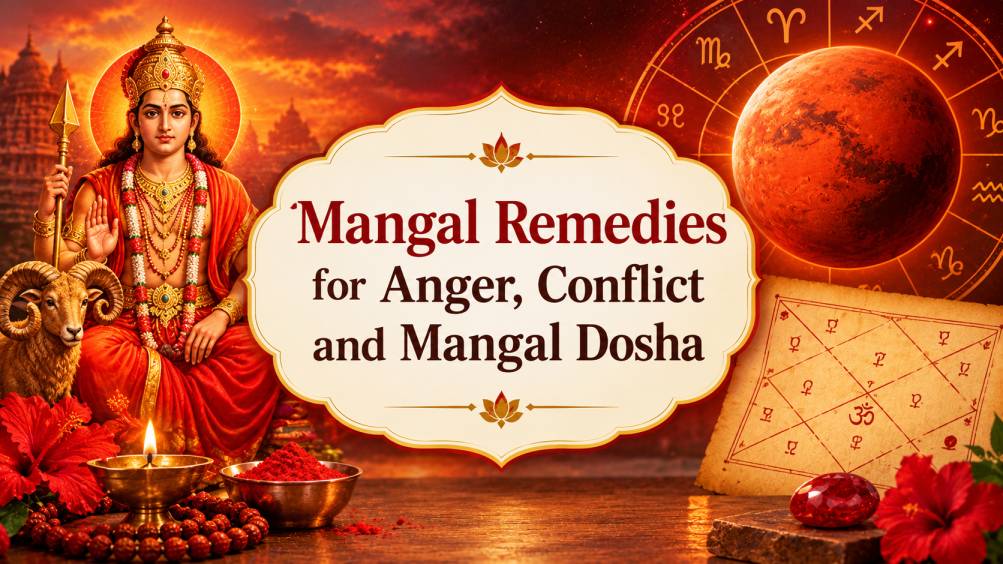
In Vedic astrology, Mars, known as Mangal or Kuja, represents energy, courage, ambition, physical strength, and the ability to take action. It is also traditionally associated with aggression, impatience, competition, and conflict when its influence is interpreted as challenging in a birth chart. For this reason, Mangal remedies are commonly discussed by people seeking greater emotional balance, relationship harmony, or guidance about Mangal Dosha.
Mangal Dosha, also called Manglik Dosha or Kuja Dosha, is a traditional astrological condition assessed through specific placements of Mars in the Kundli. However, it does not automatically indicate marital problems or an unhappy future. Understanding Mars requires examining the complete horoscope alongside real-life circumstances. Traditional remedies such as Tuesday prayers, Hanuman worship, mantra chanting, and charitable activities can support personal reflection, while practical anger-management techniques help people respond to conflict constructively.
What Does Mars Represent in Vedic Astrology?
Mars is considered a fiery planet associated with initiative, determination, physical activity, leadership, and the ability to confront challenges.
Its placement in the birth chart is traditionally interpreted in relation to several areas of life:
- Personality: Courage, confidence, assertiveness, and competitiveness.
- Career: Initiative, technical ability, engineering, defence, and action-oriented work.
- Relationships: Boundaries, disagreements, passion, and approaches to resolving conflict.
- Energy: Motivation, physical drive, and the willingness to overcome obstacles.
In traditional astrology, a well-supported Mars may symbolise disciplined action, while an afflicted Mars may be interpreted as impulsiveness or excessive aggression. These are astrological interpretations rather than scientifically established personality assessments.
Signs Traditionally Associated With Challenging Mars
Astrologers may examine Mars when a person experiences recurring difficulties with anger, impatience, or conflict. However, such experiences cannot reliably establish that Mars is weak or afflicted.
Traditional interpretations may consider the following themes:
- Reacting quickly during disagreements.
- Struggling with impatience or frustration.
- Becoming overly competitive in personal or professional situations.
- Experiencing recurring tension in close relationships.
- Taking risks without adequately considering consequences.
These patterns can also result from stress, sleep deprivation, communication difficulties, or other circumstances. Practical support and behavioural changes are important regardless of one’s astrological beliefs.
Understanding Mangal Dosha in Kundli
Mangal Dosha is traditionally assessed when Mars occupies certain houses in a birth chart. Depending on the astrological school, these commonly include the 1st, 2nd, 4th, 7th, 8th, and 12th houses, although some traditions use different rules.
Does Mangal Dosha Always Cause Marriage Problems?
No. Mangal Dosha should not be interpreted as an automatic prediction of marital difficulties.
Astrologers may examine Mars’s zodiac sign, house placement, aspects, conjunctions, ascendant, and the positions of other planets. Some traditions also consider cancellation conditions, known as Mangal Dosha cancellation or Dosha Bhanga.
In marriage matching, the complete charts of both individuals may be considered rather than relying on a Manglik or non-Manglik label alone. Relationship quality also depends on mutual respect, communication, shared expectations, and emotional maturity.
Effective Mangal Remedies for Anger and Conflict
Traditional Mangal upay focus on discipline, devotion, courage, and responsible action. These practices can be incorporated into daily life without excessive expense.
1. Perform Tuesday Hanuman Worship
Tuesday, known as Mangalwar, is traditionally associated with Mars. Many devotees worship Lord Hanuman as part of their spiritual practice.
Consider these simple remedies:
- Visit a Hanuman temple or pray at home.
- Read the Hanuman Chalisa according to your personal tradition.
- Offer flowers or other customary offerings if desired.
- Practise patience and avoid unnecessary arguments.
- Dedicate time to physical activity and disciplined work.
These practices may provide a meaningful routine for reflection and self-control, but they are not guaranteed to change planetary influences.
2. Chant the Mangal Mantra
A commonly used mantra associated with Mars is:
ॐ क्रां क्रीं क्रौं सः भौमाय नमः।
Om Kraam Kreem Kraum Sah Bhaumaya Namah.
Devotees may chant this mantra on Tuesdays, sometimes using a mala for repetition. A shorter, consistent practice is also an option.
Mantra chanting can serve as a reminder to pause, focus, and respond thoughtfully. There is no reliable scientific evidence that it directly changes planetary positions or guarantees relief from anger or relationship conflict.
3. Donate Red Lentils on Tuesday
Red is traditionally associated with Mars, and donating red lentils (masoor dal) is a commonly practised Mangal remedy.
Other charitable activities may include:
- Donating nutritious food to people in need.
- Supporting educational or community initiatives.
- Helping someone facing practical difficulties.
- Contributing according to your financial capacity.
Charity should be voluntary and affordable. Avoid expensive rituals or financial commitments made out of fear of Mangal Dosha.
4. Use Practical Anger-Management Techniques
Spiritual practices can be combined with everyday methods for managing anger and disagreements.
Try these habits:
- Pause before responding: Take a few slow breaths before replying during a tense conversation.
- Identify triggers: Notice whether tiredness, work pressure, or particular situations make you more reactive.
- Use calm language: Explain your feelings without insulting or blaming the other person.
- Exercise regularly: Walking, yoga, or other suitable physical activities can provide a constructive outlet for energy.
- Set healthy boundaries: Address disagreements firmly without threats or intimidation.
If anger repeatedly harms relationships or creates safety concerns, consider seeking help from a qualified mental health professional.
Remedies for Mangal Dosha Before Marriage
People concerned about Manglik Dosha may explore traditional remedies after receiving a detailed chart interpretation.
Common practices include:
- Tuesday Hanuman worship and mantra chanting.
- Charity and acts of service.
- Consulting a knowledgeable astrologer about the full birth chart.
- Reviewing traditional cancellation conditions before drawing conclusions.
- Prioritising compatibility, communication, and shared values during marriage decisions.
Some astrological traditions prescribe specific ceremonies, including Mangal Shanti Puja. Such rituals are matters of religious and cultural belief, not scientifically proven requirements for a successful marriage.
No one should be pressured into a marriage decision, costly ritual, or gemstone purchase solely because of an astrological label.
Conclusion
Mangal remedies for anger, conflict, and Mangal Dosha traditionally emphasise devotion, discipline, courage, and responsible behaviour. Tuesday Hanuman worship, Mangal mantra chanting, and affordable charitable activities are familiar practices within Hindu astrological traditions. Their value may lie in personal meaning, consistency, and the positive habits they encourage.
Before interpreting Mars as harmful, consider the complete Kundli rather than a single planetary placement. Mangal Dosha does not guarantee an unhappy marriage, and anger cannot be explained by astrology alone. Combining spiritual practices with effective communication, regular physical activity, emotional awareness, and professional guidance when necessary offers a balanced approach.
Choose remedies that fit your beliefs and circumstances, and avoid fear-based claims or guaranteed predictions. Ultimately, constructive action and mutual respect remain important foundations for healthier relationships and a more balanced daily life.
FAQs: Mangal Remedies for Anger, Conflict and Mangal Dosha
1. How can I reduce anger according to Mangal remedies?
Traditional Mangal remedies include Tuesday Hanuman worship, mantra chanting, charity, and disciplined daily routines.
In Vedic astrology, these practices are associated with Mars’s fiery symbolism. For everyday anger, however, recognising triggers, pausing before reacting, and communicating calmly are practical steps that can help.
Helpful tips:
- Practise slow breathing during tense moments.
- Exercise regularly.
- Use prayer or meditation as a calming routine.
2. Which day is best for Mangal remedies?
Tuesday is traditionally considered the main day for Mars-related remedies in Vedic astrology.
Devotees may worship Lord Hanuman, chant a Mangal mantra, or donate food on Mangalwar. These practices can be adapted to personal beliefs and available time.
Helpful tips:
- Keep the routine simple and affordable.
- Perform charity voluntarily.
- Focus on consistency rather than elaborate rituals.
3. Which mantra is used to reduce Mangal Dosha?
The mantra Om Kraam Kreem Kraum Sah Bhaumaya Namah is traditionally associated with Mars.
Some devotees chant it on Tuesdays as part of their spiritual practice. However, mantra chanting is not scientifically established as a way to remove Mangal Dosha or guarantee changes in marriage outcomes.
Helpful tips:
- Chant in a peaceful environment.
- Follow a comfortable routine.
- Consult a trusted religious guide if you need help with pronunciation.
4. Does Mangal Dosha always cause divorce or marital conflict?
No, Mangal Dosha does not automatically predict divorce or an unhappy marriage.
Traditional astrologers assess several chart factors, including Mars’s placement, aspects, and possible cancellation conditions. Real-world relationship outcomes depend on many factors, including respect, communication, compatibility, and individual circumstances.
Helpful tips:
- Avoid judging a potential partner by Manglik status alone.
- Discuss expectations openly before marriage.
- Seek relationship counselling when appropriate.
5. Can Mangal Dosha be cancelled in Kundli?
Yes, certain traditional Vedic astrology rules describe conditions under which Mangal Dosha may be reduced or cancelled.
The interpretation varies across astrological traditions and depends on the complete birth chart. A single placement is not enough to determine whether cancellation applies.
Helpful tips:
- Review the full horoscope rather than one house.
- Ask the astrologer to explain the relevant rule.
- Avoid accepting frightening or guaranteed predictions without question.
6. Which donations are recommended for Mars?
Red lentils, food, and other charitable offerings are traditionally associated with Mangal remedies, particularly on Tuesdays.
The emphasis is generally on generosity and responsible action rather than the monetary value of the donation. Giving to people who genuinely need support can also have direct social benefits.
Helpful tips:
- Donate within your means.
- Choose useful food or essential items.
- Avoid borrowing money for religious remedies.
7. Should I wear a red coral gemstone for Mangal Dosha?
Red coral (Moonga) is traditionally associated with Mars, but it is not suitable for every horoscope.
Its astrological recommendation depends on the ascendant, Mars’s house rulership, planetary strength, and other chart factors. There is no reliable scientific evidence that wearing red coral changes planetary effects or guarantees success.
Helpful tips:
- Seek a detailed chart assessment if following gemstone traditions.
- Avoid expensive purchases made out of fear.
- Do not treat gemstones as substitutes for practical solutions.
8. Can Mangal remedies improve career and confidence?
Traditional astrology associates Mars with courage, initiative, leadership, and the ability to take action.
Prayer, meditation, and disciplined routines may help some people organise their efforts, while practical steps such as training, exercise, and goal-setting directly support skill development and confidence. Astrological remedies cannot guarantee career advancement.
Helpful tips:
- Set clear, realistic goals.
- Develop skills relevant to your career.
- Practise assertive but respectful communication.