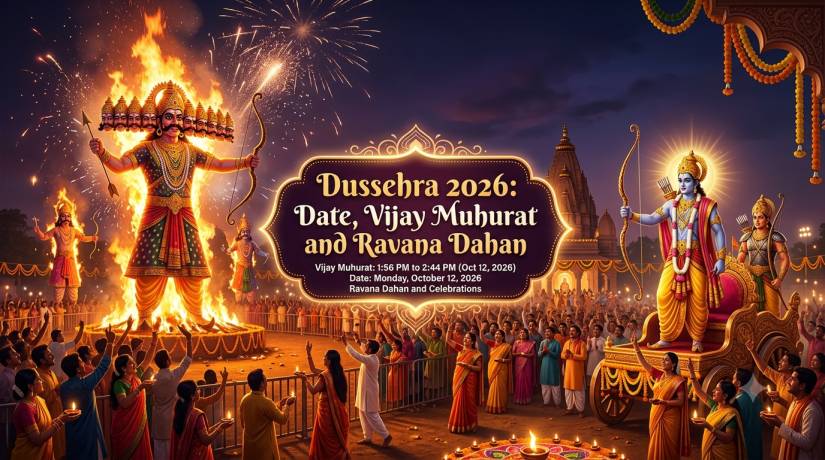
Dussehra, also known as Vijayadashami or Dasara, is one of India’s most important Hindu festivals. It celebrates the victory of good over evil and marks the triumph of Lord Rama over Ravana in the Ramayana. In many traditions, the festival also commemorates Goddess Durga’s victory over Mahishasura, following the nine days of Navratri.
In 2026, Dussehra will be observed on Tuesday, 20 October, across much of India, although some regional traditions follow 21 October for particular Vijayadashami rituals. The festival includes prayers, Shami Puja, worship of tools and instruments, cultural performances, and the symbolic burning of Ravana’s effigy.
From a traditional Hindu and astrological perspective, Vijayadashami is associated with courage, righteous action, and auspicious beginnings. Understanding its date, Vijay Muhurat, and local celebration timings helps devotees plan their observances meaningfully.
Dussehra 2026 Date and Vijay Muhurat
Dussehra 2026 falls on Tuesday, 20 October, according to the New Delhi Panchang. The Dashami tithi begins at 12:50 PM IST on 20 October and ends at 2:11 PM IST on 21 October.
Important dates and timings
- Dussehra / Vijayadashami: Tuesday, 20 October 2026
- Dashami tithi begins: 12:50 PM IST, 20 October
- Dashami tithi ends: 2:11 PM IST, 21 October
- Vijay Muhurat in New Delhi: 1:59 PM–2:45 PM IST
Vijay Muhurat is traditionally considered an auspicious period for worship and activities associated with victory, courage, and new beginnings. The exact muhurat varies by location because sunrise and the division of daytime differ across India.
Some regional traditions, particularly in Bengal and Kerala, observe specific Vijayadashami ceremonies on 21 October. Therefore, devotees should follow their local Panchang and family customs rather than assuming every ritual takes place on the same date.
Ravana Dahan Timing on Dussehra 2026
Ravana Dahan is one of the most recognised Dussehra traditions in North India. Large effigies of Ravana, and often Kumbhakarna and Meghnad, are burned during public celebrations to symbolise the defeat of arrogance, injustice, and harmful actions.
There is no single nationwide Ravana Dahan time for 2026. The schedule depends on the local Ramlila committee, venue arrangements, sunset, and regional customs.
In many cities, Ravana Dahan takes place around sunset or during the early evening after Ramlila performances. However, the exact time for Delhi, Lucknow, Jaipur, Bhopal, or another city should be confirmed through the relevant event organiser or municipal announcement.
What should visitors keep in mind?
- Check the local Ramlila committee’s published programme.
- Arrive early because popular venues may have traffic restrictions and large crowds.
- Follow police and event-organiser safety instructions.
- Keep children at a safe distance from the effigy and fireworks.
- Avoid lighting private fireworks near crowds or combustible materials.
Ravana Dahan is a symbolic cultural practice, not a ritual that must be performed at a universally fixed astrological time.
Dussehra Puja Vidhi at Home
Devotees can celebrate Vijayadashami with a simple puja at home. The exact procedure varies across regions, but worship commonly focuses on Lord Rama, Goddess Durga, or the deities revered by the family.
Puja samagri
Prepare the following items according to your tradition:
- Picture or idol of Lord Rama or Goddess Durga
- Flowers, kumkum, and akshat
- Diya, incense, and clean water
- Fruits or sweets for bhog
- A prayer book or devotional text, if available
Step-by-step Dussehra puja
- Clean the worship area: Arrange the puja items and prepare a peaceful space.
- Offer prayers: Worship Lord Rama or Goddess Durga according to your family tradition.
- Recite a devotional text: Read a passage from the Ramayana or chant a familiar prayer.
- Perform aarti: Offer the diya and pray for wisdom, courage, and well-being.
- Seek blessings: Reflect on personal responsibilities and the importance of righteous conduct.
- Share prasad: Distribute the offerings among family members.
Families may also perform Shami Puja, Ayudha Puja, or worship books, tools, vehicles, and work equipment, depending on regional customs.
Shami Puja, Ayudha Puja and Astrological Significance
Shami Puja
Shami Puja is a traditional Vijayadashami observance in several parts of India. The Shami tree holds religious significance in Hindu traditions, and worship is associated with prosperity, courage, and auspicious beginnings.
Devotees may offer prayers or flowers to the tree, where local customs permit. The practice is also connected with stories from the Mahabharata and traditions surrounding the return of the Pandavas from exile.
Ayudha Puja
Ayudha Puja, observed prominently in southern India, honours tools, machinery, instruments, books, and equipment used in daily work.
The ritual encourages gratitude for the resources that support a person’s livelihood. For students, it may involve books and learning materials; for artisans and business owners, it may involve work tools or machinery.
Astrological significance
In Hindu tradition, Vijayadashami is regarded as a favourable occasion for beginning constructive activities. The festival is not governed by one universal planetary combination; its date and auspicious periods are calculated using the lunar calendar and local Panchang.
Practical ways to reflect on the festival include:
- Starting a planned learning or skill-development activity.
- Reviewing professional goals and completing pending tasks.
- Practising honesty and fairness in business and personal relationships.
- Donating food or supporting people in need.
These practices connect the festival’s traditional symbolism with real-life goals without promising guaranteed results.
Mantra for Dussehra 2026
Devotees may chant a prayer dedicated to Lord Rama during Vijayadashami worship:
श्री रामाय नमः।
Shri Ramaya Namah.
This simple mantra expresses devotion to Lord Rama, who is traditionally regarded as an embodiment of dharma, courage, and righteous conduct.
You may also recite the Ram Raksha Stotra, read the Ramayana, or offer prayers to Goddess Durga according to your family’s tradition. Regular prayer can serve as a reminder to act thoughtfully and responsibly.
Conclusion
Dussehra 2026 will be celebrated on Tuesday, 20 October, across much of India. The New Delhi Vijay Muhurat is 1:59 PM to 2:45 PM IST, while Ravana Dahan timings will depend on local event schedules. Some regions follow 21 October for particular Vijayadashami observances.
The festival’s deeper message is the victory of righteousness over wrongdoing. Whether you perform a home puja, observe Shami Puja, honour your work tools, or attend a Ramlila celebration, focus on the values represented by the occasion.
Use Vijayadashami as an opportunity to begin constructive activities, strengthen personal discipline, and let go of habits that hinder your growth. Check your local Panchang and official event announcements to plan your celebrations safely and meaningfully.
SEO Tags: Dussehra 2026, Vijayadashami Muhurat, Ravana Dahan Timing, Dussehra Puja Vidhi, Vijayadashami Significance
FAQs: Dussehra 2026
1. When is Dussehra in 2026?
Dussehra will be celebrated on Tuesday, 20 October 2026, across much of India.
The Dashami tithi begins at 12:50 PM IST on 20 October and ends at 2:11 PM IST on 21 October, according to the New Delhi Panchang. Some regional traditions observe particular ceremonies on 21 October.
– Tip: Confirm the date followed by your local temple or family tradition.
2. What is the Vijay Muhurat for Dussehra 2026?
The Vijay Muhurat in New Delhi is 1:59 PM to 2:45 PM IST on 20 October 2026.
This period is traditionally considered auspicious for worship and activities associated with victory and new beginnings. The timing varies by location, so the Delhi muhurat should not be applied automatically to other cities.
– Tip: Consult a city-specific Panchang before scheduling a ritual.
3. What is the Ravana Dahan timing for Dussehra 2026?
Ravana Dahan will generally be scheduled around sunset or in the early evening at many public celebrations, but the exact timing depends on the local organiser.
Ramlila performances, venue arrangements, and regional customs influence the programme. A single nationwide time cannot be assumed for every city.
– Tip: Check the official announcement from your local Ramlila committee before travelling to the venue.
4. Why is Ravana Dahan performed on Dussehra?
Ravana Dahan symbolises the victory of good over evil and commemorates Lord Rama’s victory over Ravana in the Ramayana.
The burning effigy also serves as a reminder to reflect on arrogance, injustice, and the misuse of power. The practice is particularly prominent in North Indian Dussehra celebrations.
– Tip: Use the occasion to reflect on honesty, humility, and responsible behaviour.
5. Which puja is performed on Vijayadashami?
Devotees commonly worship Lord Rama or Goddess Durga on Vijayadashami, while some traditions also observe Shami Puja and Ayudha Puja.
The rituals vary by region. Families may offer flowers, perform aarti, recite devotional texts, or honour the tools and books that support their work and education.
– Tip: Follow your family’s tradition and prepare the puja items in advance.
6. Is Dussehra an auspicious day to start something new?
Yes, Vijayadashami is traditionally regarded as a favourable occasion for beginning educational, professional, and other constructive activities.
Some families use the day to begin learning, launch a project, or worship work equipment. These are cultural and religious customs rather than guarantees of success.
– Tip: Combine an auspicious beginning with careful planning, consistent effort, and realistic goals.
7. Which mantra can be chanted on Dussehra?
Devotees may chant Shri Ramaya Namah during Dussehra worship.
The mantra expresses devotion to Lord Rama and reflects the festival’s association with dharma and courage. Families may also recite the Ram Raksha Stotra or other prayers familiar to their tradition.
– Tip: Choose a prayer that is meaningful to you and recite it calmly.
8. What is the astrological significance of Vijayadashami?
In Hindu tradition, Vijayadashami is associated with auspicious beginnings, victory, and the completion of Navratri.
The day’s tithi and muhurat are determined using the Hindu lunar calendar and location-specific Panchang calculations. No single planetary combination guarantees success for every individual.
– Tip: Use the festival as an opportunity for prayer, reflection, and taking practical steps towards your goals.