A full moon is one of the most recognised phases of the lunar cycle. It occurs when the Moon appears fully illuminated from Earth, traditionally symbolising completion, emotional awareness, and the culmination of ongoing matters. In Vedic astrology, the Moon represents the mind, emotions, comfort, and everyday mental experiences. Its placement in a birth chart is therefore considered important when interpreting how a person responds to changing circumstances.
Astrologers often associate the full moon with heightened awareness, the resolution of unfinished matters, and opportunities for reflection. Its traditional interpretation varies according to the zodiac sign, house placement, lunar constellation (Nakshatra), and aspects involving other planets.
Understanding how a full moon is interpreted for each zodiac sign can offer a useful framework for self-reflection. However, astrology is a traditional belief system, and there is no strong scientific evidence that a full moon consistently produces specific emotional or behavioural changes in individuals.
What Does a Full Moon Mean in Astrology?
In Vedic astrology, the Moon is associated with Manas, or the mind, as well as emotions, memory, nurturing, and mental comfort. The full moon, called Purnima in the Hindu lunar calendar, occurs when the Moon is opposite the Sun in the sky.
Astrologically, this opposition is often interpreted as a period of illumination, awareness, or culmination. Matters that have been developing over time may become easier to recognise, although actual outcomes depend on real-world circumstances.
Full Moon Significance in Vedic Astrology
Astrologers consider several factors when interpreting a full moon:
- Moon sign (Chandra Rashi): The zodiac sign occupied by the Moon influences the traditional interpretation of emotional patterns.
- House placement: The house activated by the full moon may indicate themes involving career, relationships, family, finances, or personal growth.
- Nakshatra: The Moon’s lunar constellation adds another layer of interpretation in Vedic astrology.
- Planetary aspects: Relationships between the Moon and other planets may modify an astrologer’s reading.
The full moon does not affect every person in the same way according to astrological interpretations. Your complete birth chart provides more context than your Sun sign alone.
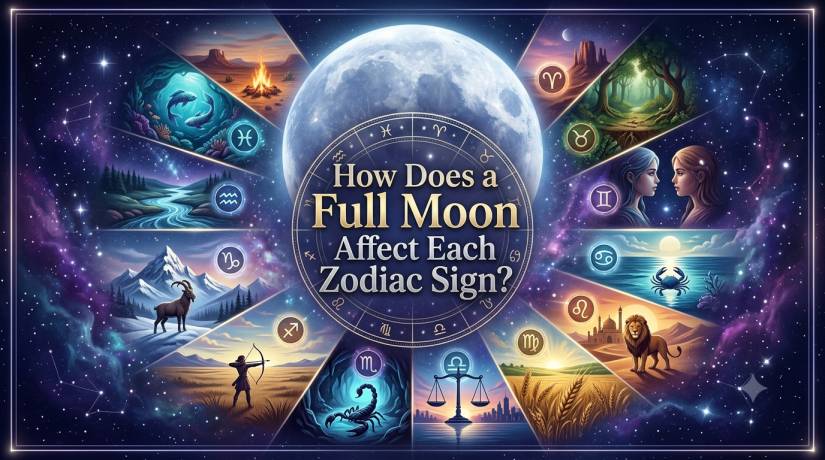
How Does a Full Moon Affect Each Zodiac Sign?
The following interpretations describe traditional astrological themes for the 12 zodiac signs. They are general reflections, not certain predictions. In Western astrology, readings often use the Sun sign, while Vedic astrology commonly gives greater importance to the Moon sign and birth-chart houses.
1. Aries (Mesh Rashi)
Aries is associated with initiative, independence, and action. A full moon may symbolically highlight unfinished tasks, personal priorities, or the need to balance ambition with patience.
Practical tip: Pause before making impulsive decisions, particularly during disagreements. Physical activity, journaling, and setting realistic goals can help channel your energy constructively.
2. Taurus (Vrishabh Rashi)
Taurus is traditionally linked with stability, comfort, material security, and personal values. A full moon may prompt reflection on spending habits, financial priorities, or the balance between security and change.
Practical tip: Review your budget, avoid unnecessary purchases, and make time for activities that bring genuine comfort.
3. Gemini (Mithun Rashi)
Gemini represents communication, curiosity, learning, and adaptability. Full moon interpretations may emphasise conversations, social connections, and information that requires closer attention.
Practical tip: Listen carefully, verify important information, and write down your thoughts before addressing sensitive topics.
4. Cancer (Kark Rashi)
Cancer is ruled by the Moon in Vedic astrology and is associated with home, family, nurturing, and emotional security. Astrologers may interpret the full moon as an invitation to examine family relationships and personal boundaries.
Practical tip: Make time for rest and meaningful conversations. Express your needs clearly instead of assuming others will understand them automatically.
5. Leo (Singh Rashi)
Leo is associated with confidence, creativity, leadership, and recognition. A full moon may symbolically bring attention to personal ambitions, creative projects, or the desire for appreciation.
Practical tip: Celebrate genuine progress while remaining open to constructive feedback. Share recognition with others rather than focusing exclusively on personal achievements.
6. Virgo (Kanya Rashi)
Virgo represents organisation, analysis, service, and practical problem-solving. A full moon may encourage a review of routines, responsibilities, and habits that affect daily productivity.
Practical tip: Organise your schedule, complete pending tasks, and avoid expecting perfection from yourself or others.
7. Libra (Tula Rashi)
Libra is linked with relationships, fairness, cooperation, and harmony. A full moon may symbolically highlight the balance between personal needs and the expectations of partners, friends, or colleagues.
Practical tip: Address misunderstandings calmly, communicate your boundaries, and aim for mutual respect rather than avoiding every disagreement.
8. Scorpio (Vrishchik Rashi)
Scorpio is associated with transformation, privacy, intensity, and deeper emotional reflection. Full moon interpretations may focus on trust, personal attachments, and situations that require an honest assessment.
Practical tip: Reflect before reacting, avoid making assumptions about other people’s intentions, and seek constructive ways to resolve conflicts.
9. Sagittarius (Dhanu Rashi)
Sagittarius represents exploration, learning, philosophy, and broader perspectives. A full moon may encourage reflection on educational goals, travel plans, or long-term beliefs.
Practical tip: Revisit your goals, explore new ideas, and check practical details before making significant commitments.
10. Capricorn (Makar Rashi)
Capricorn is associated with responsibility, structure, ambition, and professional development. Full moon interpretations may draw attention to work-life balance, deadlines, and long-term achievements.
Practical tip: Review your priorities, recognise completed work, and schedule adequate time for rest instead of measuring success only through productivity.
11. Aquarius (Kumbh Rashi)
Aquarius represents innovation, independence, community, and unconventional thinking. A full moon may symbolically encourage reflection on friendships, group responsibilities, and future aspirations.
Practical tip: Reconnect with supportive people, evaluate collaborative commitments, and balance independence with consideration for others.
12. Pisces (Meen Rashi)
Pisces is associated with imagination, compassion, intuition, and spirituality. Full moon interpretations may emphasise creativity, personal reflection, and the importance of emotional boundaries.
Practical tip: Make time for creative activities, meditation, or journaling. Distinguish intuitive impressions from verified facts when making important decisions.
Full Moon Remedies and Practices for Balance
In Indian traditions, Purnima is often observed through prayer, meditation, charity, and spiritual reflection. These practices can provide structure and meaning without requiring expensive rituals.
Consider the following simple activities:
- Meditation: Spend five to ten minutes breathing slowly or sitting quietly.
- Gratitude journaling: Record what you have learned and which goals need further attention.
- Charity: Donate food or support someone in need according to your means.
- Chandra worship: Devotees may offer prayers to Chandra Dev according to their family traditions.
- Healthy routines: Maintain regular meals, hydration, and sleep rather than making unnecessary changes because of the lunar phase.
There is no universally required gemstone, fast, or ritual for the full moon. Any spiritual practice should suit your beliefs, health, and circumstances.
Conclusion
The full moon holds an important place in astrology as a symbol of illumination, reflection, and completion. Each zodiac sign is traditionally associated with different themes, from Aries and initiative to Cancer and emotional security, Capricorn and responsibility, and Pisces and spirituality.
In Vedic astrology, a more detailed interpretation considers the Moon sign, Nakshatra, house placement, and planetary relationships in the birth chart. General zodiac predictions cannot establish what will happen to a particular individual.
You can use the full moon as a regular opportunity to review your goals, improve communication, and practise gratitude. Combine spiritual reflection with practical decisions and evidence-based information. Rather than expecting the Moon to determine your future, focus on the choices and habits that you can influence every day.
SEO Tags: Full Moon Astrology, Full Moon Effects on Zodiac Signs, Purnima Significance, Moon Sign in Vedic Astrology, Lunar Cycle and Astrology
FAQs: Full Moon Effects on Zodiac Signs
1. How does a full moon affect each zodiac sign?
In astrology, a full moon is traditionally associated with reflection and completion, with its interpreted themes varying by zodiac sign.
Aries may reflect on impulsive actions, Taurus on security, Gemini on communication, and Cancer on family and emotions. Other signs are associated with their own symbolic themes, but these interpretations are not scientifically established predictions.
– Tip: Use your zodiac sign as a reflection prompt rather than a fixed forecast.
2. Does a full moon affect emotions?
Scientific evidence does not establish that a full moon consistently causes stronger emotions in everyone.
In astrology, the Moon represents emotional responses and mental comfort, so a full moon is often interpreted as a period of greater awareness. Individual feelings are also shaped by sleep, stress, relationships, and personal circumstances.
– Tip: Track your mood and sleep patterns instead of automatically attributing changes to the lunar phase.
3. Which zodiac sign is most affected by a full moon?
There is no scientifically established zodiac sign that is most affected by a full moon.
In astrological interpretations, Cancer receives particular attention because the Moon rules Cancer in both traditional Western astrology and Vedic astrology. However, astrologers may interpret a full moon differently depending on the individual birth chart.
– Tip: Consider your complete birth chart if you follow astrological traditions, while keeping practical circumstances in view.
4. What should you avoid during a full moon?
There is no scientifically established list of activities that everyone must avoid during a full moon.
Some spiritual traditions recommend avoiding unnecessary conflict, practising restraint, and spending time in reflection. These can be useful personal choices, but there is no reliable evidence that ordinary decisions automatically become harmful during this lunar phase.
– Tip: Avoid impulsive decisions whenever possible, regardless of the Moon’s position.
5. What are the best remedies for a full moon in Vedic astrology?
Traditional Purnima practices include prayer, meditation, charity, and worship of Chandra Dev.
These practices may offer spiritual meaning and encourage calm, generosity, and self-discipline. Specific remedies, when recommended astrologically, may vary according to a person’s beliefs and birth chart.
– Tip: Choose simple practices that fit your circumstances, such as meditation, gratitude journaling, or donating food.
6. What is the difference between a full moon and Purnima?
A full moon is the astronomical phase when the Moon appears fully illuminated from Earth, while Purnima is the corresponding full-moon tithi in the Hindu lunar calendar.
The exact timing of Purnima can differ from the local calendar date because Hindu tithis are calculated using the relative positions of the Sun and Moon. Festivals associated with Purnima may follow specific traditional rules for observance.
– Tip: Check a reliable local Panchang for festival dates and puja timings in IST.
7. Is the full moon important for meditation and spiritual practices?
Yes, the full moon is considered spiritually significant in many traditions, including Hindu practices associated with Purnima.
Some devotees use the occasion for prayer, meditation, charity, or reflection. Although these activities can support a meaningful routine, there is no conclusive evidence that meditation becomes inherently more effective simply because it is a full moon.
– Tip: Establish a regular meditation routine and use Purnima as an optional reminder to reflect on personal growth.