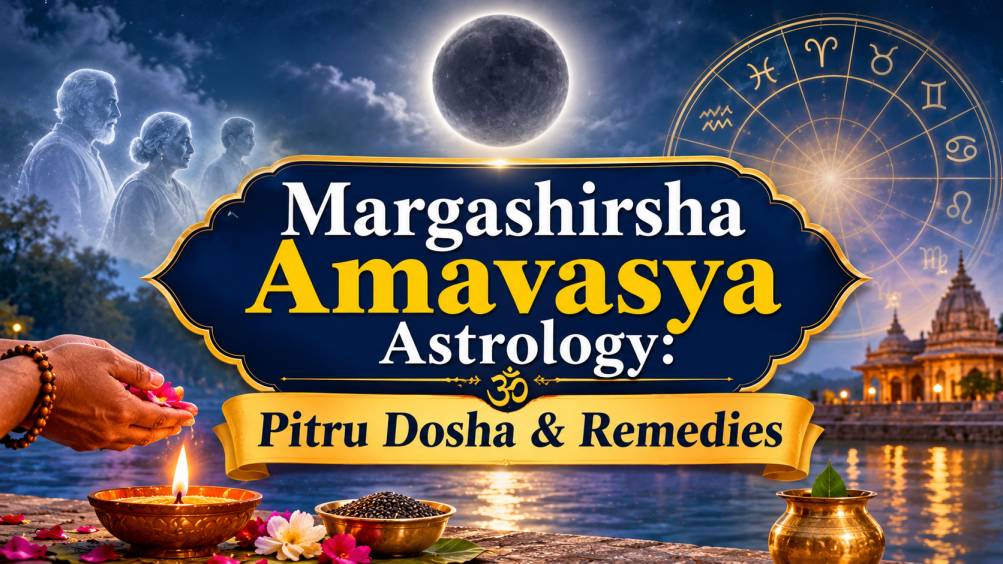
Margashirsha Amavasya holds special importance in Hindu traditions because of its association with ancestral remembrance, spiritual purification, charity, and planetary symbolism. In Vedic astrology, Amavasya occurs when the Sun and Moon come together in the same zodiac sign, marking the end of a lunar cycle. The Moon represents the mind, emotions, and inner peace, while the Sun symbolises the soul, authority, and ancestral connections. This combination makes Margashirsha Amavasya a significant occasion for understanding Pitru-related beliefs and Chandra influences. Devotees traditionally perform Pitru Tarpan, offer prayers, donate food, and worship Lord Vishnu or Lord Shiva. From an astrological perspective, the day also encourages reflection on family responsibilities, emotional balance, and spiritual growth.
1. Astrological Significance of Margashirsha Amavasya
Margashirsha is considered a spiritually important month in Hindu tradition. In the Bhagavad Gita (10.35), Lord Krishna states:
Maasanam Margashirsho’ham.
This means, “Among months, I am Margashirsha.”
Amavasya occurs when the Sun and Moon occupy the same zodiac sign. Their conjunction represents the completion of the lunar cycle and is traditionally associated with introspection, prayer, and ancestral remembrance.
The main astrological significators include:
- Sun: Soul, father, authority, confidence, and ancestral lineage.
- Moon: Mind, mother, emotions, mental peace, and nourishment.
- Saturn: Karma, discipline, responsibility, and service.
- Rahu and Ketu: Lunar nodes associated with karmic symbolism and spiritual transformation.
Margashirsha Amavasya is therefore considered suitable for spiritual practices, charity, and remembering departed family members.
2. Margashirsha Amavasya and Pitru Dosha in Kundli
Pitru Dosha is a traditional concept in Vedic astrology associated with ancestral karma and unresolved family responsibilities.
Some astrological traditions examine the following factors while assessing possible Pitru Dosha:
Important Houses and Planets
Ninth House: The ninth house represents father, ancestors, fortune, dharma, and blessings from elders. Afflictions to the ninth house or its lord are sometimes considered relevant in Pitru Dosha analysis.
Sun: The Sun is an important significator of father, authority, and ancestral lineage. Its association with Rahu, Ketu, or other malefic influences may receive attention in traditional interpretations.
Fifth House: The fifth house represents Purva Punya (past-life merit), intelligence, children, and accumulated karmic tendencies.
Eighth House: This house is associated with longevity, inheritance, transformation, and hidden family matters.
However, Pitru Dosha cannot be confirmed through one planetary placement alone. The complete birth chart, planetary dignity, aspects, conjunctions, and divisional charts should be considered.
Possible Traditional Interpretations
- Repeated family disagreements or unresolved responsibilities.
- Difficulties in maintaining family relationships.
- Challenges involving inheritance or ancestral property.
- Concerns related to family traditions and obligations.
These are traditional astrological interpretations, not established causes of real-life difficulties.
3. Chandra Remedies on Margashirsha Amavasya
The Moon represents the mind, emotions, mother, and mental comfort in Vedic astrology. Since Amavasya involves the conjunction of the Sun and Moon, traditional practices often emphasise Chandra-related prayers and self-discipline.
Recommended Chandra Remedies
- Worship Lord Shiva
Lord Shiva is traditionally associated with the Moon, particularly through the crescent moon depicted on his head.
Devotees can:
- Offer water to a Shiva Lingam.
- Chant Om Namah Shivaya.
- Practise meditation and prayer.
- Observe personal discipline.
- Donate White-Coloured Items
White-coloured objects are traditionally associated with the Moon.
Suitable donations include:
- Rice.
- Milk.
- White clothes.
- Sugar.
- White food grains.
Donations should be made according to financial capacity and without expectations.
- Respect and Care for the Mother
The Moon is considered a significator of the mother in Vedic astrology. Respecting one’s mother, caring for elderly women, and supporting family members are considered meaningful ways of expressing gratitude.
- Practise Meditation
A regular meditation routine can help improve concentration and emotional awareness. It is a practical habit that complements traditional Chandra remedies.
4. Pitru Tarpan and Ancestral Remedies
Pitru Tarpan is one of the most important rituals associated with Amavasya.
It involves offering water, often mixed with black sesame seeds, while remembering departed ancestors and reciting prescribed prayers.
Traditional Ritual Procedure
- Take a bath and wear clean clothes.
- Remember departed ancestors with respect.
- Perform Tarpan according to family customs.
- Offer black sesame seeds and water as prescribed.
- Donate food, grains, or clothing to deserving people.
- Pray for peace and well-being within the family.
Families following Shraddha traditions may consult their family priest regarding the correct procedure.
Other Traditional Donations
- Black sesame seeds: Associated with Pitru-related rituals.
- Food grains: Represent nourishment and generosity.
- Clothes and blankets: Symbolise protection and compassion.
- Jaggery and pulses: Suitable for charitable distribution.
The purpose of these practices is to express gratitude and support people in need.
5. Role of Saturn, Rahu and Ketu in Pitru Dosha Analysis
Apart from the Sun and Moon, Saturn, Rahu, and Ketu are also considered in traditional Pitru Dosha interpretations.
Saturn: Represents karma, responsibility, discipline, and service. Its affliction to the ninth house or Sun may be examined in ancestral-related chart analysis.
Rahu: Its association with the Sun or ninth house lord may be interpreted as unconventional family circumstances or questions involving ancestral traditions.
Ketu: Its connection with the Sun or ninth house may be associated with detachment, spiritual inclination, and separation from traditional practices.
These combinations do not independently establish Pitru Dosha. Their effects depend on the Ascendant, planetary strength, house ownership, and overall horoscope.
6. Simple Spiritual Practices for Margashirsha Amavasya
<AsyncImage query=”Indian Hindu devotional puja arrangement brass diya flowers tulsi leaves Vishnu prayer traditional home altar” aspectRatio=”16:9″ width=”100%”/>
Apart from specific astrological remedies, devotees can follow simple spiritual practices.
- Chant Om Namo Bhagavate Vasudevaya.
- Recite the Maha Mrityunjaya Mantra.
- Offer prayers to Lord Shiva and Lord Vishnu.
- Donate food to needy families.
- Help elderly people and underprivileged communities.
- Avoid unnecessary arguments and harmful speech.
- Remember ancestors through prayers and family traditions.
These activities encourage gratitude, compassion, and self-reflection.
7. What Should Be Avoided on Margashirsha Amavasya?
Traditional customs recommend maintaining discipline and simplicity.
Some commonly followed practices include:
- Avoid disrespecting elders and ancestors.
- Do not waste food or essential resources.
- Avoid unnecessary conflicts and dishonesty.
- Do not perform unfamiliar rituals without understanding them.
- Avoid expensive remedies based on fear.
- Do not wear gemstones without proper horoscope analysis.
There is no need to approach Amavasya with fear. The emphasis should remain on devotion, charity, and responsible behaviour.
Conclusion
Margashirsha Amavasya has considerable spiritual and astrological significance because of its association with ancestral remembrance, the Sun-Moon conjunction, and traditional Pitru-related observances. It provides an opportunity to perform Tarpan, offer charity, worship Lord Shiva and Lord Vishnu, and follow Chandra remedies for spiritual discipline. From a Vedic astrology perspective, the ninth house, Sun, Moon, Saturn, Rahu, and Ketu are relevant when examining ancestral-related combinations in a horoscope. However, Pitru Dosha should never be diagnosed through a single planetary placement. Ultimately, the deeper message of Margashirsha Amavasya is gratitude towards previous generations, compassion towards others, and the development of inner peace through meaningful actions.
Frequently Asked Questions (FAQs)
1. What is the astrological significance of Margashirsha Amavasya?
Margashirsha Amavasya is astrologically significant because it occurs when the Sun and Moon occupy the same zodiac sign.
The Sun represents the soul and ancestral lineage, while the Moon signifies emotions, the mind, and mental peace. This conjunction is traditionally associated with spiritual reflection and ancestral remembrance.
Suggested practices:
- Perform Pitru Tarpan.
- Worship Lord Shiva.
- Donate food and essential items.
- Practise meditation.
2. Is Margashirsha Amavasya beneficial for Pitru Dosha remedies?
Yes, Margashirsha Amavasya is traditionally considered suitable for Pitru-related prayers, Tarpan, charity, and ancestral remembrance.
Devotees may perform rituals according to their family traditions. However, Pitru Dosha should first be assessed through a complete horoscope rather than assuming that every family difficulty is caused by ancestral karma.
3. Which planet is important on Amavasya?
Both the Sun and Moon are important on Amavasya because the lunar day occurs when they come together in the same zodiac sign.
The Sun represents authority, vitality, and the soul, while the Moon represents emotions and mental well-being.
Traditional Chandra remedies include:
- Worshipping Lord Shiva.
- Chanting Om Namah Shivaya.
- Donating rice and milk.
- Maintaining emotional discipline.
4. Which mantra should be chanted on Margashirsha Amavasya?
Devotees can chant Om Namah Shivaya, Om Namo Bhagavate Vasudevaya, or the Maha Mrityunjaya Mantra.
These mantras are traditionally associated with devotion, spiritual discipline, and inner peace.
Regular chanting with concentration is generally preferred over performing rituals out of fear.
5. Does Rahu with the Sun indicate Pitru Dosha?
Some Vedic astrology traditions consider the conjunction of Rahu and Sun an important factor while examining Pitru Dosha.
However, this conjunction alone does not confirm Pitru Dosha. The ninth house, ninth lord, fifth house, Sun’s dignity, and other planetary influences must also be evaluated.
6. How can I strengthen the Moon in my birth chart?
Traditional Chandra remedies include worshipping Lord Shiva, donating white-coloured items, respecting one’s mother, and maintaining a disciplined daily routine.
The Moon’s strength should be assessed through its zodiac sign, house, aspects, conjunctions, and Navamsa placement.
Simple remedies:
- Chant Om Som Somaya Namah.
- Donate rice or milk.
- Practise meditation.
- Maintain healthy sleeping habits.
7. Is black sesame donation important on Margashirsha Amavasya?
Yes, black sesame seeds are traditionally associated with Pitru Tarpan and Amavasya-related rituals.
They are commonly mixed with water during ancestral offerings and may also be donated according to family customs.
The practice is intended as an expression of devotion and remembrance.
8. Can Pitru Dosha be removed through Amavasya rituals?
Traditional Hindu practices regard Tarpan, Shraddha, charity, and prayers as meaningful ways of expressing gratitude towards ancestors, but there is no universally established guarantee that these rituals will eliminate every astrological difficulty.
A balanced approach includes understanding the birth chart, following family traditions, helping others, and fulfilling responsibilities towards living family members.
9. Which house represents ancestors in Vedic astrology?
The ninth house is commonly associated with father, ancestors, fortune, and dharma in Vedic astrology.
The Sun, fifth house, and other relevant planetary combinations may also be examined when assessing ancestral-related interpretations.