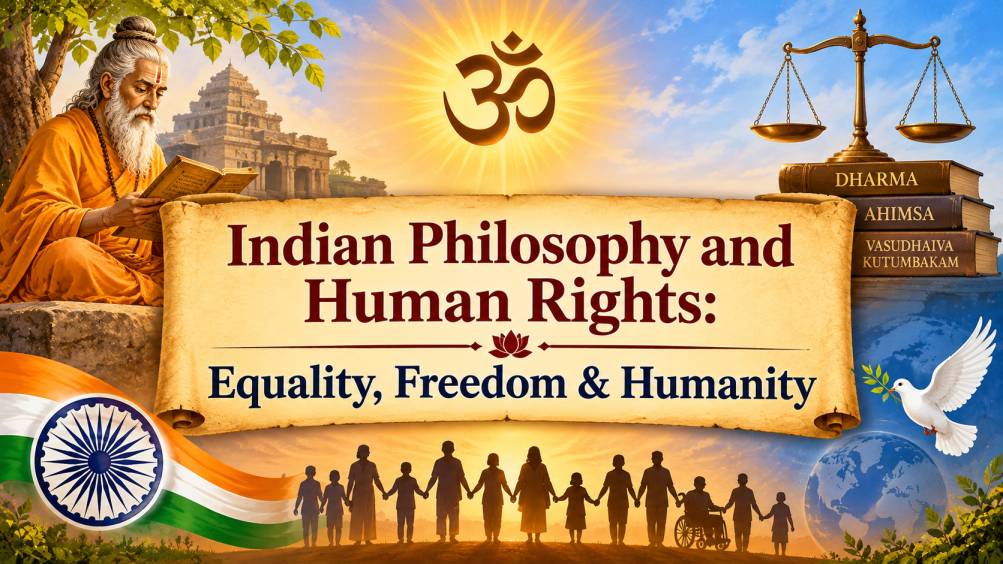
Indian philosophy has explored fundamental questions about human dignity, equality, freedom, justice, and moral responsibility for thousands of years. Ancient Indian scriptures and philosophical traditions contain ideas that remain relevant to modern discussions about human rights. Concepts such as Vasudhaiva Kutumbakam (the world is one family), Ahimsa (non-violence), Dharma (righteous conduct), and Karuna (compassion) emphasise the importance of respecting life and treating others with dignity.
Although ancient Indian philosophy did not formulate human rights in the same legal framework used today, several of its ethical principles provide a foundation for discussing social justice and individual freedom. Understanding these teachings helps connect India’s intellectual heritage with contemporary constitutional values and universal human rights.
1. Vasudhaiva Kutumbakam: Equality and Universal Humanity
One of the most widely recognised ideas in Indian philosophy is Vasudhaiva Kutumbakam, meaning “the world is one family.”
This expression appears in the Maha Upanishad and communicates the idea that humanity should not be divided by narrow distinctions of nationality, community, or social identity.
Its central message is that every individual deserves consideration and respect.
Its relevance to human rights includes:
- Respect for people regardless of their background.
- Promotion of social harmony and peaceful coexistence.
- Recognition of shared human dignity.
- Encouragement of international cooperation.
- Opposition to hatred and unnecessary discrimination.
In modern society, this philosophy supports discussions about equality, refugee protection, cultural diversity, and global humanitarian responsibility.
2. Ahimsa: The Right to Life and Freedom from Violence
Ahimsa, or non-violence, is an important ethical principle in Hinduism, Jainism, and Buddhism.
Jain philosophy gives particularly strong importance to Ahimsa, extending the principle of non-harm to all living beings. Buddhist teachings also emphasise compassion and avoiding actions that cause suffering.
The principle is closely connected with modern human rights, particularly the right to life, personal security, and freedom from violence.
Practical applications of Ahimsa include:
- Rejecting physical and emotional violence.
- Avoiding discrimination and harassment.
- Respecting the dignity of others.
- Resolving disagreements through peaceful dialogue.
- Showing compassion towards vulnerable communities.
Mahatma Gandhi later made Ahimsa a central element of his philosophy of non-violent resistance, demonstrating how an ancient ethical principle could influence modern social and political movements.
3. Dharma: Justice, Responsibility and Social Equality
Dharma is a complex concept in Indian philosophy. It can refer to righteousness, ethical responsibility, duty, and conduct that supports social and moral order.
In the Bhagavad Gita, Lord Krishna explains the importance of performing one’s duties with sincerity and without excessive attachment to personal rewards.
However, Dharma should not be interpreted as unquestioning acceptance of social injustice. Ethical conduct also requires examining whether actions protect dignity, fairness, and the welfare of others.
Dharma and human rights are connected through:
- Responsibility towards society.
- Fairness in personal and public conduct.
- Protection of vulnerable individuals.
- Honesty in positions of authority.
- Respect for justice and moral accountability.
In contemporary life, Dharma can inspire individuals, institutions, and governments to act responsibly while protecting fundamental rights.
4. Equality in the Bhagavad Gita: Recognising Human Dignity
The Bhagavad Gita contains philosophical teachings about the deeper nature of human existence.
In Chapter 5, Verse 18, Krishna describes the wise person as seeing with equal vision a learned scholar, a cow, an elephant, a dog, and a person regarded as socially marginalised.
The Sanskrit verse begins:
Vidya-vinaya-sampanne brahmane gavi hastini…
The teaching highlights the importance of looking beyond external differences and recognising the deeper spiritual value of living beings.
Its contemporary relevance includes:
- Respect for human dignity.
- Opposition to prejudice and discrimination.
- Recognition of equality beyond social status.
- Development of empathy and understanding.
- Encouragement of inclusive communities.
This philosophical vision can contribute to discussions about caste discrimination, gender equality, social inclusion, and equal opportunities.
However, philosophical ideals and actual historical social practices must be examined separately.
5. Freedom of Thought and Spiritual Inquiry
Indian philosophical traditions have historically included different schools of thought, including Vedanta, Samkhya, Yoga, Nyaya, Vaisheshika, and Mimamsa.
There were also materialist and sceptical traditions, such as Charvaka, which questioned certain religious and metaphysical assumptions.
This intellectual diversity demonstrates the importance of debate, reasoning, and philosophical inquiry in India’s intellectual history.
The Upanishadic tradition frequently uses questions and discussions to explore the nature of reality, knowledge, and the self.
Its connection with modern freedom includes:
- Freedom of thought and expression.
- Respect for intellectual disagreement.
- Encouragement of education and inquiry.
- Recognition of diverse philosophical perspectives.
- Peaceful discussion of differing beliefs.
In modern democratic society, these values are relevant to freedom of expression, academic freedom, and freedom of conscience.
6. Indian Philosophy and the Constitution of India
India’s Constitution provides the legal framework for protecting fundamental rights and ensuring equality before the law.
The Constitution was adopted on 26 November 1949 and came into effect on 26 January 1950.
Several constitutional principles can be discussed alongside ethical ideas found in Indian philosophy, although their historical and legal origins are distinct.
| Constitutional provision | Human rights significance |
| Article 14 | Equality before the law |
| Article 15 | Prohibition of specified forms of discrimination |
| Article 19 | Protection of specified freedoms |
| Article 21 | Protection of life and personal liberty |
| Article 25 | Freedom of conscience and religion |
The Preamble also emphasises justice, liberty, equality, and fraternity.
These constitutional commitments provide enforceable legal protections, whereas ancient philosophical teachings generally operate as ethical and spiritual guidance.
Connecting both traditions can encourage a society that values individual dignity, social responsibility, and justice.
7. Practical Lessons from Indian Philosophy for Modern Society
Ancient Indian philosophy becomes meaningful when its ethical principles are reflected in everyday behaviour.
Individuals can apply these teachings through simple actions:
- Practise Ahimsa: Avoid violence, bullying, and harmful speech.
- Follow Dharma: Act honestly and fulfil responsibilities fairly.
- Respect equality: Treat people with dignity irrespective of caste, gender, religion, or economic status.
- Develop Karuna: Support people facing hardship and social exclusion.
- Encourage dialogue: Respect different opinions and avoid intolerance.
- Promote education: Help others access knowledge and opportunities.
These practices can strengthen social trust and encourage responsible citizenship.
Conclusion
Indian philosophy offers valuable ethical perspectives on equality, freedom, justice, compassion, and human dignity. Teachings such as Vasudhaiva Kutumbakam, Ahimsa, Dharma, and the Bhagavad Gita’s principle of equal vision provide meaningful ways to reflect on humanity’s shared responsibilities.
However, philosophical ideals must be distinguished from historical social realities and modern legal rights. India’s Constitution provides the enforceable framework for equality, liberty, and justice, while ancient philosophical traditions can offer moral inspiration for protecting these values.
The real relevance of Indian philosophy lies in applying its humane principles through everyday actions. A society becomes stronger when individuals respect differences, oppose injustice, and recognise the dignity of every human being.
Frequently Asked Questions (FAQs)
1. What does Indian philosophy teach about human rights?
Indian philosophy offers ethical teachings about human dignity, compassion, equality, non-violence, and social responsibility.
Concepts such as Ahimsa, Dharma, and Vasudhaiva Kutumbakam encourage people to respect others and avoid causing unnecessary suffering.
Important teachings include:
- Ahimsa for non-violence.
- Dharma for ethical responsibility.
- Karuna for compassion.
- Vasudhaiva Kutumbakam for universal humanity.
2. What is the meaning of Vasudhaiva Kutumbakam in human rights?
Vasudhaiva Kutumbakam means “the world is one family” and promotes the idea of universal human connection.
It encourages individuals to move beyond narrow social divisions and recognise the importance of cooperation, equality, and mutual respect.
Practical applications:
- Respect cultural differences.
- Support humanitarian causes.
- Reject discrimination.
- Promote peaceful coexistence.
3. How is Ahimsa connected with modern human rights?
Ahimsa is connected with modern human rights through its emphasis on protecting life, preventing violence, and respecting individual dignity.
The principle is particularly important in Jainism, Buddhism, and Hindu philosophical traditions. Gandhi also demonstrated its relevance through non-violent movements for social and political change.
Practising Ahimsa involves peaceful communication, rejecting harassment, and resolving conflicts without violence.
4. Does the Bhagavad Gita support equality?
The Bhagavad Gita contains teachings that emphasise equal vision and the deeper spiritual value of living beings.
Chapter 5, Verse 18 describes how a wise person looks beyond external distinctions when understanding different forms of life.
This teaching can inspire respect for human dignity and encourage people to challenge prejudice and discrimination.
5. How is Dharma related to social justice?
Dharma is related to social justice through its emphasis on righteousness, ethical conduct, fairness, and responsibility.
It encourages individuals to consider the consequences of their actions and fulfil their responsibilities towards society.
In modern life, following Dharma can mean:
- Acting honestly.
- Respecting others’ rights.
- Opposing exploitation.
- Supporting fairness and accountability.
6. Did ancient India have the concept of human rights?
Ancient Indian traditions contained philosophical and ethical ideas concerning dignity, compassion, justice, and freedom, but they did not establish human rights in the same universal legal framework recognised today.
Modern human rights involve specific legal protections and international standards. Ancient Indian teachings can provide ethical perspectives, but historical social inequalities must also be acknowledged.
7. How does the Indian Constitution reflect values associated with Indian philosophy?
The Indian Constitution protects equality, liberty, justice, and fraternity, values that can be meaningfully discussed alongside ethical themes in Indian philosophy.
For example, Article 14 establishes equality before the law, Article 19 protects specified freedoms, and Article 21 protects life and personal liberty.
These are constitutional guarantees, not simply philosophical ideals.
8. Why is Indian philosophy relevant to human rights today?
Indian philosophy remains relevant because its teachings encourage compassion, non-violence, mutual respect, and responsible social behaviour.
In a world facing discrimination, conflict, intolerance, and inequality, these principles can encourage more humane relationships and inclusive communities.
The most meaningful approach is to combine ethical reflection with respect for constitutional rights and practical action against injustice.