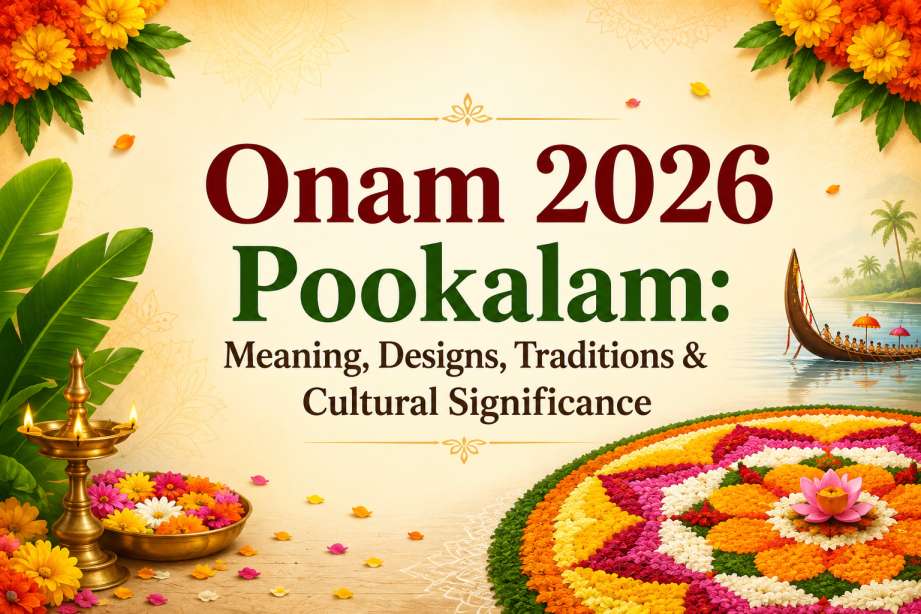
Onam 2026 Pookalam is more than a colourful floral decoration—it is one of Kerala’s most recognizable expressions of welcome, prosperity, harmony and cultural identity. Traditionally called Athapookkalam or Onapookkalam, it is created in homes, public spaces, schools and workplaces during the ten-day Onam celebrations.
In 2026, Thiruvonam falls on Wednesday, August 26. According to Drik Panchang, the Thiruvonam Nakshatra begins at 22:51 IST on August 25 and ends at 00:48 IST on August 27 for Kerala locations such as Kochi.
The floral carpet is traditionally associated with welcoming King Mahabali, whose annual return is central to the Onam tradition. Kerala Tourism describes Pookkalam as a symbol of prosperity and joy, while its gradual expansion over the festival days reflects the evolving rhythm of the celebration.
From a Vedic perspective, Pookalam can also be viewed symbolically through themes of Venus, Moon, Sun and Jupiter—beauty, emotional harmony, vitality and abundance—without treating these associations as guaranteed astrological effects.
What Is Pookalam and Why Is It Made?
Pookalam literally refers to a floral arrangement or flower carpet. It is generally created on the floor at the entrance or courtyard of a home.
The tradition is linked with the belief that Mahabali returns to see his people during Onam, and the floral decoration serves as a warm and beautiful welcome. Kerala Tourism notes that Pookkalam traditionally begins from Atham and becomes more elaborate as the festival progresses.
Traditionally, families used flowers available locally rather than relying on commercially sourced decorations. This gives the practice an important ecological and community-oriented dimension.
Traditional Pookalam Design
A traditional Pookalam is usually circular, although modern designs can take many forms.
Common design elements include:
- Concentric floral rings
- Geometric patterns
- Lotus-inspired motifs
- Symmetrical borders
- Traditional Kerala patterns
- Central floral arrangements
- Diyas or lamps placed around the design
- Small decorative elements associated with Onam traditions
Kerala Tourism records the traditional practice of gradually increasing the number and variety of flowers used during the ten days.
Pookalam 2026: Day-Wise Tradition
The exact customs can differ between regions and families, but the traditional progression remains an important part of Athapookkalam.
Atham to Thiruvonam
On the first day, a comparatively simple Pookalam is prepared. As the days progress, additional flowers and increasingly elaborate patterns are introduced.
Kerala Tourism describes traditions in which the Pookalam expands in size and complexity through the Onam period, culminating around Uthradam and Thiruvonam.
A simplified progression can be understood as:
- Atham: Begin with a simple floral arrangement.
- Chithira: Introduce additional colours and flowers.
- Chothi: More vibrant floral elements may be added.
- Moolam: Traditional patterns become more prominent.
- Uthradam: The Pookalam may reach its largest and most elaborate form.
- Thiruvonam: The central ritual significance becomes especially important.
Regional practices are not identical, so families should follow their local customs rather than treating one design as universally mandatory.
Popular Flowers Used in Pookalam
Traditional Pookalams use a variety of seasonal flowers. Kerala Tourism lists flowers such as Thumba, Tulasi, Chethi, Chemparathy, Sankhupushpam, Jamanthi, Mandaram, Kongini, Hanuman Kereedam and Mukuthi among those associated with Pookalam traditions.
Flowers can also be selected according to availability rather than rigid rules.
For an eco-friendly Pookalam in 2026:
- Prefer locally available flowers.
- Avoid plastic petals and synthetic decorations.
- Reuse natural materials where practical.
- Keep the design manageable rather than wasting flowers.
- Compost discarded flowers after the celebration.
Astrological and Symbolic Significance of Pookalam
Pookalam is primarily a cultural and traditional practice, but its symbolism can be interpreted through familiar Vedic concepts.
Venus: Beauty and Harmony
In Jyotish, Venus (Shukra) represents beauty, aesthetics, refinement, relationships and artistic expression. The colours, symmetry and creativity of a Pookalam naturally resonate with these themes.
This does not mean creating a particular Pookalam will automatically strengthen Venus. Instead, it can be considered a mindful expression of Venusian qualities such as beauty, balance and appreciation of art.
Moon: Emotional Connection
The Moon (Chandra) is associated with emotions, nourishment, home and mental peace in Vedic astrology.
Because Pookalam is often created collectively by family members, it can encourage emotional bonding and a sense of belonging. The activity itself may therefore support the practical qualities traditionally associated with the Moon.
Sun: Vitality and Renewal
Onam occurs during the Malayalam month of Chingam, marking an important seasonal and agricultural transition. The Sun represents vitality, confidence and life force in Jyotish.
The bright colours and fresh flowers of Pookalam can symbolically represent renewal, optimism and the beginning of a prosperous cycle.
Jupiter: Prosperity and Generosity
Jupiter (Guru) is traditionally associated with wisdom, abundance, ethics and generosity. The broader spirit of Onam—sharing food, welcoming others and celebrating prosperity—can be interpreted through these Jupiterian themes.
The cultural message is therefore more important than any promise of material gain.
Simple Pookalam Remedies and Mindful Practices
For those who enjoy combining tradition with spiritual reflection, Pookalam can become a simple mindful practice.
Consider these approaches:
- Keep the entrance and surrounding space clean before creating the Pookalam.
- Use fresh, natural flowers wherever possible.
- Create the design with family members to encourage cooperation.
- Light a traditional lamp safely near the decoration.
- Offer a brief prayer according to your family tradition.
- Practise gratitude for food, family, nature and community.
- Donate food or useful items as an expression of Onam generosity.
If your family follows Vishnu-related traditions, a simple remembrance of Lord Vishnu or Vamana may add devotional meaning. The purpose should be devotion and gratitude rather than fear or superstition.
Cultural Significance of Pookalam in Modern India
Pookalam has evolved beyond the traditional household courtyard. Today, it appears in schools, colleges, offices, apartment communities and public celebrations.
Pookalam competitions also encourage teamwork and creativity. Kerala Tourism specifically highlights its role in fostering unity and collective participation.
Its modern relevance is particularly strong because it combines:
- Art and creativity
- Family participation
- Environmental awareness
- Regional identity
- Community bonding
- Traditional knowledge
- Celebration of seasonal change
The tradition therefore remains meaningful even when people adapt designs to urban homes or limited spaces.
Conclusion
Onam 2026 Pookalam represents far more than an attractive floral decoration. Its circular patterns, seasonal flowers and gradual expansion express ideas of welcome, beauty, prosperity, togetherness and continuity.
The traditional connection with Mahabali gives Pookalam its cultural depth, while its creative and communal character keeps the practice relevant for modern families.
From an astrological viewpoint, its symbolism can be thoughtfully related to Venusian beauty, lunar harmony, solar vitality and Jupiterian generosity—but these should be understood as symbolic associations rather than guaranteed astrological remedies.
In 2026, consider making your Pookalam an opportunity to slow down, involve loved ones, respect nature and celebrate the deeper values of Onam.
FAQs
1. When is Onam 2026 Pookalam celebrated?
Pookalam celebrations begin with Atham and culminate around Thiruvonam, which falls on August 26, 2026.
The Pookalam tradition generally develops throughout the ten-day Onam celebration. Thiruvonam is the main day, and local customs determine the precise rituals followed by individual families.
Tips:
- Start with a simple design.
- Add flowers gradually.
- Follow local family traditions.
2. What does Pookalam symbolize?
Pookalam traditionally symbolizes welcome, prosperity, joy and the annual homecoming of King Mahabali.
The floral carpet is traditionally placed at the entrance or courtyard to welcome Mahabali. It also represents creativity, togetherness and the festive spirit of Onam.
Related practices:
- Keep the entrance clean.
- Use fresh flowers.
- Involve family members.
3. Which flowers are best for an Onam Pookalam?
Traditional Pookalams commonly use seasonal flowers such as Thumba, Tulasi, Chethi, marigold, hibiscus and other locally available varieties.
Flower selection can vary by region and availability. Historically, locally available flowers were an important part of the tradition.
Eco-friendly tips:
- Choose local flowers.
- Avoid plastic petals.
- Compost flowers after use.
4. Does Pookalam have astrological significance?
Pookalam does not have a universally prescribed astrological rule, but its symbolism can be related to qualities represented by planets such as Venus, Moon, Sun and Jupiter.
Venus relates to beauty and artistic expression, Moon to emotional harmony, Sun to vitality and Jupiter to generosity and abundance. These are symbolic interpretations rather than guaranteed planetary remedies.
For a mindful approach:
- Focus on gratitude.
- Keep the activity peaceful.
- Combine it with your family’s traditional prayer.
5. Can I make a modern Pookalam at home?
Yes, a modern Pookalam can be created in a small space while retaining its traditional floral character.
Apartment residents can use a balcony, doorway or common area, provided the practice is permitted. A smaller natural design can preserve the essence of the tradition without requiring large quantities of flowers.
Simple ideas:
- Use concentric circles.
- Choose three to five natural colours.
- Add a traditional Kerala-inspired border.
- Avoid synthetic decorative waste.
6. What is the spiritual meaning of creating Pookalam?
Creating Pookalam can be viewed as a practice of welcome, gratitude, beauty, cooperation and respect for nature.
The act of preparing the design collectively can make the festival more meaningful than simply treating it as decoration. The tradition also connects households with Kerala’s cultural memory and the story of Mahabali.
You can enhance the experience by:
- Creating it together as a family.
- Offering a simple prayer.
- Sharing food with others.
- Donating to someone in need.