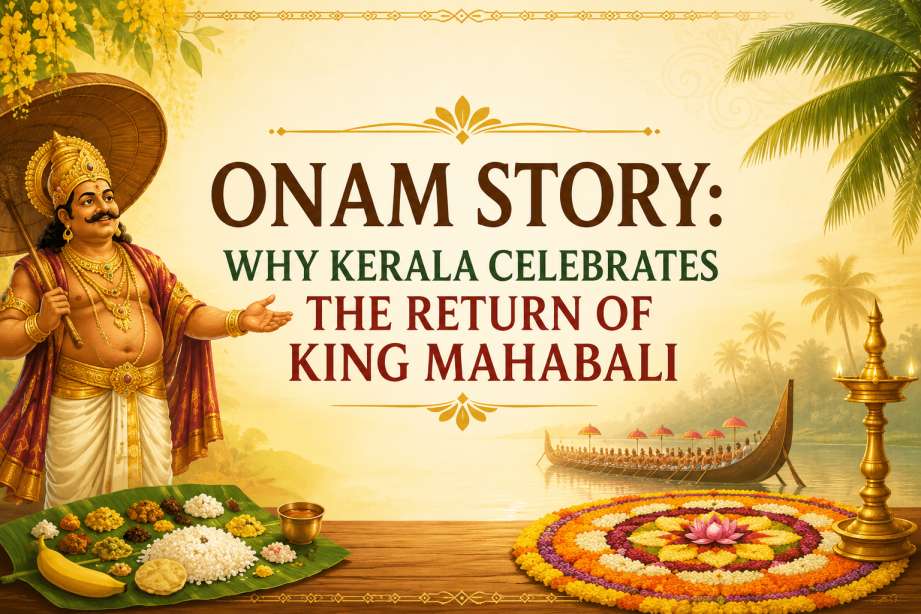
The Onam story is one of Kerala’s most cherished cultural narratives. At its heart is the story of King Mahabali, a powerful and generous ruler whose annual return is traditionally believed to be welcomed during the Onam festival. Celebrated with pookalam, sadya, traditional games, prayers and family gatherings, Onam represents prosperity, gratitude, equality and the bond between a ruler and his people.
The story is connected with Lord Vishnu’s Vamana Avatar, described in Hindu scriptures including the Bhagavata Purana. From a spiritual and astrological perspective, the story also offers meaningful symbolism involving Jupiter, Saturn, the Sun, the Moon and the principle of dharma.
Rather than treating these associations as predictions, they can be understood as traditional symbolic interpretations that connect the festival with generosity, discipline, humility and righteous conduct.
The Onam Story of King Mahabali
According to Hindu tradition, Mahabali, also known as Bali Chakravarti, was an asura king and the grandson of Prahlada. Despite his asura lineage, he was remembered for his devotion, generosity, courage and commitment to his subjects.
Under Mahabali’s rule, his kingdom became prosperous. Traditional Kerala folklore describes his reign as a period when people lived with abundance and social harmony. His popularity became so great that the gods became concerned about the balance of cosmic authority.
Lord Vishnu then appeared as Vamana, a young Brahmin dwarf, and approached Mahabali during a yajna.
The Three Steps of Vamana
Vamana asked Mahabali for land that could be covered by three steps. The king agreed.
Vamana then revealed his divine form. With the first step, he covered the earth; with the second, he covered the heavens. There was nowhere remaining for the third step.
Mahabali offered his own head for the final step.
This act represents one of the central spiritual ideas of the Onam story: true greatness is expressed through humility, sacrifice and keeping one’s word.
Vishnu was pleased with Mahabali’s devotion and granted him a special blessing. Traditional Kerala belief holds that Mahabali is permitted to return and visit his people during Onam.
Why Does Kerala Celebrate Mahabali’s Return?
The emotional centre of Onam is not simply the victory of one divine figure over another. It is the welcome given to a beloved king.
Kerala’s Onam traditions preserve the idea that Mahabali’s annual arrival is a time when homes should be clean, families should come together and communities should celebrate abundance.
The festival therefore combines several themes:
- Prosperity: Represented through the harvest and Onam Sadya.
- Equality: Community celebrations traditionally bring people together.
- Gratitude: People acknowledge nature, agriculture and divine blessings.
- Hospitality: Guests are welcomed with food and festive decorations.
- Cultural memory: The Mahabali story connects generations with Kerala’s heritage.
The Pookalam, or floral carpet, is traditionally prepared to welcome Mahabali. Its expanding circular patterns can also be viewed symbolically as representing harmony, completeness and the cyclical nature of life.
Astrological Significance of the Onam Story
Onam is primarily a religious and cultural festival rather than an astrological event. However, several themes in the Mahabali-Vamana narrative can be interpreted symbolically through Vedic astrology.
Jupiter: Wisdom and Generosity
Jupiter, or Guru, is traditionally associated with wisdom, dharma, generosity, learning and spiritual guidance.
Mahabali’s willingness to give despite his immense power reflects qualities traditionally associated with Jupiter. The story reminds us that wealth becomes meaningful when it is used responsibly.
Practical insight: On and around Onam, people can focus on charitable giving, helping students, supporting families in need or sharing food with others.
Saturn: Humility and Karma
Saturn, or Shani, represents discipline, responsibility, karma, patience and humility in Vedic astrology.
Mahabali’s story can be interpreted as a reminder that power and material success are temporary. Responsible conduct and acceptance of circumstances are important parts of spiritual maturity.
Practical insight: Use the festival as an opportunity to review responsibilities, repay genuine debts and correct actions that may have caused difficulty to others.
Sun: Leadership and Dharma
The Sun represents authority, leadership, confidence and self-respect.
Mahabali was a powerful ruler, but the story ultimately highlights the importance of using authority responsibly. A strong leader is not defined only by power but also by how people are treated.
Practical insight: Leaders, business owners and professionals can use Onam as a reminder to practise fairness, transparency and responsible decision-making.
Moon: Family and Emotional Harmony
The Moon is traditionally connected with the mind, emotions, family bonds and nourishment.
Onam’s emphasis on returning home, sharing meals and celebrating with loved ones naturally reflects these lunar themes.
Practical insight: Make time for family conversations, traditional meals and meaningful connections rather than focusing only on material aspects of the festival.
Onam Traditions and Their Spiritual Meaning
Several popular Onam customs carry deeper cultural symbolism.
Pookalam
The floral decoration represents beauty, welcome and community participation. Families often create increasingly elaborate designs during the festival period.
Onam Sadya
The traditional vegetarian feast represents abundance and sharing. Eating together also reinforces the social message of equality and togetherness.
Vallam Kali
The famous snake boat races demonstrate teamwork, coordination and collective effort. Their symbolism extends beyond competition to community cooperation.
Thiruvathira and Traditional Arts
Music, dance and folk performances preserve Kerala’s cultural memory and make Onam a celebration of living heritage rather than merely a religious observance.
Simple Spiritual Practices for Onam
The following practices are culturally appropriate and do not require elaborate rituals:
- Offer prayers to Lord Vishnu and seek guidance for righteous living.
- Donate food, clothes or useful items according to your capacity.
- Prepare or participate in a traditional Onam Sadya with family.
- Decorate the entrance with a Pookalam as a symbol of welcome.
- Avoid unnecessary arguments and consciously practise forgiveness.
- Spend time with elderly family members and listen to their stories about tradition.
- Make a personal commitment to one act of generosity or service.
These practices are better understood as ways of cultivating positive values rather than guaranteed methods of changing destiny.
Conclusion
The Onam story of King Mahabali remains powerful because it combines mythology, cultural identity and universal human values. Mahabali represents generosity and responsible leadership, while Vamana’s three steps remind us about humility, impermanence and the limits of worldly power.
From an astrological perspective, the story can be thoughtfully connected with the symbolism of Jupiter’s wisdom, Saturn’s discipline, the Sun’s leadership and the Moon’s emotional bonds. These associations should be viewed as traditional spiritual interpretations rather than fixed astrological predictions.
Ultimately, Onam invites us to welcome prosperity without arrogance, celebrate abundance with gratitude and build stronger relationships through sharing. The most meaningful way to honour Mahabali may simply be to bring a little more generosity, equality and kindness into everyday life.
FAQs
1. What is the story behind Onam?
Onam celebrates the traditional annual return of King Mahabali to Kerala and commemorates the Vamana Avatar of Lord Vishnu.
Mahabali was known for generosity and righteous governance. According to the traditional story, Vishnu appeared as Vamana and asked him for three steps of land; Mahabali ultimately offered his own head for the third step.
Related practices:
- Welcome guests and family members.
- Share food with others.
- Practise generosity and humility.
2. Why does Mahabali return to Kerala during Onam?
Traditional Kerala belief holds that Lord Vishnu granted Mahabali permission to visit his people once a year.
His return is therefore celebrated with decorations, feasts, cultural performances and family gatherings. The emotional significance lies in the relationship between a ruler and people who continue to remember him with affection.
Festival reminder: Use Onam as an occasion for family reunion, gratitude and community service.
3. What does Vamana’s three steps symbolize?
The three steps can symbolically represent the vastness of divine power and the importance of humility before the cosmic order.
Mahabali initially believes he can fulfil the request through his material resources, but Vamana’s cosmic form demonstrates that worldly possessions have limits. Mahabali’s final surrender represents acceptance and spiritual humility.
Practical lesson: Keep promises, remain humble during success and accept circumstances with wisdom.
4. Is Onam an astrological festival?
Onam is primarily a cultural and religious festival, although its themes can be interpreted symbolically through Vedic astrology.
Jupiter can represent generosity and dharma, Saturn can represent karma and humility, the Sun can represent leadership, and the Moon can represent family and emotional harmony. These are interpretive associations rather than universal astrological rules.
Astrological reflection:
- Jupiter — generosity and wisdom.
- Saturn — discipline and responsibility.
- Sun — leadership and integrity.
- Moon — family and emotional balance.
5. What is the spiritual message of the Onam festival?
The central spiritual message of Onam is to combine prosperity with gratitude, power with humility and abundance with sharing.
The Mahabali story suggests that material success alone does not define a person’s greatness. Generosity, integrity and concern for others remain equally important.
Simple Onam practice: Share a meal, help someone in need, reconnect with family and consciously practise one act of kindness.