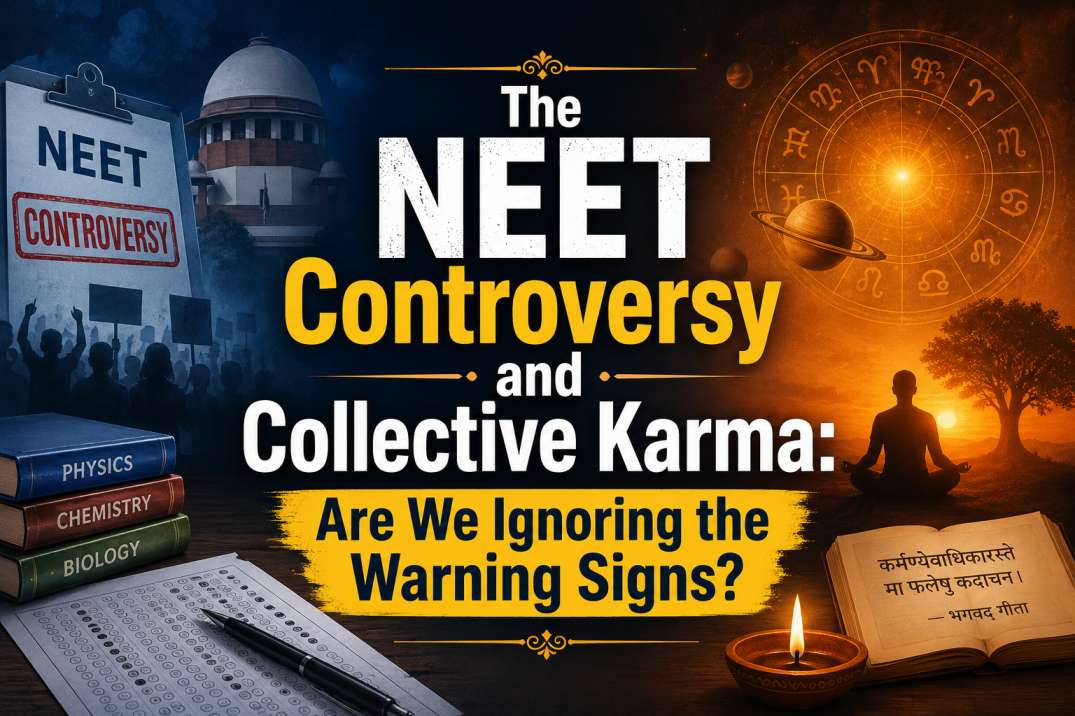
The NEET controversy has sparked widespread discussions across India about fairness, accountability, education systems, and public trust. While the issue is primarily legal, administrative, and social in nature, many people are also exploring whether Vedic astrology offers insights into such large-scale events that affect millions of students and families.
In Jyotish (Vedic astrology), events that impact society on a collective level are often studied through the concept of collective karma, also known as Samashti Karma. This principle suggests that communities, institutions, and nations may experience the consequences of collective actions over time. Rather than predicting specific controversies, astrology can help us understand broader patterns, warning signs, and opportunities for correction.
The NEET debate raises important questions about transparency, merit, justice, and ethics. From an astrological perspective, it encourages reflection on how society responds when trust in important institutions is challenged.
Understanding Collective Karma in Vedic Astrology
What Is Collective Karma?
Vedic astrology recognizes two broad forms of karma:
- Individual Karma (Vyashti Karma): Personal actions and consequences.
- Collective Karma (Samashti Karma): Shared consequences experienced by groups, institutions, communities, or nations.
When controversies affect millions simultaneously, astrologers often examine collective planetary influences rather than individual birth charts.
The ancient principle from the Bhagavad Gita reminds us:
“यदा यदा हि धर्मस्य ग्लानिर्भवति भारत।”
This verse highlights the importance of restoring dharma whenever ethical standards decline. In modern contexts, it encourages accountability and corrective action rather than fear or superstition.
Planetary Indicators Related to Education and Ethics
Jupiter: The Planet of Wisdom and Dharma
In Vedic astrology, Jupiter (Guru) governs:
- Education
- Ethics
- Knowledge
- Teachers
- Moral guidance
When Jupiter faces challenging influences in mundane astrology, discussions around educational integrity and public trust often become more prominent.
A weakened emphasis on Jupiter’s qualities may manifest as:
- Questions about academic fairness
- Declining trust in institutions
- Ethical concerns in education systems
- Public demand for transparency
Saturn: Accountability and Consequences
Saturn (Shani) represents:
- Justice
- Discipline
- Systems
- Delayed consequences
- Institutional responsibility
Saturn’s influence often exposes weaknesses that have been ignored over time. While this process can be uncomfortable, it also creates opportunities for reform.
In many traditional astrological interpretations, Saturn acts as a cosmic auditor, highlighting areas where stronger governance and accountability are required.
Rahu: Confusion, Technology, and Manipulation
Rahu is frequently associated with:
- Illusions
- Digital systems
- Shortcuts
- Unconventional methods
- Mass influence
In today’s technology-driven world, Rahu’s symbolism is often connected with:
- Information leaks
- Digital irregularities
- Rumors and misinformation
- Sudden public controversies
This does not imply that every controversy is caused by Rahu, but its symbolism helps astrologers understand why certain events generate widespread uncertainty.
Houses Connected With Education and Public Trust
The 4th House
Represents:
- Basic education
- Learning environment
- Public confidence
Challenges involving this house may raise concerns regarding educational foundations and institutional credibility.
The 5th House
Associated with:
- Intelligence
- Competitive examinations
- Academic performance
- Merit
Issues affecting competitive exams often relate symbolically to themes governed by the fifth house.
The 9th House
Connected with:
- Dharma
- Ethics
- Higher education
- Moral principles
When discussions revolve around justice and fairness in education, astrologers frequently examine ninth-house symbolism.
Are We Ignoring Warning Signs?
Social Warning Signs
The concept of collective karma is less about punishment and more about awareness.
Some warning signs that deserve attention include:
- Increasing pressure on students
- Excessive focus on ranks and scores
- Ethical compromises in competitive environments
- Loss of trust in institutions
- Mental health challenges among aspirants
Astrology encourages observation of patterns rather than assigning blame.
The Role of Dharma
In Jyotish, dharma refers to acting responsibly and ethically.
For students, this may mean:
- Maintaining honesty during preparation
- Respecting fair competition
- Focusing on genuine learning
For institutions, it may involve:
- Transparency
- Accountability
- Stronger safeguards
- Public trust-building measures
Practical Astrological Remedies
While remedies cannot solve administrative issues, they can help individuals cultivate clarity, discipline, and emotional balance.
For Students
- Offer water to the rising Sun daily before 8:00 AM IST.
- Recite the Gayatri Mantra 11 or 21 times.
- Maintain a disciplined study schedule.
- Avoid comparison and negative thinking.
For Mental Clarity
- Chant “Om Gurave Namah” on Thursdays.
- Donate educational materials to underprivileged students.
- Read inspirational spiritual literature regularly.
For Strengthening Saturn’s Positive Qualities
- Practice honesty in academic work.
- Help elderly individuals.
- Follow commitments consistently.
- Engage in disciplined routines.
For Families
- Encourage open communication.
- Prioritize emotional well-being over examination pressure.
- Support balanced lifestyles that include rest and recreation.
Conclusion
The NEET controversy has become more than an educational issue—it has evolved into a national conversation about trust, fairness, and accountability. Through the lens of Vedic astrology, such events can be viewed as opportunities to reflect on collective karma and the importance of dharma in public life.
Astrology does not replace legal investigations, policy reforms, or factual analysis. However, it can provide a symbolic framework for understanding larger social patterns and the lessons they may offer. Whether one approaches the issue from a practical, spiritual, or astrological perspective, the central message remains the same: strong institutions are built on transparency, ethics, and responsibility.
As individuals and as a society, the real question may not be whether warning signs exist, but whether we are willing to learn from them and take constructive action.
FAQs
1. What is collective karma in Vedic astrology?
Collective karma refers to the shared consequences experienced by a group, community, institution, or society.
Unlike individual karma, collective karma focuses on patterns that affect large numbers of people simultaneously. In Vedic astrology, major social events are sometimes studied through this lens to understand broader lessons and trends.
Helpful Practices:
- Promote ethical behavior.
- Support community welfare.
- Encourage transparency and fairness.
- Participate in positive social initiatives.
2. Does astrology predict educational controversies?
Astrology may highlight themes and tendencies but cannot specifically predict every controversy.
Planetary combinations can indicate periods when discussions about education, ethics, and public trust become more significant. However, real-world events depend on many human, social, and institutional factors.
Key Reminder:
- Use astrology for reflection, not certainty.
- Consider legal and factual evidence first.
- View planetary influences as symbolic indicators.
3. Which planet is most connected with education?
Jupiter is traditionally considered the primary planet of education and wisdom.
Known as Guru, Jupiter governs knowledge, teachers, ethics, and higher learning. Strong Jupiter influences are often associated with learning opportunities and intellectual growth.
Remedies for Jupiter:
- Chant “Om Gurave Namah.”
- Study regularly.
- Respect teachers and mentors.
- Donate books or educational resources.
4. How can students reduce exam-related stress astrologically?
Combining disciplined routines with spiritual practices can help improve emotional balance.
Astrological remedies are intended to support focus and confidence rather than replace preparation. Consistent effort remains the most important factor for success.
Simple Remedies:
- Offer water to the Sun before 8:00 AM IST.
- Recite the Gayatri Mantra.
- Maintain a fixed study timetable.
- Practice meditation or breathing exercises.
5. What does Saturn teach during collective challenges?
Saturn teaches responsibility, accountability, patience, and long-term reform.
When systemic issues become visible, Saturn’s symbolism encourages institutions and individuals to address weaknesses rather than ignore them. Its lessons are often demanding but ultimately constructive.
Ways to Align with Saturn’s Energy:
- Be honest in all work.
- Fulfill responsibilities diligently.
- Respect rules and procedures.
- Serve society through practical actions.