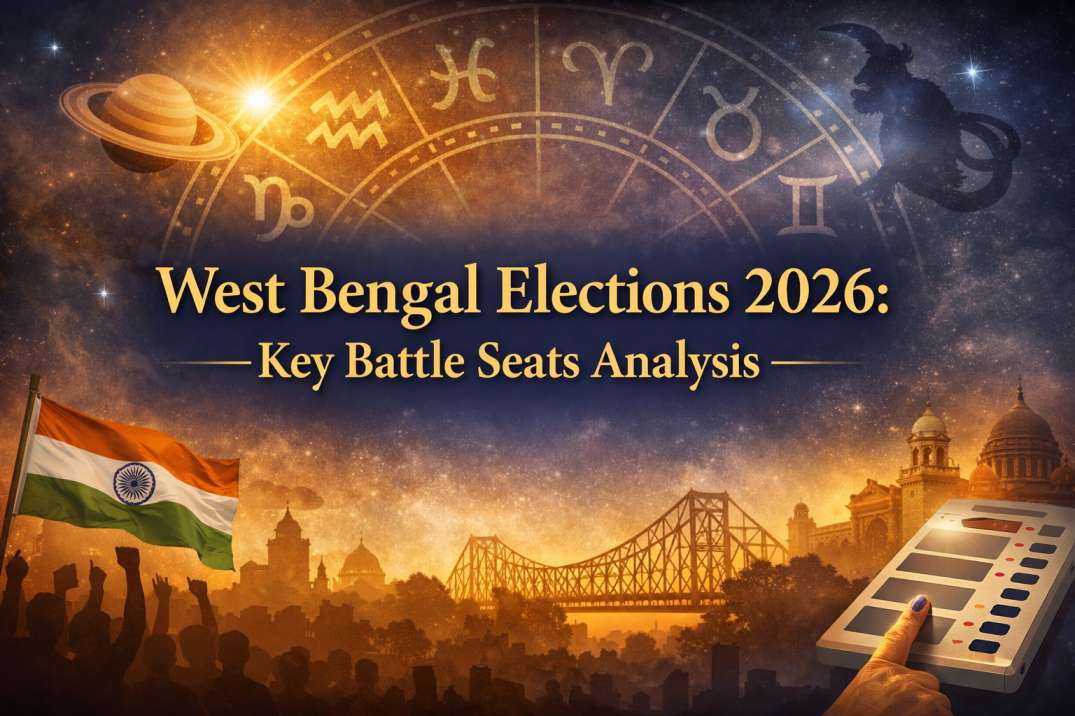
The West Bengal Elections 2026 are expected to be one of the most closely watched political contests in India. With shifting alliances, strong regional leadership, and evolving voter sentiments, the outcome will likely hinge on a handful of crucial constituencies, often called battle seats.
From an astrological perspective, elections are not just about numbers but also about timing (muhurat), planetary transits, and collective karmic patterns. In Vedic astrology, mass events like elections are influenced by Saturn (Shani), Jupiter (Guru), and Rahu-Ketu—planets that govern public mood, justice, and sudden shifts. Understanding these influences can offer a deeper analytical layer to political predictions.
Political Landscape of West Bengal 2026
The primary contest is expected between:
- Mamata Banerjee led All India Trinamool Congress
- Narendra Modi and Amit Shah representing the Bharatiya Janata Party
- The declining but still relevant Communist Party of India (Marxist) and Congress alliance
These elections are expected to peak in political activity between March and May 2026 (IST).
Key Battle Seats to Watch
1. Nandigram – Symbolic and Strategic
- Previously a high-voltage contest involving Mamata Banerjee
- Represents rural sentiment and grassroots mobilization
- Swing here reflects broader voter mood in South Bengal
Astrological Insight:
Transit of Saturn in Pisces (Meena Rashi) indicates karmic payback and accountability. Leaders with strong Saturn placements may gain advantage here.
2. Bhabanipur – Power Centre Seat
- Chief Minister’s stronghold
- Urban voters, educated demographic
- Influences perception of leadership stability
Astrological Insight:
Jupiter (Guru) transiting Aries (Mesh) during early 2026 enhances leadership confidence but also increases scrutiny. Public expectations may rise.
3. Asansol – Industrial Belt Indicator
- Key seat for working-class voters
- Strong BJP presence in recent years
- Reflects industrial and employment issues
Astrological Insight:
Rahu’s influence can create sudden shifts and unexpected results. This seat may produce a surprise outcome.
4. Barrackpore – Political Volatility Zone
- Known for party-switching leaders
- High voter turnout and intense campaigning
Astrological Insight:
With Mars (Mangal) playing a strong role in early 2026, aggression in campaigns may increase. The seat could witness close margins.
5. Cooch Behar – Border and Rural Dynamics
- Strategic due to location and demographics
- Reflects North Bengal political trends
Astrological Insight:
Ketu’s transit indicates detachment from traditional loyalties. Voters may prioritize issues over party lines.
Astrological Factors Influencing Elections
1. Saturn (Shani) – Karma and Accountability
Saturn governs justice and public judgment. Its placement in Pisces during 2026 suggests:
- Voters demanding transparency
- Focus on governance performance
- Punishment for unmet promises
Shloka Insight:
“शनैः शनैः कर्मफलं ददाति”
(Saturn delivers results slowly but surely)
2. Jupiter (Guru) – Wisdom and Leadership
Jupiter represents wisdom, expansion, and public trust.
- Strong Jupiter favors experienced leadership
- Weak Jupiter can lead to confusion in voter decisions
3. Rahu-Ketu Axis – Unexpected Outcomes
- Rahu brings sudden waves and unconventional trends
- Ketu creates detachment and rejection of old patterns
This combination often leads to:
- Surprise wins
- Unpredictable alliances
- Swing votes in key constituencies
Practical Remedies for Political Stability (Astrological Perspective)
While elections are collective events, astrology suggests certain remedies that align with societal harmony:
- For stability: Chant “ॐ शं शनैश्चराय नमः” on Saturdays
- For clarity in leadership: Donate yellow items on Thursdays (Jupiter remedy)
- For reducing conflict: Offer water to the Sun daily at sunrise (before 8:00 AM IST)
These remedies symbolically promote balance and clarity in collective consciousness.
Real-Life Relevance: Why Battle Seats Matter
Battle seats act as trend indicators. Winning these constituencies often means:
- Control over narrative
- Momentum across regions
- Psychological advantage in later phases
In West Bengal, even a swing of 20–30 seats can determine government formation, making these battlegrounds decisive.
Conclusion
The West Bengal Elections 2026 will be shaped by both political strategy and deeper socio-cultural currents. Key battle seats like Nandigram, Bhabanipur, and Asansol will play a defining role in deciding the next government.
Astrologically, the combined influence of Saturn, Jupiter, and Rahu-Ketu suggests a mix of accountability, leadership testing, and unexpected outcomes. Voters may prioritize performance over promises, leading to a closely contested election.
As the political climate intensifies, the final result will likely reflect not just party strength but also timing, public sentiment, and karmic cycles at play. Observing these patterns can offer a more holistic understanding of the electoral process.
FAQs Section
1. Which seats are most important in West Bengal Elections 2026?
Answer: Seats like Nandigram, Bhabanipur, and Asansol are crucial.
These constituencies represent different voter segments—rural, urban, and industrial—making them key indicators of the overall result. Their outcomes often influence surrounding regions.
Tips:
- Watch voter turnout trends
- Track candidate profiles
- Observe campaign intensity
2. How does astrology influence election predictions?
Answer: Astrology analyzes planetary transits affecting public mood and leadership.
Planets like Saturn and Jupiter influence collective decisions, while Rahu-Ketu bring unpredictability. These factors are studied alongside political data.
Tips:
- Focus on major planetary transits
- Combine astrology with ground reports
- Avoid absolute conclusions
3. Can Rahu-Ketu change election results suddenly?
Answer: Yes, Rahu-Ketu are known for sudden and unexpected shifts.
They influence mass psychology and can lead to surprise victories or defeats, especially in close contests.
Tips:
- Expect volatility in close seats
- Watch for last-minute swings
- Analyze past election surprises
4. What role does Saturn play in elections?
Answer: Saturn represents accountability and justice.
It ensures leaders are judged based on past actions, making performance and governance key factors.
Tips:
- Evaluate incumbency performance
- Look for anti-incumbency trends
- Track public dissatisfaction
5. Are astrological remedies useful for political outcomes?
Answer: Remedies symbolically promote balance rather than directly influencing results.
They are rooted in Vedic traditions and aim to harmonize energies, not alter democratic processes.
Tips:
- Practice remedies with sincerity
- Focus on collective harmony
- Combine faith with practical awareness