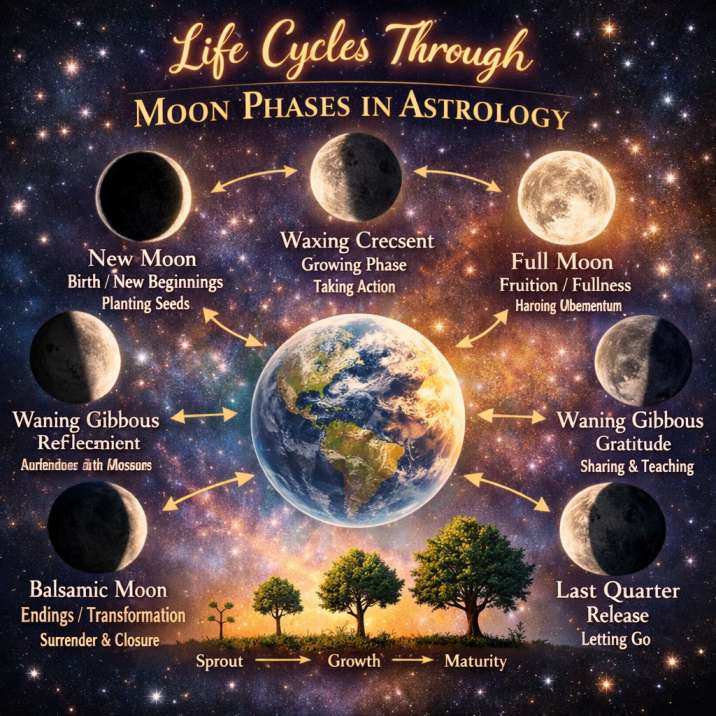
Understanding life cycles through Moon phases is an ancient astrological concept deeply rooted in Vedic astrology. The Moon, or Chandra, represents the mind, emotions, habits, and subconscious patterns. Unlike slow-moving planets, the Moon changes its phase roughly every 2.25 days and completes a full cycle in about 29.5 days, making it a powerful indicator of short-term emotional and psychological shifts.
In Indian astrology, Moon phases (Paksha, Tithi, Purnima, Amavasya) are used to understand beginnings, growth, maturity, release, and rest. These phases subtly influence our energy levels, decision-making, relationships, and even spiritual practices. By aligning daily actions with lunar cycles, one can live with greater awareness rather than resistance.
Moon Phases in Vedic Astrology: The Foundation
Why the Moon Matters More Than We Think
In Vedic astrology, the Moon is considered more important than the Sun for understanding lived experience. While the Sun shows purpose, the Moon shows how life is felt.
Key Moon-related factors include:
- Rashi (Moon Sign): Emotional nature
- Tithi (Lunar Day): Daily mental tone
- Paksha: Growth or release energy
- Nakshatra: Subtle psychological patterns
Traditional texts like Brihat Parashara Hora Shastra emphasize that a strong Moon supports mental stability and adaptability.
The Four Major Moon Phases and Life Cycles
🌑 Amavasya (New Moon): The Phase of Reset
Amavasya marks the beginning of the lunar cycle. The Moon is invisible, symbolizing rest, introspection, and emotional reset.
Life themes:
- Endings and closures
- Letting go of old habits
- Mental fatigue or silence
Practical relevance:
- Avoid impulsive decisions
- Ideal for journaling and self-reflection
Traditional insight:
Amavasya is linked with ancestral karma (Pitru Paksha). Many families perform tarpan rituals on this day.
🌒 Shukla Paksha (Waxing Moon): Growth and Building
From Amavasya to Purnima, the Moon gains light. This phase supports growth, effort, and emotional clarity.
Life themes:
- New beginnings
- Learning and expansion
- Relationship development
Best activities:
- Starting projects
- Job interviews
- Financial planning
Most auspicious activities in India are scheduled during Shukla Paksha, especially during Abhijit Muhurat (usually around midday IST).
🌕 Purnima (Full Moon): Peak Awareness
Purnima represents emotional fullness and heightened sensitivity. The Moon is fully illuminated, often amplifying thoughts and feelings.
Life themes:
- Clarity or emotional overflow
- Completion and realization
- Spiritual openness
Astrological note:
Meditation during Purnima evenings (around 7–9 PM IST) is considered highly effective.
Relevant shloka:
“Chandrama manaso jatah” — Purusha Sukta
(The Moon governs the mind)
🌘 Krishna Paksha (Waning Moon): Release and Healing
As the Moon wanes, energy turns inward. This phase supports detox—mental, emotional, and physical.
Life themes:
- Detachment
- Healing and forgiveness
- Simplification
Best practices:
- Decluttering
- Emotional closure
- Light fasting
Krishna Paksha is ideal for addressing subconscious patterns rather than pushing outward goals.
Moon Phases, Zodiac Signs, and Houses
How Moon Phases Interact With Your Birth Chart
The impact of Moon phases changes based on:
- Your Moon sign
- The house where the transit Moon falls
- Aspects from Saturn, Rahu, or Ketu
Examples:
- Full Moon in the 7th house may highlight relationships
- New Moon in the 10th house may trigger career changes
Astrologers often track monthly lunar transits for practical predictions rather than relying only on yearly charts.
Practical Remedies to Balance Lunar Energy
Simple, Non-Superstitious Remedies
To maintain emotional balance across Moon phases:
- Sleep before 11 PM IST, especially during Purnima
- Drink water stored in silver overnight (if suitable)
- Chant “Om Som Somaya Namah” on Mondays
- Spend time near natural water bodies
These remedies are recommended for mental grounding, not blind belief.
Real-Life Relevance in Modern Life
Understanding life cycles through Moon phases helps explain:
- Why motivation fluctuates
- Why certain days feel emotionally heavy
- Why clarity comes in cycles
Instead of labeling these changes as weakness, lunar awareness frames them as natural rhythms—similar to tides influenced by the Moon.
Conclusion
Understanding life cycles through Moon phases offers a practical framework to observe emotional patterns, decision-making cycles, and personal growth. Vedic astrology does not ask us to fear the Moon but to understand its timing. By aligning action with lunar phases; rest during Amavasya, build during Shukla Paksha, reflect during Purnima, and release during Krishna Paksha- we move with life rather than against it.
This awareness promotes mental balance, emotional intelligence, and conscious living. Even small adjustments, when made consistently, can create long-term stability and clarity.
FAQs
1. How do Moon phases affect daily life?
Moon phases influence emotional energy, focus levels, and decision-making patterns by affecting the mind.
They work subtly, not dramatically, and are best observed over time rather than judged by one day.
Tips:
- Track mood patterns for one lunar month
- Avoid major decisions on emotionally intense days
2. Is Purnima good or bad in astrology?
Purnima is neither good nor bad; it amplifies emotions and awareness.
People with sensitive Moon placements may feel overwhelmed, while others experience clarity.
Tips:
- Practice meditation
- Avoid emotional confrontations
3. Why is Amavasya considered sensitive?
Amavasya symbolizes mental rest and low external energy.
It is ideal for introspection but not for aggressive action.
Tips:
- Keep schedules light
- Focus on inner work
4. Can Moon phases affect relationships?
Yes, especially communication and emotional reactions.
Full Moons can bring unresolved feelings to the surface.
Tips:
- Practice patience
- Delay serious discussions if emotions run high
5. How can I strengthen my Moon?
A strong Moon supports emotional stability and clarity.
This depends on lifestyle habits more than rituals.
Remedies:
- Maintain regular sleep
- Stay hydrated
- Respect emotional boundaries