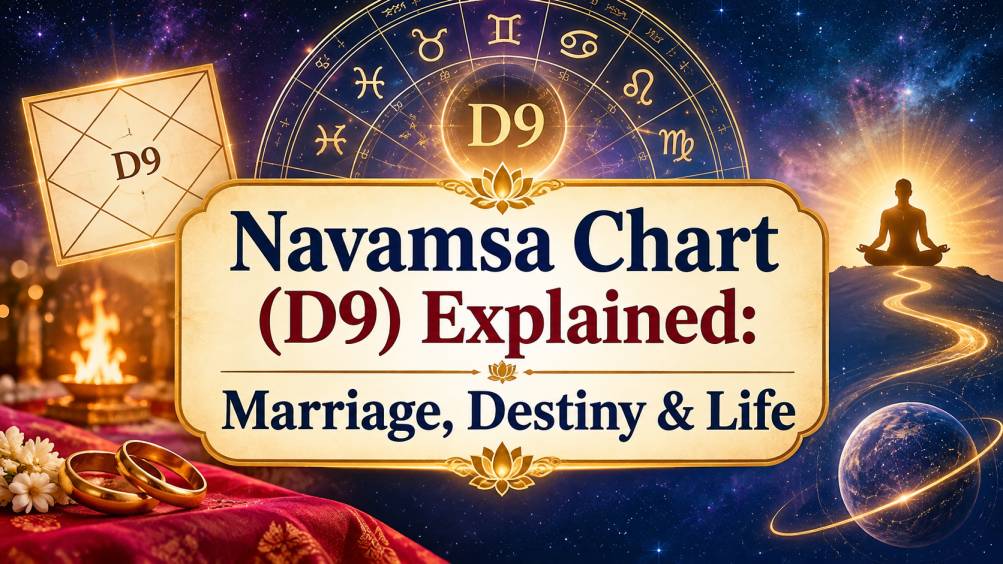
In Vedic astrology, the Navamsa Chart, also known as the D9 chart, is one of the most important divisional charts used to understand marriage, relationships, spiritual growth, and the deeper strength of planets. While the birth chart (D1 or Lagna Chart) provides an overview of a person’s life, the Navamsa offers additional insight into how planetary influences may develop over time.
Astrologers traditionally examine the D9 chart alongside the birth chart to assess marital harmony, spouse-related matters, personal values, and inner development. It is also considered an important tool for evaluating planetary dignity and maturity. Understanding the Navamsa chart can help individuals explore relationship patterns and long-term life priorities through the traditional framework of Vedic astrology.
What Is a Navamsa Chart in Vedic Astrology?
The Navamsa chart is the ninth divisional chart in Vedic astrology. The Sanskrit word Navamsa combines two words: Nava (nine) and Amsa (division).
Each zodiac sign of 30 degrees is divided into nine equal parts of 3 degrees and 20 minutes each. These divisions are used to construct the D9 chart.
The Navamsa is particularly significant for:
- Marriage and marital compatibility.
- Nature and characteristics of the spouse.
- Strength and dignity of planets.
- Emotional maturity and personal development.
- Spiritual interests and long-term values.
- Understanding the deeper results of planetary placements.
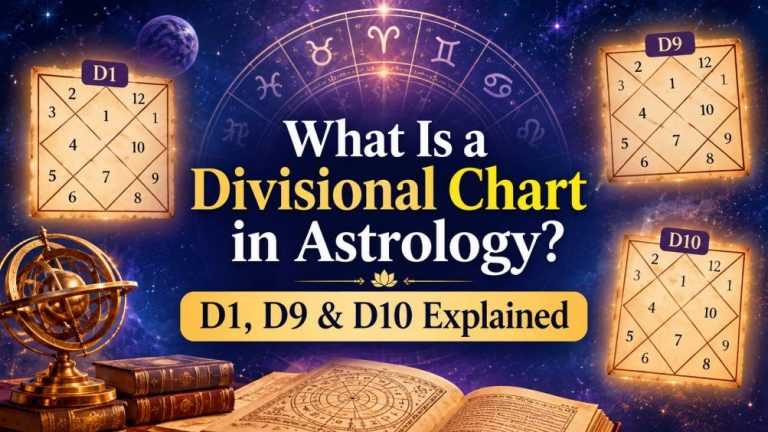
Traditionally, astrologers do not interpret the D9 chart independently. They compare it with the D1 birth chart for a more balanced understanding.
Why Is the D9 Chart Important for Marriage?
Marriage is one of the primary areas examined through the Navamsa chart. It provides additional astrological indicators regarding relationships, commitment, and married life.
However, the D9 chart should not be treated as a guaranteed prediction of marriage timing or relationship outcomes.
1. Seventh House in the Navamsa Chart
The seventh house is traditionally associated with marriage, partnerships, and committed relationships.
Astrologers examine:
- The sign occupying the seventh house.
- The seventh house lord and its placement.
- Benefic and malefic planetary influences.
- Aspects on the seventh house.
- Connections between the seventh lord and Venus or Jupiter.
A well-supported seventh house may traditionally indicate favourable relationship tendencies, while challenging combinations may suggest areas requiring patience and understanding.
2. Venus and Jupiter in D9
Venus and Jupiter are important planets in traditional marriage analysis.
Venus (Shukra):
- Represents love, attraction, romance, and relationship harmony.
- Its placement can provide insights into relationship expectations.
- Its dignity and associations are considered when examining marital satisfaction.
Jupiter (Guru):
- Represents wisdom, guidance, values, and expansion.
- Traditionally signifies the husband in a woman’s horoscope in classical interpretive frameworks.
- Its placement may provide additional insights into shared values and family life.
Both planets should be assessed in relation to the complete horoscope rather than through isolated placements.
How Planets Influence the Navamsa Chart
Planetary placement in D9 adds another layer to the interpretation of the birth chart.
Sun in Navamsa
The Sun represents confidence, authority, identity, and self-respect. Its D9 placement may indicate how a person expresses individuality and responsibility in marriage.
Moon in Navamsa
The Moon represents emotions, mental comfort, and sensitivity. Its position can offer insights into emotional needs and the ability to maintain a supportive relationship.
Mars in Navamsa
Mars represents courage, energy, passion, and assertiveness. Its placement may highlight enthusiasm as well as the need to manage disagreements constructively.
Mercury in Navamsa
Mercury represents communication, intelligence, and practical thinking. A supportive Mercury may indicate an emphasis on discussion, understanding, and intellectual compatibility.
Saturn in Navamsa
Saturn represents discipline, patience, responsibility, and long-term commitment. Its influence may highlight lessons involving maturity and consistency in relationships.
Rahu and Ketu in Navamsa
Rahu and Ketu represent unconventional tendencies, desires, detachment, and karmic themes in traditional astrology. Their placement may suggest areas where individuals experience unusual expectations or personal transformation.
Navamsa Lagna: What Does It Reveal?
The Navamsa Lagna, or D9 Ascendant, is another important element of this divisional chart.
It provides a traditional framework for examining a person’s inner nature, values, and development in committed relationships.
Astrologers examine:
- The sign of the Navamsa Ascendant.
- The condition of its ruling planet.
- Planets placed in the first house.
- Aspects and conjunctions influencing the Ascendant.
- Connections between the D9 Lagna lord and the D1 chart.
The D9 Ascendant should be interpreted carefully because even a small difference in birth time can sometimes change divisional chart placements.
Vargottama and Planetary Strength in D9
One important concept in Navamsa analysis is Vargottama.
A planet is called Vargottama when it occupies the same zodiac sign in both the D1 birth chart and the D9 Navamsa chart.
Traditionally, this placement is considered significant because it can indicate consistency or reinforcement of the planet’s qualities.
For example:
- A Vargottama Jupiter may reinforce Jupiter-related qualities.
- A Vargottama Venus may strengthen the expression of Venusian themes.
- A Vargottama Saturn may emphasise discipline and responsibility.
However, Vargottama does not automatically make every planetary result favourable. House ownership, aspects, conjunctions, and overall chart conditions remain important.
Practical Remedies for Improving Relationship Harmony
Astrological remedies are traditionally followed as spiritual practices. They should complement practical efforts rather than replace communication, counselling, or responsible decision-making.
Some commonly followed practices include:
- For Venus: Maintain cleanliness, practise kindness, and offer white flowers during Friday worship.
- For Jupiter: Respect teachers, support education, and recite the Guru mantra if comfortable.
- For Mars: Practise patience, regular exercise, and Hanuman worship according to personal beliefs.
- For Saturn: Help elderly people, practise discipline, and fulfil responsibilities sincerely.
- For the Moon: Maintain a healthy routine, practise meditation, and develop emotional awareness.
Mantra chanting, charity, and prayer can provide a meaningful spiritual routine. Gemstones should not be recommended solely on the basis of one D9 placement.
How to Read the D9 Chart Correctly
For a balanced Navamsa interpretation, consider the following steps:
- Examine the D1 birth chart and confirm the Ascendant.
- Check the seventh house and its lord in D1.
- Analyse the D9 Ascendant and its ruling planet.
- Examine the seventh house and seventh lord in D9.
- Assess Venus, Jupiter, and other relevant planetary placements.
- Compare planetary dignity in D1 and D9.
- Consider the operating Mahadasha and Antardasha.
- Evaluate the complete horoscope before drawing conclusions.
Accurate birth details are essential because the D9 chart is sensitive to birth-time accuracy.
Conclusion
The Navamsa Chart (D9) is an essential component of traditional Vedic astrology, particularly for understanding marriage, relationship dynamics, planetary strength, and personal development. Its interpretation can provide additional context about the seventh house, spouse-related indicators, Venus, Jupiter, and the Navamsa Ascendant.
However, no single planet or house can independently determine the success of a marriage or the course of someone’s life. The D1 and D9 charts must be studied together, considering planetary dignity, aspects, yogas, and planetary periods.
Ultimately, astrology can serve as a framework for reflection and self-understanding. Healthy relationships also depend on mutual respect, emotional maturity, trust, and consistent effort.
Frequently Asked Questions (FAQs)
1. What is a Navamsa Chart (D9) in astrology?
The Navamsa Chart is the ninth divisional chart in Vedic astrology, traditionally used to examine marriage, planetary strength, spiritual development, and long-term relationships.
Each zodiac sign is divided into nine equal sections of 3 degrees and 20 minutes.
Important points:
- D9 is derived from the D1 birth chart.
- It is important for marriage analysis.
- It provides additional information about planetary dignity.
2. Does the Navamsa Chart predict marriage?
The Navamsa chart provides traditional astrological indicators related to marriage, but it cannot independently guarantee marriage or determine its timing.
Astrologers generally examine the seventh house, seventh lord, Venus, Jupiter, and relevant planetary periods in both D1 and D9.
For better analysis:
- Examine the seventh house in both charts.
- Consider Mahadasha and Antardasha.
- Assess the complete horoscope.
3. Which house is most important in the D9 chart for marriage?
The seventh house is one of the most important houses for marriage analysis in the Navamsa chart.
It represents committed partnerships, marital relationships, and the dynamics of married life.
Other important factors include:
- Seventh house lord.
- Venus and Jupiter.
- D9 Ascendant.
- Benefic and malefic planetary influences.
4. What happens if Venus is strong in the Navamsa chart?
A well-placed Venus in D9 is traditionally associated with favourable relationship qualities, affection, attraction, and an appreciation of harmony.
However, Venus alone cannot determine marital happiness. Its house placement, sign, conjunctions, aspects, and condition in D1 must also be considered.
Traditional Venus-related practices:
- Maintain respectful relationships.
- Practise kindness and generosity.
- Follow Friday prayers or worship if personally meaningful.
5. What does Vargottama mean in the Navamsa chart?
Vargottama refers to a planet occupying the same zodiac sign in both the D1 and D9 charts.
It is traditionally considered an indication of reinforced planetary qualities.
For example, Vargottama Jupiter may emphasise wisdom, knowledge, and ethical values.
Remember:
- Vargottama does not automatically mean a planet is benefic.
- House ownership remains important.
- The complete horoscope determines the interpretation.
6. Can the Navamsa chart change after marriage?
The calculated Navamsa chart does not change after marriage because it is based on the person’s birth details.
However, astrologers traditionally believe that certain planetary qualities and life experiences become more noticeable with maturity and changing circumstances.
Keep in mind:
- D9 remains fixed.
- Life experiences can change personal priorities.
- Marriage does not physically alter planetary placements.
7. Is the Navamsa chart more important than the birth chart?
No, the Navamsa chart is not considered a replacement for the D1 birth chart; both are important and should be interpreted together.
The D1 provides the broader foundation of life, while D9 offers additional insight into marriage, planetary strength, and deeper personal development.