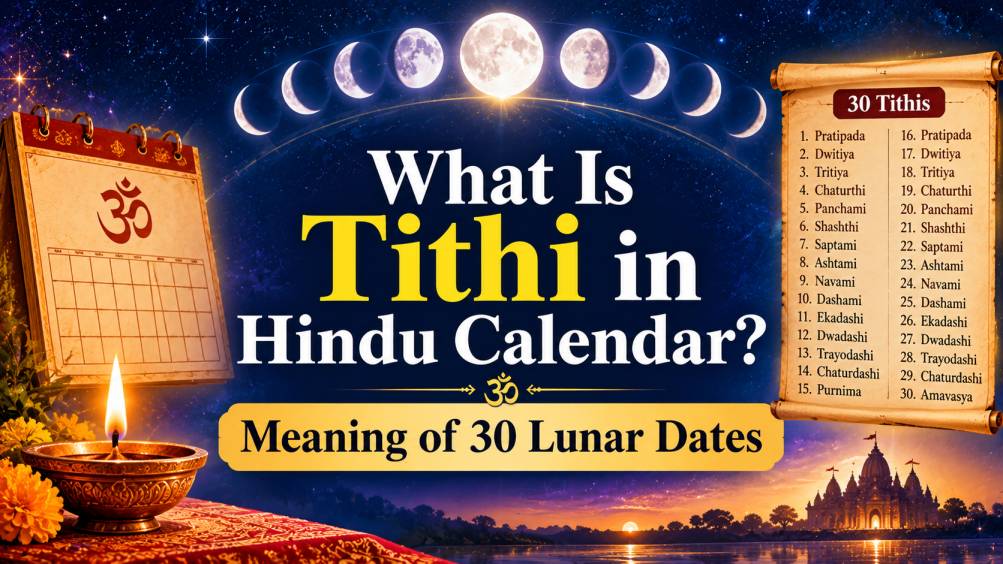
In Hindu astrology, a Tithi is a lunar date calculated using the relative positions of the Sun and Moon. Unlike the Gregorian calendar, which follows the solar cycle, the traditional Hindu Panchang uses lunar movements to determine important dates, festivals, fasting periods, and religious ceremonies.
A Hindu lunar month consists of 30 Tithis, divided into two phases: Shukla Paksha (waxing Moon) and Krishna Paksha (waning Moon). Each Tithi carries a distinct traditional significance and is associated with particular activities, rituals, and spiritual practices.
Understanding Tithi is important in Vedic astrology because it forms one of the five essential elements of Panchang. It helps people select suitable timings for religious observances, festivals, marriage-related ceremonies, and other important activities.
What Is a Tithi? Meaning and Calculation
A Tithi represents the time taken by the angular distance between the Sun and Moon to increase by 12 degrees.
The complete angular cycle between these two celestial bodies is 360 degrees. Dividing it into 30 equal portions gives 30 lunar Tithis.
Therefore:
- One Tithi represents 12 degrees of angular separation.
- 15 Tithis form Shukla Paksha.
- 15 Tithis form Krishna Paksha.
- One complete lunar month contains 30 Tithis.
Unlike an ordinary calendar date, a Tithi does not necessarily last exactly 24 hours. Its duration varies according to the apparent movements of the Sun and Moon.
For accurate Tithi timings, astrologers refer to the local Panchang, which provides start and end times in IST (Indian Standard Time) for Indian locations.
Understanding the 30 Tithis in the Hindu Calendar
The 30 lunar dates are divided into two Pakshas.
1. Shukla Paksha: The Bright Fortnight
Shukla Paksha begins after Amavasya and continues until Purnima. During this period, the Moon gradually becomes brighter.
Traditionally, this phase represents growth, expansion, positivity, and new beginnings.
The 15 Tithis are:
- Pratipada – Traditionally associated with beginnings.
- Dwitiya – Associated with cooperation and relationships.
- Tritiya – Considered favourable for prosperity-related observances.
- Chaturthi – Associated with Lord Ganesha.
- Panchami – Traditionally connected with learning and knowledge.
- Shashthi – Associated with protection and courage.
- Saptami – Dedicated to Surya Dev in traditional observances.
- Ashtami – Associated with Goddess Durga.
- Navami – Connected with divine feminine worship.
- Dashami – Traditionally associated with victory and accomplishment.
- Ekadashi – Important for fasting and spiritual discipline.
- Dwadashi – Associated with Lord Vishnu worship.
- Trayodashi – Significant for Pradosh Vrat.
- Chaturdashi – Associated with Shiva worship.
- Purnima – The full Moon day, traditionally considered significant for worship, charity, and meditation.
2. Krishna Paksha: The Dark Fortnight
Krishna Paksha begins after Purnima and continues until Amavasya. During this phase, the visible illuminated portion of the Moon decreases.
Traditionally, this period is associated with introspection, spiritual discipline, simplicity, and letting go.
Its 15 Tithis are:
- Pratipada – Beginning of the waning phase.
- Dwitiya – Associated with family and relationship observances.
- Tritiya – Connected with traditional fasting practices.
- Chaturthi – Important for Sankashti Chaturthi.
- Panchami – Associated with traditional devotional practices.
- Shashthi – Connected with Skanda worship.
- Saptami – Associated with Surya-related observances.
- Ashtami – Significant for Goddess worship.
- Navami – Associated with traditional religious rituals.
- Dashami – Represents the continuation of the waning phase.
- Ekadashi – Important for fasting and devotion to Lord Vishnu.
- Dwadashi – Associated with Vishnu worship and fasting observances.
- Trayodashi – Significant for Pradosh Vrat.
- Chaturdashi – Particularly important for Masik Shivaratri.
- Amavasya – The new Moon day, traditionally associated with Pitru Tarpan and remembrance of ancestors.
Importance of Tithi in Vedic Astrology
Tithi is one of the five elements of Panchang, along with Vara (weekday), Nakshatra, Yoga, and Karana.
It provides an additional layer of information when evaluating an auspicious time or Muhurta.
1. Tithi and Daily Activities
Traditional Muhurta astrology considers Tithi when selecting dates for activities such as:
- Marriage ceremonies.
- Griha Pravesh (housewarming).
- Starting a business.
- Religious ceremonies.
- Fasting and spiritual practices.
The suitability of a Tithi depends on the activity, regional traditions, and the complete Panchang.
2. Tithi and the Moon’s Influence
The Moon represents the mind, emotions, mental comfort, and adaptability in Vedic astrology.
Since Tithi is calculated through the relationship between the Sun and Moon, astrologers also consider it when interpreting traditional lunar influences.
However, Tithi alone cannot determine someone’s personality, future, or emotional condition. A complete birth chart requires the Ascendant, planetary placements, houses, Nakshatras, and planetary periods.
3. Tithi and Planetary Associations
Traditional Muhurta astrology groups Tithis into five categories called Nanda, Bhadra, Jaya, Rikta, and Purna.
| Category | Tithis | Traditional association |
| Nanda | 1, 6, 11 | Happiness and growth |
| Bhadra | 2, 7, 12 | Stability and auspicious activities |
| Jaya | 3, 8, 13 | Victory and achievement |
| Rikta | 4, 9, 14 | Traditionally avoided for certain auspicious activities |
| Purna | 5, 10, 15 | Completion and fulfilment |
These classifications are useful in traditional Muhurta selection. They should not be treated as universal guarantees of success or failure.
Practical Remedies According to Tithi
Traditional Hindu practices associate different Tithis with particular deities and devotional activities. These practices can help people maintain discipline, gratitude, and spiritual awareness.
Some commonly followed observances include:
- Chaturthi: Worship Lord Ganesha and recite Ganesh mantras.
- Ekadashi: Observe a suitable fast, practise self-control, and worship Lord Vishnu.
- Purnima: Offer prayers, meditate, and perform charity according to one’s capacity.
- Amavasya: Remember ancestors and perform traditional Tarpan where appropriate.
- Ashtami: Worship Goddess Durga and practise acts of compassion.
- Trayodashi: Perform Pradosh worship dedicated to Lord Shiva.
Fasting should always be adapted to one’s health and circumstances. There is no need to undertake difficult rituals or expensive remedies to observe a Tithi.
How to Find Your Daily Tithi
You can check the daily Tithi through a reliable Hindu Panchang or Vedic astrology calendar.
For accurate information, consider these factors:
- Your city and geographical location.
- The local sunrise and sunset timings.
- Tithi beginning and ending times.
- Whether the Tithi is present at sunrise.
- Special festival or Vrat rules.
For example, a Tithi may begin in the afternoon and end the following morning. This is why a Hindu festival may not always fall on the same Gregorian calendar date every year.
Always check the relevant festival’s traditional observance rules instead of relying only on the date printed in a general calendar.
Conclusion: Why Understanding Tithi Matters
Tithi is an important component of the Hindu lunar calendar and Vedic astrology. The 30 lunar dates provide a traditional framework for understanding lunar cycles, religious festivals, fasting practices, and auspicious timings.
Shukla Paksha represents the waxing Moon, while Krishna Paksha represents the waning Moon. Each Tithi has its own traditional significance, making it useful for Panchang analysis and Muhurta selection.
Understanding Tithi helps individuals connect everyday activities with India’s traditional calendar system. Rather than viewing Tithis as predictions of guaranteed outcomes, they can be understood as a cultural and astrological guide for planning, reflection, and spiritual discipline.
Frequently Asked Questions (FAQs)
1. How many Tithis are there in a Hindu lunar month?
There are 30 Tithis in a complete Hindu lunar month, divided into 15 Tithis each in Shukla Paksha and Krishna Paksha.
Each Tithi represents a 12-degree increase in the angular separation between the Sun and Moon.
Related tips:
- Check both Pakshas in your daily Panchang.
- Remember that Purnima and Amavasya mark the ends of the two lunar phases.
2. What is the difference between Shukla Paksha and Krishna Paksha?
Shukla Paksha is the waxing Moon phase, while Krishna Paksha is the waning Moon phase.
Shukla Paksha begins after Amavasya and ends on Purnima. Krishna Paksha begins after Purnima and ends on Amavasya.
Related tips:
- Shukla Paksha is traditionally associated with growth and beginnings.
- Krishna Paksha is traditionally associated with introspection and spiritual discipline.
3. Which Tithi is considered most auspicious in Vedic astrology?
There is no single universally auspicious Tithi because its suitability depends on the purpose, Panchang classification, and traditional Muhurta rules.
Panchami, Dashami, Ekadashi, and Purnima are commonly considered significant for different religious and auspicious activities.
Related tips:
- Consult a complete Panchang before selecting a Muhurta.
- Consider Nakshatra, Yoga, Karana, and Vara alongside Tithi.
4. Does Tithi affect a person’s birth chart?
Yes, the birth Tithi is considered one of the traditional factors in Vedic astrology, but it cannot independently determine a person’s personality or destiny.
Astrologers may examine the birth Tithi along with the Moon’s position, Ascendant, planetary placements, and Nakshatra.
Related tips:
- Check the exact birth date, time, and location.
- Use a complete horoscope rather than relying on Tithi alone.
5. What is the difference between Tithi and Nakshatra?
Tithi is calculated using the angular separation between the Sun and Moon, whereas Nakshatra is based on the Moon’s position along the zodiac.
Both are important elements of Hindu Panchang and are used in traditional Muhurta calculations.
Related tips:
- Tithi represents a lunar date.
- Nakshatra represents one of 27 divisions of the zodiac along the Moon’s path.
6. Why does a Tithi sometimes change twice in one Gregorian date?
A Tithi does not have a fixed 24-hour duration, so two Tithis can occur within the same Gregorian calendar day.
Similarly, a single Tithi can extend across two sunrise periods.
Related tips:
- Check the exact beginning and ending times.
- Use local IST timings for Indian locations.
- Follow the specific festival observance rules when selecting Vrat dates.
7. Which Tithi is suitable for fasting and spiritual practices?
Ekadashi is especially important for fasting and Lord Vishnu worship, while Chaturthi, Pradosh Trayodashi, and Purnima are also associated with traditional fasting and devotional observances.
The appropriate fasting practice depends on the specific Tithi and individual circumstances.
Related tips:
- Observe fasting according to your health and capacity.
- Maintain cleanliness, prayer, and self-discipline.
- Follow a reliable Panchang for the correct fasting and Parana timings.
I can also create a matching rectangular blog cover image with a traditional Hindu Panchang and lunar-phase theme.