
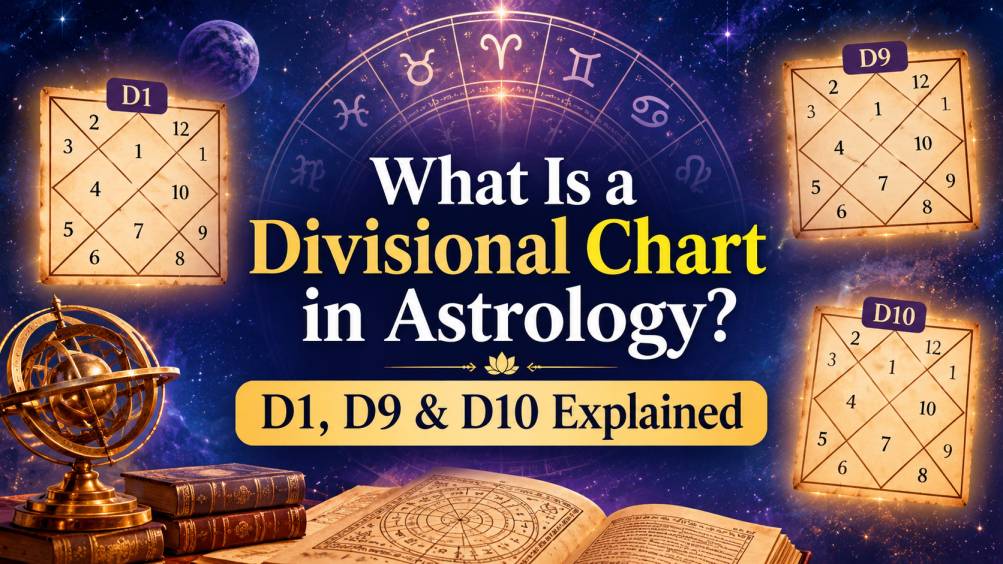
In Vedic astrology, a divisional chart is a specialised horoscope used to understand specific areas of life in greater detail. Also known as Varga Charts, these charts are derived by dividing each of the 12 zodiac signs into smaller sections. While the main birth chart (D1 or Rashi Chart) provides an overall picture of life, divisional charts offer additional insights into marriage, career, finances, education, spirituality and other important matters.
Among the 16 commonly discussed divisional charts, D1, D9 and D10 hold particular importance. Astrologers use them to examine planetary influences and understand how different areas of life may develop. Learning about these charts can help individuals understand the broader principles of Vedic astrology without relying on a single planetary placement.
What Is a Divisional Chart in Vedic Astrology?
A divisional chart is a mathematical subdivision of the zodiac used in traditional Vedic astrology. Each zodiac sign spans 30 degrees and is divided into smaller portions according to a specific calculation.
These divisions create different Varga Charts, each associated with a particular aspect of life.
For example:
- D1 represents the overall birth horoscope.
- D9 provides insights into marriage, relationships and Dharma.
- D10 focuses on career, profession and public responsibilities.
Divisional charts are generally interpreted alongside the main birth chart rather than independently.
What Is a D1 Chart (Rashi Chart)?
The D1 Chart, also called the Rashi Chart or Lagna Chart, is the foundation of Vedic astrology.
It is prepared using the individual’s date, exact birth time and birthplace. It shows the positions of the nine traditional Vedic planetary influences, including Rahu and Ketu, across the 12 zodiac signs and houses.
Importance of the D1 Chart
The D1 chart provides a broad understanding of different life areas.
Astrologers examine:
- Lagna (Ascendant): Personality, physical constitution and general approach to life.
- Second House: Family, speech, savings and accumulated wealth.
- Fourth House: Home, mother, education and emotional comfort.
- Seventh House: Marriage, partnerships and relationships.
- Tenth House: Career, profession, reputation and responsibilities.
- Eleventh House: Income, achievements and social networks.
For example, an astrologer may examine the tenth house, its lord and Saturn to understand traditional career indications. However, the complete planetary combinations must be considered before drawing conclusions.
What Is a D9 Chart (Navamsa Chart)?
The D9 Chart, commonly known as the Navamsa Chart, is one of the most significant divisional charts in Vedic astrology.
Each zodiac sign is divided into nine equal parts, with each division measuring 3 degrees and 20 minutes. The resulting chart is traditionally associated with marriage, partnerships, Dharma and the deeper strength of planets.
Importance of the D9 Chart
The Navamsa chart is particularly important when examining marriage and long-term relationships.
Astrologers generally study:
- The seventh house and its lord.
- Venus as an important relationship significator.
- Jupiter in traditional marriage analysis.
- The Navamsa Lagna and its ruling planet.
- The placement and dignity of planets in D9.
The D9 chart is also used to assess planetary strength and understand how planetary promises in the D1 chart may manifest over time.
For example, if Venus occupies a favourable position in both D1 and D9, some astrologers may interpret this as supportive of relationship-related matters. However, no single placement guarantees marital happiness or compatibility.
What Is a D10 Chart (Dashamsa Chart)?
The D10 Chart, also known as the Dashamsa Chart, is used to examine career, professional development, authority and responsibilities.
Each zodiac sign is divided into ten equal portions of 3 degrees each. This produces a specialised chart that provides additional information about professional life.
Importance of the D10 Chart
The D10 chart is useful in traditional career analysis, especially when studied with the D1 chart.
Astrologers commonly examine:
- Tenth House: Profession, status and responsibilities.
- Sun: Authority, leadership and recognition.
- Saturn: Discipline, work ethic and long-term responsibilities.
- Mercury: Communication, business and analytical skills.
- Jupiter: Knowledge, teaching and guidance.
For instance, a strong Mercury in the D10 chart may traditionally be associated with communication, marketing, writing or business-related activities. Actual career decisions should also consider education, experience, skills and opportunities.
Difference Between D1, D9 and D10 Charts
Although all three charts are important, their primary purposes differ.
| Chart | Sanskrit Name | Main Focus |
| D1 | Rashi Chart | Overall life and personality |
| D9 | Navamsa Chart | Marriage, Dharma and planetary strength |
| D10 | Dashamsa Chart | Career and professional development |
An important principle in Vedic astrology is that divisional charts should support and refine the indications of the D1 chart rather than contradicting it without further analysis.
Why Are Divisional Charts Important in Astrology?
Divisional charts allow astrologers to examine specific subjects more closely.
Their importance can be understood through three main factors:
1. Detailed Planetary Analysis
A planet may occupy a particular sign in D1 but appear in a different sign in D9 or D10. Astrologers examine these placements to understand its traditional strength and role in different life areas.
2. Understanding Planetary Dignity
Planetary dignity, including exaltation, debilitation and own-sign placement, is considered across relevant divisional charts. The Varga system helps provide a more detailed interpretation of planetary influences.
3. Evaluating Specific Life Areas
Different charts help focus on different subjects, such as:
- Education through D24 (Chaturvimshamsa).
- Children through D7 (Saptamsa).
- Parents and property through relevant Varga charts.
- Spirituality through D20 (Vimshamsa).
- Career through D10.
The interpretation depends on the complete horoscope and the astrological tradition being followed.
How Accurate Is a Divisional Chart?
The accuracy of a divisional chart depends heavily on the accuracy of birth details.
Even a small difference in birth time can change the Ascendant or planetary positions in certain divisional charts, particularly when a planet is close to a division boundary.
For a meaningful interpretation:
- Use the correct date of birth.
- Verify the recorded birth time.
- Enter the correct birthplace.
- Use a consistent Vedic astrology calculation system.
- Consult an experienced astrologer for detailed analysis.
Divisional charts are traditional interpretative tools, not scientifically validated methods of predicting future events.
Practical Guidance and Traditional Remedies
Divisional charts are primarily used for horoscope interpretation, but people often explore traditional remedies based on planetary placements.
Some commonly followed practices include:
- For Sun: Offer water to the rising Sun and maintain discipline.
- For Moon: Practise meditation and maintain a balanced routine.
- For Mars: Recite Hanuman Chalisa and practise patience.
- For Mercury: Focus on communication, learning and honest speech.
- For Jupiter: Respect teachers and participate in charitable activities.
- For Venus: Maintain healthy relationships and appreciate art and creativity.
- For Saturn: Practise consistency, responsibility and service to others.
These are traditional spiritual practices rather than guaranteed methods of changing planetary outcomes. Practical actions, professional guidance and personal effort remain important.
Conclusion
Divisional charts are an important part of traditional Vedic astrology because they provide a detailed perspective on different areas of life. The D1 chart represents the overall horoscope, the D9 Navamsa chart focuses on marriage, Dharma and planetary strength, while the D10 Dashamsa chart helps examine career and professional responsibilities.
However, these charts should never be interpreted in isolation. Accurate birth details, planetary dignity, house positions, aspects and the overall horoscope all matter. Understanding the relationship between D1, D9 and D10 can provide a more structured approach to horoscope analysis. Rather than treating astrology as a fixed prediction, individuals can use these traditional concepts as a framework for reflection and self-understanding.
Frequently Asked Questions (FAQs)
1. What is a divisional chart in astrology?
A divisional chart is a specialised horoscope created by dividing the 30-degree zodiac signs into smaller sections.
In Vedic astrology, these charts are used to study specific life areas in greater detail. They are also called Varga Charts and are interpreted alongside the main birth chart.
Remember:
- D1 represents the overall horoscope.
- D9 focuses on marriage and Dharma.
- D10 focuses on career.
2. What is the difference between D1 and D9 charts?
The D1 chart represents the overall birth horoscope, whereas the D9 chart provides additional insights into marriage, Dharma and planetary strength.
The D1 chart is the foundation of horoscope analysis. The D9 chart helps astrologers examine the deeper significance of planetary placements.
Key points:
- D1 is called the Rashi Chart.
- D9 is called the Navamsa Chart.
- Both should be analysed together.
3. Why is the D9 Navamsa chart important for marriage?
The D9 chart is traditionally considered important for analysing marriage, relationships and marital compatibility.
Astrologers examine the seventh house, its lord, Venus, Jupiter and the Navamsa Lagna to understand relationship-related indications. However, a favourable D9 placement alone cannot guarantee a successful marriage.
For marriage analysis:
- Examine the seventh house in D1.
- Study the seventh house in D9.
- Consider Venus and Jupiter.
- Evaluate the complete horoscope.
4. What does the D10 chart reveal about career?
The D10 Dashamsa chart is traditionally used to study professional life, career development, authority and responsibilities.
Astrologers examine the tenth house, its ruling planet and the placements of Sun, Saturn, Mercury and Jupiter. It can provide additional context when evaluating professional indications in the D1 chart.
Important factors:
- Tenth house and its lord.
- Sun and Saturn placements.
- Mercury and Jupiter influences.
- Overall D1 and D10 relationship.
5. How many divisional charts are there in Vedic astrology?
Vedic astrology commonly discusses 16 principal divisional charts, collectively known as Shodashvarga.
Each chart represents a different area of life and is calculated using a specific division of zodiac signs.
Some examples include:
- D1 – Rashi.
- D2 – Hora.
- D3 – Drekkana.
- D7 – Saptamsa.
- D9 – Navamsa.
- D10 – Dashamsa.
- D12 – Dwadashamsa.
- D20 – Vimshamsa.
- D24 – Chaturvimshamsa.
- D30 – Trimsamsa.
6. Can a divisional chart change with birth time?
Yes, divisional chart Ascendants and planetary placements can change with small differences in recorded birth time, depending on the chart and planetary degree.
This is particularly important for higher divisional charts, where even a minor timing difference can affect the interpretation.
For better accuracy:
- Verify the birth certificate or hospital record.
- Use the correct birthplace.
- Avoid guessing the birth time.
- Consult an astrologer if birth-time rectification is required.
7. Which divisional chart is most important in astrology?
The D1 chart is the foundation of Vedic horoscope analysis, while D9 and D10 are particularly important for examining marriage and career.
No single divisional chart can explain every aspect of life. Astrologers generally combine relevant charts to develop a more complete interpretation.
A useful approach: Start with D1, examine D9 for relationship and Dharma-related matters, and use D10 for professional analysis.