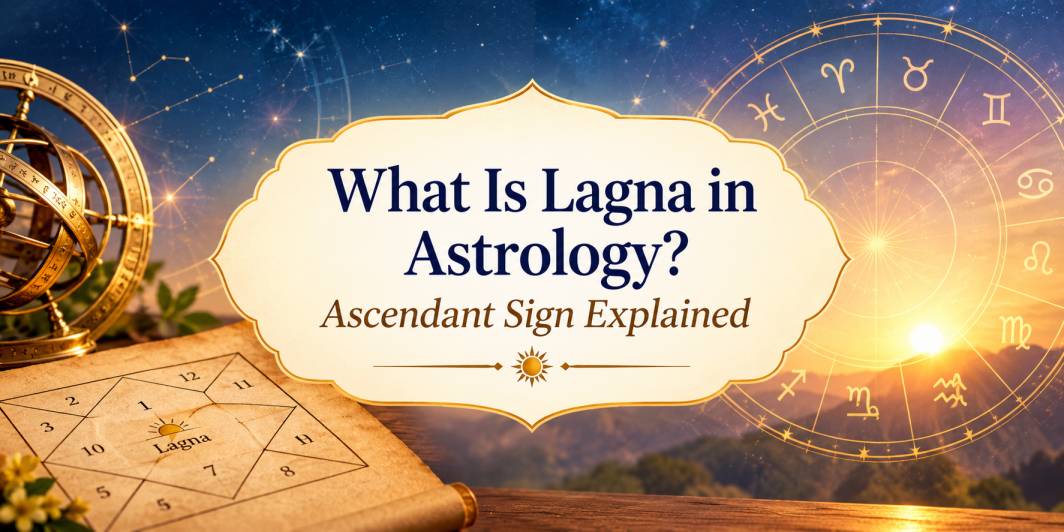
In Vedic astrology, Lagna, also called the Ascendant or rising sign, is one of the most important points in a birth chart. It is the zodiac sign rising on the eastern horizon at the exact time and place of birth. Unlike the Moon sign, which is primarily associated with the mind and emotional patterns, Lagna is traditionally used to understand the physical self, personality, approach to life and the overall structure of the Kundli.
Lagna changes approximately every two hours, although the exact duration varies according to location and season. Therefore, an accurate birth time and birthplace are important when calculating the Ascendant.
In Jyotish, the Lagna becomes the starting point for arranging the 12 houses, making it important for interpreting areas such as career, relationships, finances, health and personal development.
What Is Lagna in Astrology?
Lagna represents the zodiac sign appearing on the eastern horizon at birth. In a Vedic birth chart, this sign becomes the first house, and the remaining signs follow in order.
For example, if Aries is the Ascendant, Aries becomes the first house, Taurus the second, Gemini the third, and so on.
Traditionally, Lagna is associated with:
- Physical appearance and constitution
- General personality and behaviour
- Self-confidence and individuality
- Approach toward new experiences
- Physical vitality
- Overall direction of life
- The framework of the birth chart
The importance given to Lagna is reflected in classical Jyotish texts such as Brihat Parashara Hora Shastra, where the Ascendant and its lord are central to horoscope interpretation.
Why Is Lagna Important in Vedic Astrology?
1. Lagna Determines the Houses
The Ascendant establishes the first house of the Kundli. From this reference point, astrologers examine the remaining 11 houses.
The houses traditionally represent areas such as:
- 1st house: self, personality and physical body
- 2nd house: wealth, speech and family
- 3rd house: communication, courage and skills
- 4th house: home, comfort and mother
- 5th house: education, creativity and children
- 6th house: health challenges, service and competition
- 7th house: marriage and partnerships
- 8th house: transformation and shared resources
- 9th house: dharma, higher learning and fortune
- 10th house: career, profession and public role
- 11th house: gains, networks and aspirations
- 12th house: expenses, isolation and foreign connections
Because the house structure depends on the Ascendant, even a small change in birth time can sometimes alter important chart calculations.
2. The Lagna Lord Matters
Every zodiac sign has a ruling planet. This planet is known as the Lagna lord or Ascendant lord.
For example:
- Aries Lagna → Mars
- Taurus Lagna → Venus
- Gemini Lagna → Mercury
- Cancer Lagna → Moon
- Leo Lagna → Sun
- Virgo Lagna → Mercury
- Libra Lagna → Venus
- Scorpio Lagna → Mars
- Sagittarius Lagna → Jupiter
- Capricorn Lagna → Saturn
- Aquarius Lagna → Saturn
- Pisces Lagna → Jupiter
Astrologers traditionally examine the Lagna lord’s sign, house placement, strength and associations to understand how a person may express the qualities of their Ascendant.
3. Planets in or Aspecting the Lagna
Planets placed in the first house can become important influences in a horoscope. Traditional Jyotish also considers planetary aspects, conjunctions and dignity.
For example, a strong benefic influence on the Ascendant may traditionally be interpreted as supporting confidence, learning or social ease. A challenging planetary influence does not automatically indicate a negative life outcome; its interpretation depends on the complete chart.
This is why evaluating only one planet or one placement can give an incomplete picture.
Lagna vs Moon Sign vs Sun Sign
These three concepts are often confused.
Lagna: Traditionally connected with the physical self, personality and the way one engages with the external world.
Moon Sign (Rashi): Primarily associated with the mind, emotions, habits and subjective experiences.
Sun Sign: Traditionally connected with vitality, identity, authority and self-expression.
In Vedic astrology, astrologers commonly examine all three rather than relying on one placement alone.
How to Find Your Lagna
To calculate your Ascendant accurately, you generally need:
- Date of birth
- Exact birth time
- Birthplace
The birth time should ideally be recorded accurately because the Ascendant changes relatively quickly.
For Indian users, the calculated birth time should be interpreted using Indian Standard Time (IST) when the birth occurred in India. Historical time-zone changes and location-specific calculations may also matter for older birth records.
A Vedic Kundli calculator can provide the Ascendant, but interpretation should consider the complete birth chart rather than the Lagna alone.
Practical Insights and Traditional Remedies
Lagna itself is not something that needs to be “fixed” simply because a particular sign is present. Traditional remedies are generally considered in relation to the Lagna lord and the overall horoscope.
Simple practices that can support the qualities traditionally associated with a healthy Ascendant include:
- Maintain a consistent daily routine.
- Give adequate attention to physical fitness and sleep.
- Practice meditation or mindful breathing.
- Develop self-awareness instead of reacting impulsively.
- Follow ethical and disciplined habits.
- If using traditional Jyotish remedies, consult the complete Kundli before choosing gemstones, mantras or planetary rituals.
Remedies should be viewed as cultural or spiritual practices rather than guaranteed methods for changing outcomes.
Real-Life Importance of Lagna
The concept of Lagna can be useful as a framework for self-reflection. For example, studying the Ascendant and its lord may encourage someone to think about their communication style, personal strengths, habits and approach to challenges.
However, astrology should not replace practical decision-making in areas such as healthcare, finance, education or career planning. A balanced approach combines traditional astrological interpretation with real-world information and personal judgment.
Conclusion
Lagna in astrology, or the Ascendant, is the zodiac sign rising on the eastern horizon at the time of birth. In Vedic astrology, it establishes the first house and provides the framework for interpreting the remaining houses of the Kundli.
Understanding Lagna involves more than simply identifying the rising sign. The Lagna lord, planets influencing the first house, house placements and the broader planetary pattern all contribute to a traditional interpretation.
Rather than treating one placement as a fixed prediction, Lagna can be explored as part of a broader Jyotish framework and as a tool for understanding traditional perspectives on personality and life experiences.
FAQs
1. What is Lagna in astrology?
Lagna is the zodiac sign rising on the eastern horizon at the exact time and place of birth.
In Vedic astrology, it becomes the first house of the Kundli and determines the sequence of the remaining houses. It is traditionally associated with the physical self, personality and approach to life.
Related tips:
- Use an accurate birth time.
- Include the correct birthplace.
- Interpret Lagna with the complete Kundli.
2. Is Lagna the same as the Moon sign?
No, Lagna and Moon sign are calculated differently and traditionally represent different aspects of a horoscope.
Lagna is based on the sign rising at birth, while the Moon sign is based on the Moon’s position. Jyotish commonly considers both when analysing a person’s chart.
Helpful approach: Compare Lagna, Lagna lord and Moon sign rather than relying on only one factor.
3. Why is the Ascendant important in a Kundli?
The Ascendant is important because it establishes the first house and the overall house structure of the birth chart.
The placement of planets in relation to the Ascendant is then used to examine traditional areas such as personality, career, relationships, health and finances.
For accurate interpretation:
- Check the Ascendant degree.
- Examine the Lagna lord.
- Consider planets influencing the first house.
4. How often does Lagna change?
Lagna generally changes approximately every two hours, although the exact duration varies by geographical location and time of year.
This makes the birth time particularly important when preparing a Vedic horoscope. Even a difference of some minutes can matter when the Ascendant is close to changing signs.
Tip: Use the most reliable recorded birth time available.
5. Can Lagna change a person’s destiny?
In traditional Jyotish, Lagna is considered an important framework for interpreting the birth chart, but it should not be treated as a guarantee of specific life events.
Astrological interpretations depend on multiple factors, including planetary positions, dashas, yogas, transits and the strength of relevant houses and planets. Personal choices and real-world circumstances also influence how people experience their lives.
Balanced approach:
- Consider the complete horoscope.
- Avoid absolute predictions.
- Combine traditional interpretation with practical judgment.