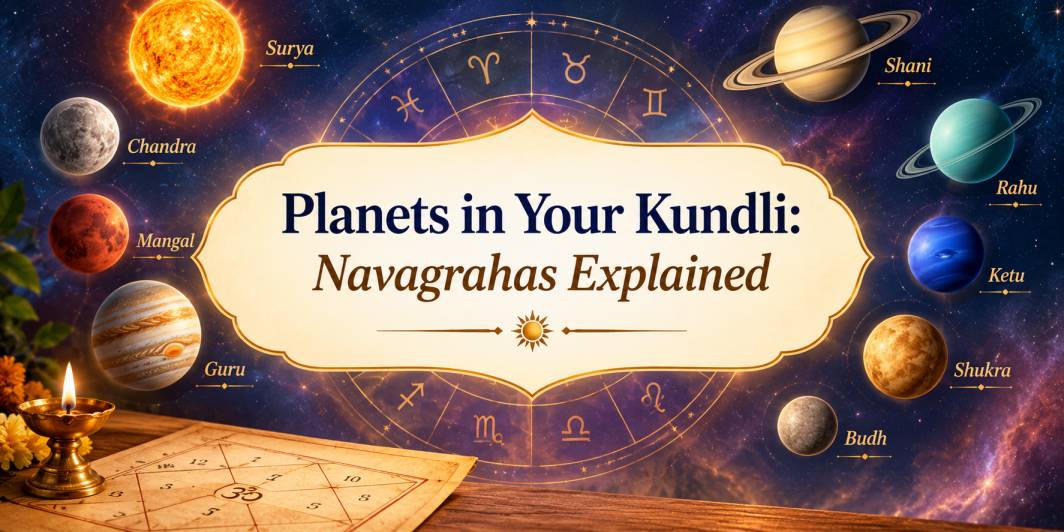
In Vedic astrology, the nine planetary influences known as the Navagrahas are central to interpreting a Kundli or birth chart. They include the Sun, Moon, Mars, Mercury, Jupiter, Venus, Saturn, Rahu and Ketu. Unlike modern astronomy, Jyotish uses the term Graha in a broader astrological sense, including the lunar nodes Rahu and Ketu.
Each Graha is traditionally associated with particular qualities, life areas and psychological themes. Their zodiac signs, houses, strength, aspects, conjunctions and planetary periods are considered together when reading a horoscope.
Understanding the planets in your Kundli can therefore provide a useful introduction to how Vedic astrology approaches personality, relationships, career, finances, learning and personal development.
What Are the Navagrahas in Vedic Astrology?
The Navagrahas are:
- Surya (Sun) – identity, vitality and authority
- Chandra (Moon) – mind, emotions and adaptability
- Mangal (Mars) – courage, energy and initiative
- Budh (Mercury) – communication, learning and analysis
- Guru (Jupiter) – wisdom, knowledge and expansion
- Shukra (Venus) – relationships, beauty and comforts
- Shani (Saturn) – discipline, responsibility and persistence
- Rahu – ambition, desire and unconventional experiences
- Ketu – detachment, introspection and spiritual themes
Classical Jyotish works, including Brihat Parashara Hora Shastra, discuss planetary nature, dignity, houses, aspects and their role in horoscope interpretation. However, traditional interpretations can vary between schools of astrology.
Sun in Kundli: Identity and Vitality
The Sun (Surya) is traditionally associated with self-expression, vitality, authority, confidence, leadership and one’s relationship with father or authority figures.
Its house and sign placement may be considered when examining areas such as career visibility, personal responsibility and recognition.
Traditional associations include:
- Leadership and authority
- Self-respect
- Physical vitality
- Government or administration
- Father and mentors
A practical way to work with Sun-related qualities is to develop consistency, responsibility and healthy self-confidence rather than seeking constant external recognition.
Moon in Kundli: Mind and Emotions
The Moon (Chandra) is strongly connected with the mind, emotional responses, habits, nurturing and adaptability in Jyotish.
Because the Moon moves relatively quickly through the zodiac, its placement is important when analysing the Moon sign (Rashi).
Moon-related themes include:
- Emotional responses
- Mental habits
- Mother and nurturing
- Memory
- Comfort and security
- Adaptability
Maintaining regular sleep, mindful routines and emotional awareness can be useful practical approaches to the qualities traditionally associated with the Moon.
Mars in Kundli: Energy and Courage
Mars (Mangal) represents energy, courage, initiative, competition and assertiveness in traditional Vedic astrology.
Mars is also associated with technical skills, physical activity and the ability to take decisive action.
When analysing Mars, astrologers may examine its house, sign, aspects and relationship with other planets. Certain combinations involving Mars are traditionally discussed under Mangal Dosha, but such interpretations should consider the entire Kundli rather than one placement alone.
Practical approach: Channel Mars energy through exercise, disciplined work and constructive competition.
Mercury in Kundli: Communication and Intelligence
Mercury (Budh) is traditionally linked with communication, reasoning, mathematics, business, learning and analytical thinking.
It can be particularly relevant when examining education, writing, trade and communication-related professions.
Useful Mercury-related habits include:
- Reading regularly
- Improving communication skills
- Checking facts before making decisions
- Developing analytical and digital skills
Jupiter in Kundli: Wisdom and Growth
Jupiter (Guru or Brihaspati) is traditionally associated with wisdom, education, teachers, philosophy, ethics, children and expansion.
Its position is often examined in relation to higher learning, guidance and financial or social growth. However, astrological symbolism should not be treated as a guarantee of wealth or success.
Traditional Jupiter-related practices may include respecting teachers, supporting education and engaging in charitable activities.
Venus in Kundli: Relationships and Comforts
Venus (Shukra) represents love, relationships, beauty, art, luxury, enjoyment and material comforts in Jyotish.
Its placement may be considered when studying partnerships, artistic interests and preferences concerning lifestyle and aesthetics.
Rather than focusing only on material results, Venus can also be understood through qualities such as appreciation, cooperation, creativity and relationship awareness.
Saturn in Kundli: Discipline and Responsibility
Saturn (Shani) is traditionally associated with discipline, patience, responsibility, labour, limitations and long-term effort.
Saturn’s influence is often interpreted through the idea that sustained effort and realistic expectations matter over time.
Traditional Shani-related practices include:
- Helping people in need
- Respecting workers and elders
- Maintaining discipline
- Fulfilling responsibilities
- Practising patience
These are practical ethical habits rather than guaranteed methods for changing planetary outcomes.
Rahu and Ketu in Kundli
Rahu and Ketu are the north and south lunar nodes. They are not physical planets, but they are treated as important Grahas in Vedic astrology.
Rahu
Rahu is traditionally associated with:
- Ambition
- Strong desires
- Unconventional paths
- Foreign connections
- Technology and new experiences
Ketu
Ketu is traditionally associated with:
- Detachment
- Introspection
- Spiritual inquiry
- Past patterns
- Reduced attachment to material outcomes
Because Rahu and Ketu always occur opposite each other in the zodiac, astrologers often interpret their axis as a contrast between areas of desire and areas of detachment.
Why Planetary Houses Matter
A planet’s meaning cannot be understood completely without considering which house it occupies.
For example, the same planet may be interpreted differently when placed in the 2nd house of speech and resources compared with the 10th house associated traditionally with career and public responsibilities.
Astrologers may also consider:
- Zodiac sign placement
- House placement
- Planetary aspects
- Conjunctions
- Planetary strength
- Nakshatra
- Dasha periods
- Yogas
This broader approach helps avoid overly simple interpretations such as calling a planet simply “good” or “bad.”
Practical Remedies for Navagrahas
Traditional Jyotish includes different remedies for planetary concerns. These can be approached as cultural and spiritual practices rather than scientifically proven methods.
Depending on the complete Kundli, traditional practices may include:
- Sun: Morning prayer or offering water to the Sun.
- Moon: Meditation, adequate rest and maintaining emotional balance.
- Mars: Physical exercise and constructive use of energy.
- Mercury: Learning, reading and improving communication.
- Jupiter: Respecting teachers and supporting education.
- Venus: Practising kindness and nurturing relationships.
- Saturn: Service, discipline and helping people in need.
- Rahu/Ketu: Meditation, self-reflection and avoiding impulsive decisions.
Gemstones and intensive rituals should not be selected solely from a Sun-sign or one planetary placement; traditional practitioners generally assess the complete horoscope first.
Conclusion
The Navagrahas in a Kundli provide a traditional framework for understanding different dimensions of life. The Sun relates to identity and vitality, the Moon to emotions and the mind, Mars to courage and action, Mercury to communication, Jupiter to wisdom, Venus to relationships and comforts, Saturn to discipline, and Rahu and Ketu to desire and detachment.
The most important point is that no planet should be interpreted in isolation. Its zodiac sign, house, aspects, conjunctions, Nakshatra and Dasha can all change the traditional interpretation.
Whether you study astrology for cultural knowledge, self-reflection or Kundli analysis, understanding the Navagrahas is a useful starting point. A complete horoscope provides much more context than any single planetary placement.
FAQs
1. What are the nine planets in Vedic astrology?
The nine Navagrahas are Sun, Moon, Mars, Mercury, Jupiter, Venus, Saturn, Rahu and Ketu.
Rahu and Ketu are lunar nodes rather than physical planets, but they have an important role in traditional Jyotish. Each Graha is associated with particular qualities and life themes.
Key points:
- Sun represents identity and vitality.
- Moon represents mind and emotions.
- Rahu and Ketu represent the lunar nodes.
2. Which planet is most important in a Kundli?
There is no single planet that should be considered universally most important because interpretation depends on the Ascendant, houses, planetary strength and the purpose of analysis.
The Lagna lord, Moon, Sun and planets connected with important houses can all become significant depending on the horoscope.
For a broader reading, examine:
- Lagna and Lagna lord
- Moon sign
- House placements
- Planetary periods and aspects
3. What does Mars in a Kundli mean?
Mars is traditionally associated with courage, physical energy, initiative, competition and assertiveness.
Its interpretation depends on the sign, house and other planetary influences. Mars is also involved in traditional discussions of Mangal Dosha.
Practical approach:
- Exercise regularly.
- Channel competitiveness constructively.
- Avoid impulsive reactions.
4. What do Rahu and Ketu represent?
Rahu and Ketu are the lunar nodes and are traditionally associated with desire, unconventional experiences, detachment and introspection.
Rahu is generally associated with worldly ambition and unusual paths, while Ketu is associated with detachment and inward exploration. Their opposite positions form an important axis in a Kundli.
Helpful habits:
- Avoid impulsive decisions.
- Practise self-reflection.
- Maintain realistic expectations.
5. Can planetary remedies change the results of a Kundli?
Traditional astrology considers remedies supportive practices, but they should not be treated as guaranteed methods for changing life outcomes.
Remedies can include prayer, charity, discipline, meditation and other culturally established practices. Their selection traditionally depends on the complete horoscope rather than one isolated planetary placement.
Before choosing a remedy:
- Examine the complete Kundli.
- Understand the traditional reasoning behind it.
- Avoid making major life decisions based only on astrological advice.