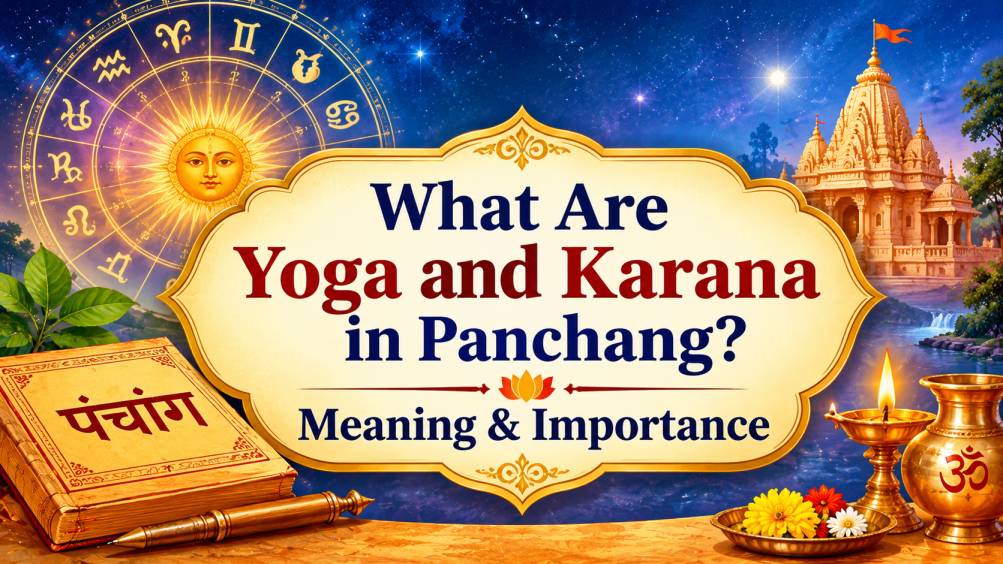
In Vedic astrology, the Panchang is an important traditional calendar used to understand daily planetary and lunar influences. It consists of five essential elements: Tithi, Vara, Nakshatra, Yoga and Karana. Among these, Yoga and Karana help determine the quality and suitability of a particular time for religious ceremonies, travel, business activities and other important events.
While Tithi represents the angular relationship between the Sun and Moon, Yoga and Karana are calculated using specific astronomical positions of these celestial bodies. Understanding Yoga and Karana in Panchang provides deeper insight into Muhurat selection and traditional Hindu timekeeping. These elements are also useful for understanding how daily Panchang calculations influence religious and cultural practices.
What Is Yoga in Panchang?
Yoga is the fourth element of the Hindu Panchang. It is calculated by adding the celestial longitudes of the Sun and Moon and dividing the resulting value into 27 equal parts.
Each Yoga covers 13 degrees and 20 minutes (13°20′) of the zodiac.
In traditional Vedic astrology, Yoga is associated with the general quality of a particular period. Some Yogas are considered favourable for auspicious activities, while others are approached with greater caution.
How Is Yoga Calculated?
The formula for calculating Yoga is:
Yoga = Longitude of the Sun + Longitude of the Moon
The combined longitude is divided into 27 equal segments of 13°20′ each.
For example, if the combined longitude falls within the first 13°20′ segment, the Yoga is Vishkambha. The next segment corresponds to Priti Yoga.
Unlike planetary aspects or combinations in a birth chart, Panchang Yoga is a daily astronomical calculation that changes as the Sun and Moon move.
27 Types of Yoga in Panchang
According to traditional Hindu astrology, there are 27 Nitya Yogas.
They are:
- Vishkambha
- Priti
- Ayushman
- Saubhagya
- Shobhana
- Atiganda
- Sukarma
- Dhriti
- Shoola
- Ganda
- Vriddhi
- Dhruva
- Vyaghata
- Harshana
- Vajra
- Siddhi
- Vyatipata
- Variyana
- Parigha
- Shiva
- Siddha
- Sadhya
- Shubha
- Shukla
- Brahma
- Indra
- Vaidhriti
Auspicious and Challenging Yogas
Traditional Panchang interpretations classify certain Yogas according to their general suitability for activities.
Generally favourable Yogas include:
- Siddhi Yoga: Associated with accomplishment and successful efforts.
- Shubha Yoga: Traditionally linked with auspicious beginnings.
- Saubhagya Yoga: Associated with prosperity and good fortune.
- Dhruva Yoga: Considered suitable for stable and long-term activities.
- Brahma Yoga: Traditionally associated with learning and spiritual pursuits.
Yogas traditionally approached with caution include:
- Atiganda
- Shoola
- Ganda
- Vyaghata
- Vyatipata
- Vaidhriti
These classifications belong to traditional Muhurat astrology. They should not be interpreted as guarantees of success or failure.
What Is Karana in Panchang?
Karana is the fifth element of the Panchang. It represents half of a Tithi and is calculated using the angular distance between the Sun and Moon.
One Tithi covers 12 degrees of angular separation between the Sun and Moon. Therefore, one Karana covers 6 degrees.
There are 11 types of Karana in traditional Hindu astrology. Since each lunar month contains 30 Tithis, there are 60 Karana periods in a lunar month.
Karana is particularly useful in Muhurat calculations because it provides another layer of information about the suitability of a specific time.
Types of Karana in Vedic Astrology
The 11 Karanas are divided into two categories: movable and fixed.
1. Seven Movable Karanas
These Karanas repeat throughout the lunar month.
- Bava: Traditionally associated with constructive activities.
- Balava: Considered suitable for religious and auspicious activities.
- Kaulava: Associated with social interaction and relationships.
- Taitila: Traditionally linked with practical and productive activities.
- Garaja: Associated with stability and organised work.
- Vanija: Traditionally considered favourable for trade and business.
- Vishti (Bhadra): Generally avoided for many auspicious ceremonies.
2. Four Fixed Karanas
These occur at specific points in the lunar cycle.
- Shakuni: Associated with strategic and thoughtful activities.
- Chatushpada: Traditionally connected with animal-related and certain practical activities.
- Naga: Symbolically associated with transformation and challenging circumstances.
- Kimstughna: Considered significant in traditional Panchang calculations and auspicious beginnings.
Difference Between Yoga and Karana in Panchang
Although both are important Panchang elements, they are calculated differently.
| Feature | Yoga | Karana |
| Calculation | Sun’s longitude + Moon’s longitude | Angular separation between Sun and Moon |
| Number of types | 27 | 11 |
| Division | 13°20′ | 6° |
| Main use | Assessing the general quality of a period | Refining Muhurat selection |
| Panchang position | Fourth element | Fifth element |
Both elements are used alongside Tithi, Vara and Nakshatra to evaluate auspicious timings.
Importance of Yoga and Karana in Daily Life
Yoga and Karana have practical relevance in traditional Hindu astrology, particularly when selecting a Muhurat.
1. Marriage and Religious Ceremonies
Astrologers examine Yoga and Karana along with Tithi and Nakshatra when selecting wedding dates, Griha Pravesh and other religious ceremonies.
2. Business and Financial Activities
Certain Karanas, particularly Vanija, are traditionally associated with trade and commercial activities. Their suitability is considered alongside other Muhurat factors.
3. Education and Spiritual Activities
Favourable Yogas such as Siddhi, Shubha and Brahma are traditionally preferred for learning, religious observances and important beginnings.
4. Travel and Important Decisions
Panchang elements may be considered when planning journeys, starting new projects or organising important events.
However, no single Yoga or Karana determines the outcome of an activity. The complete Panchang and individual circumstances should be considered.
Practical Astrological Remedies and Guidance
In traditional astrology, remedies are generally suggested according to the nature of the activity and the Panchang combination.
Some practical approaches include:
- Worship Lord Ganesha before beginning important work.
- Chant the Gayatri Mantra or perform meditation for mental clarity.
- Offer prayers to Lord Vishnu on traditionally favourable days.
- Donate food or essential supplies as an act of charity.
- Avoid making important decisions solely on the basis of one unfavourable Panchang element.
These practices support discipline and spiritual awareness rather than guaranteeing specific results.
Conclusion
Yoga and Karana are essential elements of the Hindu Panchang that help explain the traditional interpretation of time. While Yoga is calculated by adding the longitudes of the Sun and Moon, Karana represents half of a lunar Tithi. Both are important in Muhurat selection, religious ceremonies, business activities and everyday planning.
Understanding their 27 Yoga types and 11 Karana types allows individuals to interpret Panchang information more accurately. However, their significance should always be considered alongside Tithi, Nakshatra, Vara and other relevant factors. Learning these concepts can make the study of Vedic astrology more systematic, practical and meaningful.
Frequently Asked Questions (FAQs)
1. What are Yoga and Karana in Panchang?
Yoga and Karana are the fourth and fifth elements of the Hindu Panchang, respectively.
Yoga is calculated using the combined longitudes of the Sun and Moon, whereas Karana is based on half the angular distance of a Tithi. Both are used in traditional Muhurat calculations.
Remember:
- Yoga has 27 types.
- Karana has 11 types.
- Both help assess traditional auspicious timings.
2. How many types of Yoga are there in Panchang?
There are 27 Nitya Yogas in the Hindu Panchang.
Each Yoga occupies 13°20′ of the combined longitude of the Sun and Moon. Siddhi, Shubha, Saubhagya and Dhruva are examples of traditionally favourable Yogas.
For practical use, check the Yoga’s beginning and ending time in your local Panchang.
3. How many types of Karana are there?
There are 11 types of Karana, divided into seven movable and four fixed Karanas.
The movable Karanas repeat during the lunar month, while the fixed Karanas occur at specific positions in the lunar cycle.
Useful information:
- Vanija is associated with commercial activities.
- Bava and Balava are traditionally considered favourable.
- Vishti Karana is commonly known as Bhadra.
4. Which Yoga is considered auspicious in Panchang?
Siddhi, Shubha, Saubhagya, Dhruva and Brahma are traditionally regarded as favourable Yogas.
Their suitability depends on the nature of the activity and other Panchang factors. An auspicious Yoga alone does not guarantee a successful outcome.
Tip: Consider Tithi, Nakshatra, Vara and Karana before selecting a Muhurat.
5. What is Vishti Karana or Bhadra?
Vishti Karana, commonly called Bhadra, is one of the seven movable Karanas and is traditionally avoided for many auspicious ceremonies.
However, it is not considered unsuitable for every activity. Traditional Muhurat rules distinguish between different types of work.
Guidance: Check the Bhadra period and consult a knowledgeable astrologer before scheduling major ceremonies.
6. What is the difference between Tithi and Karana?
Tithi represents a 12-degree angular separation between the Sun and Moon, while Karana represents half of that interval, or 6 degrees.
Consequently, two Karana periods generally occur during one Tithi.
Remember:
- Tithi has 30 divisions in a lunar month.
- Karana has 60 periods in a lunar month.
- Both are important in Panchang calculations.
7. Why are Yoga and Karana important for Muhurat?
Yoga and Karana help astrologers assess the traditional suitability of a particular time for important activities.
They are examined alongside other Panchang elements when choosing dates for marriage, Griha Pravesh, business beginnings and religious ceremonies.
Practical advice: Always consult a complete local Panchang instead of relying on Yoga or Karana alone.
8. Do Yoga and Karana change every day?
Yes, Yoga and Karana change according to the changing positions of the Sun and Moon.
A particular Yoga or Karana may begin or end at any time of the day, not necessarily at sunrise or midnight.
For accurate daily information:
- Check the local Panchang.
- Note the beginning and ending times.
- Remember that all timings should be interpreted in the local time zone.