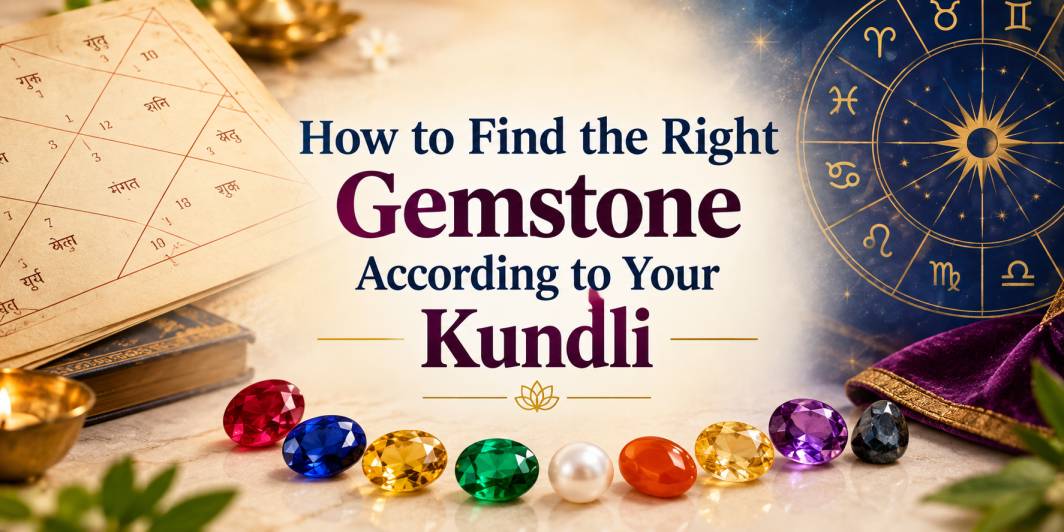
Gemstones have an important place in traditional Vedic astrology (Jyotish). In this tradition, certain natural stones are associated with specific planets, and wearing a gemstone is believed to support the qualities represented by a planet when that planet is suitable for the individual’s birth chart.
However, choosing a gemstone should not be based only on your zodiac sign or a general online list. A suitable gemstone is traditionally selected after examining the Kundli, Lagna (Ascendant), planetary placement, house ownership, dignity, aspects and dasha periods.
For example, a gemstone associated with the Sun may be traditionally considered in one Kundli but unsuitable in another. Therefore, understanding the relationship between the planet and the complete birth chart is important before deciding which gemstone to wear.
Why Your Kundli Matters for Gemstone Selection
In Jyotish, gemstones are traditionally connected with the Navagrahas, or nine planetary influences. Each gemstone is associated with a particular planet.
The commonly used associations include:
| Planet | Traditional Gemstone |
| Sun (Surya) | Ruby |
| Moon (Chandra) | Pearl |
| Mars (Mangal) | Red Coral |
| Mercury (Budh) | Emerald |
| Jupiter (Guru) | Yellow Sapphire |
| Venus (Shukra) | Diamond |
| Saturn (Shani) | Blue Sapphire |
| Rahu | Hessonite (Gomed) |
| Ketu | Cat’s Eye (Lehsunia) |
These associations come from traditional Jyotish practices. They should be understood as astrological beliefs rather than scientifically established effects.
How to Find the Right Gemstone According to Your Kundli
1. Identify Your Ascendant or Lagna
The first step is finding your Lagna using your exact date, time and place of birth.
Lagna determines the twelve houses of your birth chart and helps an astrologer assess which planets are considered functionally supportive or challenging for that particular chart.
This is one reason why simply choosing a gemstone according to your Sun sign or Moon sign may not provide a complete answer.
2. Examine the Planet Connected With the Gemstone
Once the chart is prepared, examine the planet you are considering strengthening.
An astrologer traditionally evaluates:
- Which houses the planet rules
- Where the planet is placed
- Its sign and dignity
- Beneficial or challenging aspects
- Conjunctions with other planets
- Its position from the Lagna and Moon
- Current Mahadasha and Antardasha
A gemstone associated with a planet is generally considered more appropriate when that planet has a supportive role in the individual’s chart.
3. Consider Planetary Strength
Planetary strength is another important factor.
A planet may be strong because of its sign placement, house position or other traditional Jyotish conditions. In other situations, a planet may be weak but still not be suitable to strengthen.
This distinction matters because “weak planet” does not automatically mean “wear its gemstone.”
The overall role of the planet in the Kundli should be assessed first.
Gemstones and the Nine Planets
Ruby for the Sun
Ruby (Manikya) is traditionally associated with the Sun. In Jyotish, the Sun represents authority, confidence, vitality, leadership and self-expression.
Ruby is traditionally considered when strengthening the Sun is judged appropriate in a particular Kundli.
Pearl for the Moon
Pearl (Moti) is associated with the Moon, traditionally connected with emotions, mental tendencies, nurturing qualities and sensitivity.
Its suitability depends on the Moon’s role and condition in the individual birth chart.
Red Coral for Mars
Red Coral (Moonga) is associated with Mars, which represents energy, courage, initiative and physical drive in traditional Jyotish.
It should be considered according to Mars’s house ownership and overall chart role rather than simply based on the person’s zodiac sign.
Emerald for Mercury
Emerald (Panna) is traditionally associated with Mercury, representing communication, learning, reasoning, calculation and analytical abilities.
Its suitability is evaluated by examining Mercury’s position, house ownership and relationship with other planets.
Yellow Sapphire for Jupiter
Yellow Sapphire (Pukhraj) is associated with Jupiter, traditionally representing wisdom, education, guidance, prosperity and expansion.
Jupiter’s functional role in the Kundli should be checked before considering this gemstone.
Diamond for Venus
Diamond (Heera) is traditionally connected with Venus, which represents relationships, beauty, comforts, artistic interests and material refinement.
The suitability of Venus-related gemstones depends on the individual horoscope.
Blue Sapphire for Saturn
Blue Sapphire (Neelam) is associated with Saturn. It is traditionally regarded as a powerful gemstone and is therefore often approached more cautiously in Jyotish practice.
Its suitability should be assessed from the complete Kundli rather than through a generic zodiac-sign recommendation.
Hessonite and Cat’s Eye
Hessonite (Gomed) is associated with Rahu, while Cat’s Eye (Lehsunia) is associated with Ketu.
Because Rahu and Ketu are shadow planets in Jyotish and their effects are interpreted differently from the visible planets, these gemstones are traditionally selected only after careful chart analysis.
Should You Choose a Gemstone by Zodiac Sign?
A zodiac-sign gemstone list can be useful for general information, but it is not the same as a personalized Kundli recommendation.
For example, two people born under the same Sun sign can have different Ascendants, Moon signs, planetary placements and dashas.
Therefore, a personalized gemstone assessment generally considers:
- Birth date
- Exact birth time
- Birthplace
- Lagna
- Moon sign
- Planetary positions
- House ownership
- Current dasha
- Relevant yogas and planetary relationships
How to Choose a Good Quality Gemstone
After identifying the traditionally suitable gemstone, quality is another consideration.
Look for:
- Natural or properly disclosed origin
- Appropriate clarity and transparency
- Minimal or clearly disclosed treatments
- Reliable certification
- Correct gemstone weight
- Properly fitted jewellery
Certification is particularly useful when purchasing expensive gemstones because visual appearance alone cannot reliably establish authenticity or treatment.
Traditional Ways of Wearing Gemstones
Traditional Jyotish practices may prescribe a particular metal, finger, day and time for wearing a gemstone. These recommendations vary according to the planet and the practitioner’s tradition.
For example, some practitioners associate gemstones with specific planetary days and mantras.
If a specific wearing time is recommended, it should be stated in IST (Indian Standard Time) for an Indian location and should account for the actual sunrise and local Panchang calculations.
Rather than treating a fixed internet schedule as universal, use the local Panchang or a qualified practitioner for an exact Muhurat.
Practical Precautions Before Wearing a Gemstone
Gemstones should not replace medical treatment, financial planning, professional advice or other practical measures.
Before purchasing an expensive stone:
- Confirm the birth details used for the Kundli.
- Check the gemstone’s planetary association.
- Understand why that planet is being strengthened.
- Compare recommendations with the complete chart.
- Verify the stone’s authenticity and treatment.
- Avoid purchasing based solely on fear-based claims.
Conclusion
Finding the right gemstone according to your Kundli involves more than matching a stone with your zodiac sign. Traditional Vedic astrology considers the Lagna, planetary house ownership, strength, placement, aspects, yogas and dasha periods before recommending a planetary gemstone.
Ruby, Pearl, Red Coral, Emerald, Yellow Sapphire, Diamond, Blue Sapphire, Hessonite and Cat’s Eye are traditionally associated with the nine planetary influences, but their suitability varies from one birth chart to another.
A thoughtful approach is to first understand the astrological reasoning behind a recommendation and then consider gemstone quality, authenticity and practical affordability. Whether or not you choose to follow gemstone traditions, using the Kundli as a framework for self-reflection can encourage greater awareness of personal patterns, priorities and decisions.
FAQs
1. How do I find the right gemstone according to my Kundli?
The right gemstone is traditionally selected by examining your Lagna, planetary positions, house ownership, planetary strength and current dasha rather than relying only on your zodiac sign.
A gemstone is generally associated with a particular planet, and Jyotish practitioners assess whether strengthening that planet is appropriate for the individual chart.
Useful tips:
- Use accurate birth details.
- Check the complete Kundli.
- Understand the planet associated with the gemstone.
- Avoid choosing expensive stones solely from generic zodiac lists.
2. Can I choose a gemstone based only on my zodiac sign?
A zodiac-sign gemstone can provide general information, but a personalized Kundli analysis is traditionally considered more appropriate for gemstone selection.
Two people with the same zodiac sign can have different Ascendants, planetary placements and dashas, which can lead to different traditional gemstone recommendations.
Remember:
- Zodiac sign = general guidance.
- Kundli = more individualized analysis.
- Lagna and planetary house ownership are particularly important.
3. Which gemstone is associated with each planet?
In traditional Jyotish, Ruby is associated with the Sun, Pearl with the Moon, Red Coral with Mars, Emerald with Mercury, Yellow Sapphire with Jupiter, Diamond with Venus, Blue Sapphire with Saturn, Hessonite with Rahu and Cat’s Eye with Ketu.
These associations are part of traditional astrological practice and are not scientifically established planetary effects.
Quick reference:
- Sun → Ruby
- Moon → Pearl
- Mars → Red Coral
- Mercury → Emerald
- Jupiter → Yellow Sapphire
- Venus → Diamond
- Saturn → Blue Sapphire
- Rahu → Hessonite
- Ketu → Cat’s Eye
4. Is Blue Sapphire suitable for everyone?
No, traditional Jyotish does not recommend Blue Sapphire universally because its suitability is assessed from Saturn’s role and condition in the individual Kundli.
An astrologer may examine Saturn’s house ownership, placement, strength, aspects and relationship with other planets before making a recommendation.
Before wearing it:
- Check Saturn’s complete chart position.
- Consider the current dasha.
- Avoid fear-based gemstone claims.
- Verify the stone’s authenticity before purchasing.
5. Can gemstones change your destiny?
In traditional Jyotish, gemstones are sometimes believed to strengthen or channel a planet’s influence, but they should not be treated as guaranteed methods for changing life outcomes.
Practical actions, personal choices and real-world circumstances remain important regardless of whether someone follows gemstone traditions.
A balanced approach:
- Treat gemstones as an optional spiritual practice.
- Do not replace professional advice with astrology.
- Combine reflection with practical action.
- Choose gemstones within a sensible budget.