In Vedic astrology, the Nakshatra or lunar mansion occupied by the Moon at the time of birth is an important part of a birth chart. There are 27 Nakshatras, and each covers 13°20′ of the zodiac. Your birth Nakshatra, often called Janma Nakshatra, is determined mainly by your date of birth, exact birth time, and place of birth.
Unlike simply knowing your Sun sign or Rashi, finding your Nakshatra can provide a more detailed view of traditional Jyotish interpretations. It is commonly considered when studying personality tendencies, emotional patterns, Dashas, compatibility, Muhurat, and other aspects of a Kundli.
Because the Moon moves relatively quickly through the zodiac, even a difference of a few hours can sometimes change the Nakshatra or its Pada. Therefore, accurate birth information is important.
What Is a Nakshatra in Vedic Astrology?
Nakshatras are 27 divisions of the zodiac used in Jyotish Shastra. Each Nakshatra spans 13°20′ and is further divided into four Padas, each measuring 3°20′.
The Nakshatra is determined by the Moon’s sidereal position at birth.
Some commonly known Nakshatras include:
- Ashwini
- Bharani
- Krittika
- Rohini
- Mrigashira
- Ardra
- Pushya
- Magha
- Hasta
- Swati
- Anuradha
- Shatabhisha
- Revati
Each Nakshatra has a ruling planet, traditional symbolism, deity association, and four Padas.
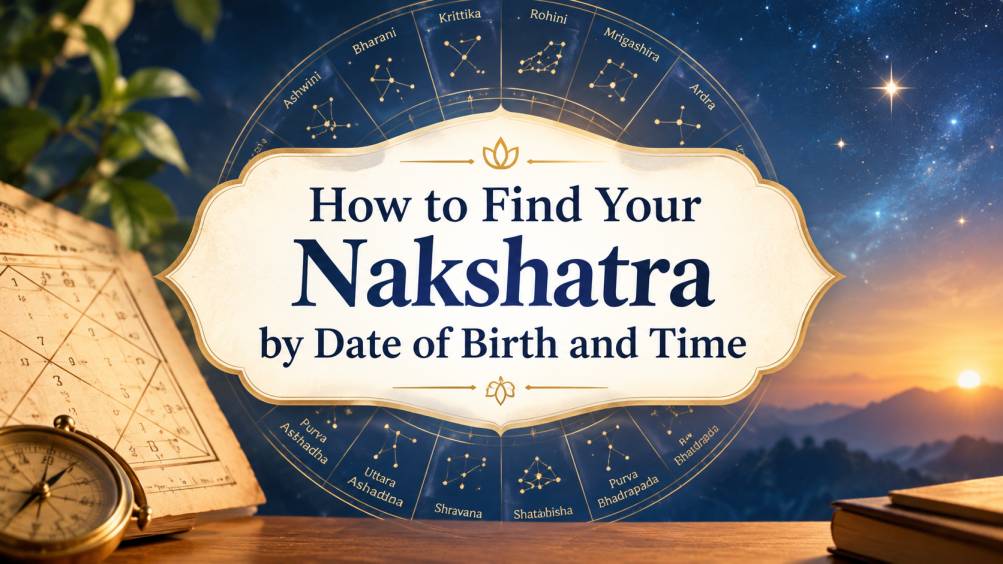
How to Find Your Nakshatra by Date of Birth and Time
Step 1: Note Your Date of Birth
Start with your complete date of birth, including the day, month, and year.
For example:
15 August 1995
The date alone, however, may not always be sufficient because the Moon can move from one Nakshatra to another within a day.
Step 2: Enter Your Exact Birth Time
Your birth time is particularly important.
For example:
10:30 AM IST
When calculating a Kundli in India, the time should be interpreted according to Indian Standard Time (IST). If the recorded birth time is approximate, the resulting Nakshatra may need additional verification.
Step 3: Add Your Birthplace
A reliable Nakshatra calculation also requires your birthplace because geographical coordinates are used to calculate the Moon’s astronomical position.
You generally need:
- Date of birth
- Exact birth time
- City and country of birth
A Jyotish calculator or Kundli software can then calculate the Moon’s sidereal longitude and identify the corresponding Nakshatra.
Step 4: Check the Nakshatra and Pada
Once the Moon’s position is calculated, you will generally see both your Nakshatra and Pada.
For example, a result may show:
Nakshatra: Rohini
Pada: 2
The Pada provides a further division of the Nakshatra and is traditionally used for more detailed interpretation.
Why Is Birth Time So Important?
The Moon changes its zodiac position much faster than the Sun. As a result, two people born on the same date can sometimes have different Nakshatras if they were born several hours apart.
This is particularly important when the Moon is close to a Nakshatra boundary.
If you do not know your exact birth time, you can still calculate an approximate Nakshatra, but the result should be treated cautiously when the Moon was near a transition point.
Nakshatra and Its Ruling Planet
Every Nakshatra is traditionally associated with one of the nine Navagraha planets. These planetary rulers repeat in a specific sequence across the 27 Nakshatras.
For example:
- Ashwini — Ketu
- Bharani — Venus
- Krittika — Sun
- Rohini — Moon
- Mrigashira — Mars
- Ardra — Rahu
- Punarvasu — Jupiter
- Pushya — Saturn
- Ashlesha — Mercury
The Nakshatra lord is particularly relevant in traditional Vimshottari Dasha calculations.
What Can Your Nakshatra Tell You?
In traditional Jyotish, the Janma Nakshatra is used as one component of a broader birth-chart analysis.
Personality and Emotional Tendencies
Since the Moon represents the mind and emotional nature in Vedic astrology, the Moon’s Nakshatra is traditionally associated with emotional responses, habits, preferences, and mental tendencies.
Career and Life Themes
Nakshatra analysis may be considered alongside the 10th house, its lord, planetary placements, and Dashas when examining career-related themes. A Nakshatra by itself should not be treated as a complete career prediction.
Marriage and Compatibility
Traditional matchmaking systems often compare the Nakshatras of two individuals through methods such as Ashtakoota or Guna Milan. However, compatibility assessment generally involves more than simply matching Nakshatras.
Timing Through Dashas
Your birth Nakshatra plays an important role in determining the starting point of the Vimshottari Dasha system. The Moon’s Nakshatra at birth helps determine which planetary period begins first.
Practical Ways to Use Your Nakshatra
Knowing your Nakshatra can be useful for exploring traditional Jyotish concepts without treating astrology as a substitute for practical decision-making.
You can use it to:
- Understand traditional Moon-based personality interpretations.
- Learn about your Nakshatra’s deity and symbolism.
- Study its four Padas.
- Explore its planetary ruler.
- Understand how Nakshatra is used in Vimshottari Dasha.
- Learn how Nakshatras are considered in Muhurat and traditional rituals.
Traditional Remedies
Remedies should be understood as cultural and spiritual practices rather than guaranteed solutions.
Depending on the Nakshatra and its ruling planet, traditional practices may include:
- Meditation or prayer on the associated weekday.
- Reciting a relevant mantra with proper guidance.
- Practising charity or seva.
- Maintaining disciplined daily habits.
- Observing personal reflection and mindfulness.
If a remedy involves gemstones, fasting, or significant religious practices, it is sensible to seek guidance from a qualified practitioner rather than choosing one solely from your Nakshatra.
Conclusion
Finding your Nakshatra by date of birth and time is an important starting point for understanding the Moon’s role in Vedic astrology. For a more accurate calculation, use your date, exact birth time, and birthplace rather than relying on the date alone.
Your Janma Nakshatra can then be studied alongside its Pada, ruling planet, Moon sign, houses, Dashas, and other Kundli factors. This broader approach provides more context than interpreting a single Nakshatra in isolation.
Astrology can also be approached as a traditional framework for self-reflection and cultural understanding. If you know your birth details, calculating your Nakshatra is a simple first step toward exploring your complete Kundli.
FAQs
1. How can I find my Nakshatra from my date of birth?
Your Nakshatra can be calculated using your date, exact birth time, and birthplace to determine the Moon’s sidereal position.
The Moon’s position at the moment of birth determines the Janma Nakshatra in traditional Vedic astrology. A reliable Kundli calculator can perform this astronomical calculation.
Helpful tips:
- Use the correct date and year.
- Enter your exact birth time.
- Include your birthplace.
- Check both Nakshatra and Pada.
2. Can two people born on the same date have different Nakshatras?
Yes, two people born on the same date can have different Nakshatras because the Moon moves continuously through the zodiac.
If their birth times are sufficiently different, particularly around a Nakshatra transition, the Moon may occupy different lunar mansions.
For better accuracy:
- Compare exact birth times.
- Check the Moon’s degree.
- Pay special attention to Nakshatra boundary periods.
3. What is Janma Nakshatra?
Janma Nakshatra is the Nakshatra occupied by the Moon at the time of a person’s birth.
It is traditionally considered an important component of a Vedic birth chart. It is used in areas such as Dasha calculations, Muhurat, and certain forms of compatibility analysis.
Related concepts:
- Moon sign or Rashi
- Nakshatra Pada
- Nakshatra lord
- Vimshottari Dasha
4. Does birth time affect Nakshatra?
Yes, birth time can affect the calculated Nakshatra, especially when the Moon is close to the boundary between two Nakshatras.
A small difference may not always change the result, but when the Moon is near a transition point, accurate timing becomes more important.
If your birth time is uncertain:
- Check official birth records if available.
- Compare multiple reliable Kundli calculations.
- Consult a qualified Jyotish practitioner for birth-time rectification if appropriate.
5. What is the difference between Nakshatra and Rashi?
Nakshatra divides the zodiac into 27 lunar mansions, while Rashi divides it into 12 zodiac signs.
Both are based on the Moon’s position in a Vedic astrology chart, but they provide different levels of traditional interpretation. Nakshatra also has four Padas, allowing for a more granular classification.
Remember:
- Rashi = 12 zodiac signs.
- Nakshatra = 27 lunar divisions.
- Pada = 4 subdivisions within each Nakshatra.
6. Is Nakshatra enough to predict my future?
Nakshatra alone is not traditionally considered sufficient for a complete Kundli interpretation.
A broader Jyotish analysis may consider the Ascendant, planetary positions, houses, aspects, Dashas, Yogas, Moon sign, and other chart factors. Therefore, reading only a Nakshatra-based description can provide limited context.
For a broader analysis, consider:
- Lagna
- Moon sign
- Planetary placements
- Houses
- Dashas and transits