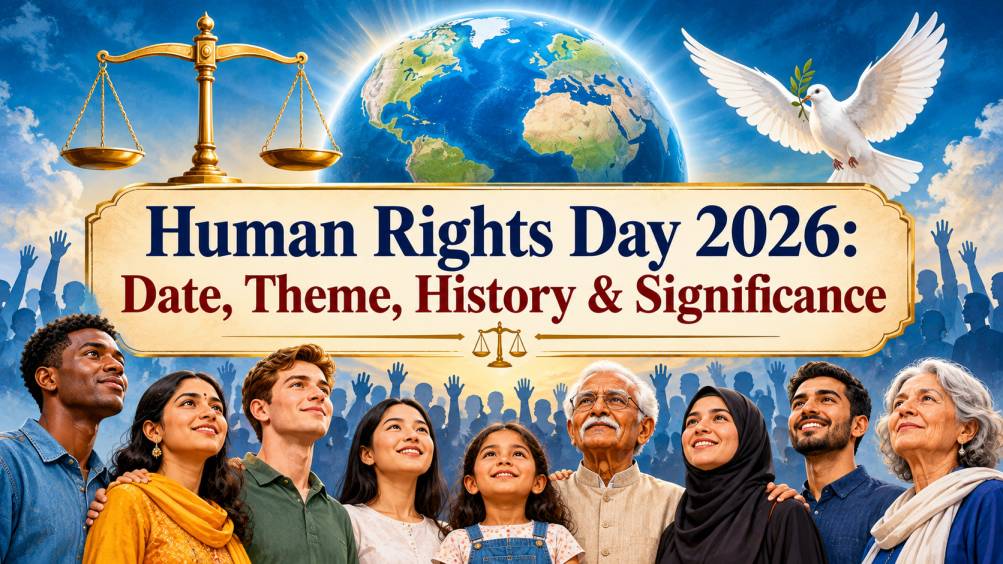
Human Rights Day is observed every year on December 10 to promote equality, freedom, justice, and dignity for every human being. It commemorates the adoption of the Universal Declaration of Human Rights (UDHR) by the United Nations General Assembly in 1948. The day reminds governments, institutions, and individuals that fundamental rights belong to everyone, irrespective of religion, caste, gender, nationality, language, or economic background.
Human Rights Day 2026 provides an opportunity to reflect on issues such as discrimination, gender equality, freedom of expression, access to education, and social justice. In India, the occasion also highlights the importance of constitutional rights and the responsibility to build a society where every individual can live with dignity and security.
Human Rights Day 2026: Date and Day
Human Rights Day 2026 will be observed on Thursday, December 10, 2026.
The occasion is celebrated internationally on the same date every year, marking the anniversary of the adoption of the Universal Declaration of Human Rights in 1948. It is observed through educational programmes, awareness campaigns, public discussions, institutional activities, and initiatives promoting equality and justice.
- Day: Thursday
- Date: December 10, 2026
- Occasion: International Human Rights Day
- Observed by: United Nations member states and organisations worldwide
The observance is global, and there is no single mandatory celebration time. Activities may take place throughout the day according to local schedules in Indian Standard Time (IST).
Human Rights Day 2026 Theme
The official United Nations theme for Human Rights Day 2026 is “Making Humanity Together.”
Its accompanying message is:
“Human rights are our shared story. Our shared power. Our shared future.”
The 2026 campaign encourages people across the world to share real-life stories demonstrating how human rights are protected and promoted through everyday actions.
The theme highlights three important ideas:
- Shared humanity: Every individual deserves dignity, equality, and respect.
- Collective responsibility: Protecting human rights is a responsibility shared by governments, communities, organisations, and individuals.
- A better future: Cooperation and solidarity can help create societies based on fairness, inclusion, and justice.
The campaign also looks towards the 80th anniversary of the Universal Declaration of Human Rights in 2028.
History of Human Rights Day
The history of Human Rights Day is closely connected with the events of the Second World War (1939–1945).
The widespread violence, discrimination, persecution, and loss of life during the war demonstrated the need for international standards to protect human dignity.
After the establishment of the United Nations in 1945, member countries began working towards a common framework for fundamental human rights.
Adoption of the Universal Declaration of Human Rights
On December 10, 1948, the United Nations General Assembly adopted the Universal Declaration of Human Rights in Paris through Resolution 217 A (III).
The declaration established 30 articles outlining fundamental rights and freedoms applicable to every human being.
Establishment of Human Rights Day
In 1950, the United Nations General Assembly adopted Resolution 423 (V), inviting countries and organisations to observe December 10 as Human Rights Day.
Since then, the occasion has become an important international platform for promoting human rights awareness, equality, and social justice.
What Are the Fundamental Human Rights?
Human rights are basic freedoms and protections that every person possesses simply because they are human.
The Universal Declaration of Human Rights covers several important areas.
1. Right to Equality
Every individual is entitled to equal dignity and protection under the law, without discrimination based on religion, caste, gender, race, or nationality.
2. Right to Life and Personal Freedom
Every person has the right to life, liberty, and personal security. No individual should face arbitrary detention, violence, or unlawful restrictions.
3. Right to Education
Education is essential for individual development and social progress. Every child should have access to educational opportunities without discrimination.
4. Freedom of Expression
People should be able to express their opinions, exchange ideas, and access information, subject to lawful restrictions that protect the rights of others.
5. Right to Work and Fair Treatment
Individuals should have access to fair working conditions, equal pay for equal work, and protection against exploitation.
6. Freedom of Religion and Belief
Every person should have the freedom to follow, practise, or change their religion or belief, in accordance with applicable laws.
Importance of Human Rights Day in India
Human Rights Day has particular relevance in India because of the country’s constitutional commitment to equality, liberty, justice, and dignity.
The Constitution of India provides several Fundamental Rights under Part III.
Some important constitutional provisions include:
- Article 14: Equality before the law.
- Article 15: Prohibition of discrimination on specified grounds.
- Article 17: Abolition of untouchability.
- Article 19: Protection of specified freedoms, including freedom of speech and expression.
- Article 21: Protection of life and personal liberty.
- Article 21A: Right to education for children aged 6–14 years.
- Article 25: Freedom of conscience and religion.
India also established the National Human Rights Commission (NHRC) on October 12, 1993, under the Protection of Human Rights Act, 1993.
The commission works towards protecting and promoting rights relating to life, liberty, equality, and individual dignity.
Human Rights Day encourages citizens to understand these constitutional protections and recognise the importance of responsible participation in society.
How Is Human Rights Day Celebrated?
Human Rights Day is observed through educational, cultural, and awareness activities across different countries.
Common activities include:
- Organising seminars, debates, and public discussions.
- Conducting human rights awareness programmes in schools and colleges.
- Promoting gender equality and anti-discrimination campaigns.
- Supporting organisations working for disadvantaged communities.
- Arranging workshops on constitutional rights and legal awareness.
- Sharing educational content and human rights stories through digital platforms.
How Can Individuals Contribute?
Protecting human rights does not always require large campaigns or institutional involvement.
Individuals can contribute through simple everyday actions:
- Treat everyone with dignity, regardless of their background.
- Speak against discrimination, bullying, and harassment.
- Respect the opinions and freedoms of others.
- Support access to education and equal opportunities.
- Help people understand their legal and constitutional rights.
- Report serious violations through appropriate legal and institutional channels.
These actions help translate the principles of human rights into everyday social behaviour.
Conclusion
Human Rights Day 2026, observed on December 10 under the theme “Making Humanity Together,” reminds the world that equality, freedom, justice, and dignity are shared responsibilities. The occasion commemorates the historic adoption of the Universal Declaration of Human Rights in 1948 and encourages people to protect the fundamental freedoms of others.
For India, the day provides an opportunity to reflect on constitutional values, social equality, individual liberty, and the importance of institutions such as the National Human Rights Commission. Real progress requires more than legal provisions; it also depends on awareness, empathy, accountability, and responsible action. Every individual can contribute to a fairer society by respecting the rights of others and standing against injustice.
Frequently Asked Questions (FAQs)
1. When is Human Rights Day 2026 celebrated?
Human Rights Day 2026 will be celebrated on Thursday, December 10.
The date is observed annually to commemorate the adoption of the Universal Declaration of Human Rights by the United Nations General Assembly in 1948.
Key facts:
- Date: December 10, 2026.
- Day: Thursday.
- Occasion: International Human Rights Day.
2. What is the theme of Human Rights Day 2026?
The official theme of Human Rights Day 2026 is “Making Humanity Together.”
The campaign focuses on shared humanity, solidarity, inclusion, and everyday actions that protect human dignity. Its accompanying message is that human rights represent our shared story, shared power, and shared future.
Important points:
- Promote equality and inclusion.
- Share stories of positive social change.
- Encourage collective responsibility.
3. Why is Human Rights Day celebrated on December 10?
Human Rights Day is celebrated on December 10 because the Universal Declaration of Human Rights was adopted on this date in 1948.
The declaration established an international framework of fundamental rights and freedoms applicable to all human beings. In 1950, the UN General Assembly invited countries to observe this anniversary annually.
Remember:
- 1948: UDHR adopted.
- 1950: Annual observance proposed by the UN General Assembly.
- December 10: International Human Rights Day.
4. Who introduced the Universal Declaration of Human Rights?
The Universal Declaration of Human Rights was adopted by the United Nations General Assembly in Paris on December 10, 1948.
Its drafting involved representatives from different countries and legal and cultural backgrounds. Eleanor Roosevelt, who chaired the UN Commission on Human Rights, played an important role in guiding its development.
Key information:
- Adopting organisation: United Nations General Assembly.
- Resolution: 217 A (III).
- Total articles: 30.
5. What is the importance of Human Rights Day in India?
Human Rights Day highlights the importance of constitutional freedoms, equality, justice, and individual dignity in Indian society.
The Constitution protects several fundamental rights, including equality before the law, freedom of expression, personal liberty, and freedom of religion. The NHRC also works to promote and protect human rights in the country.
Important provisions:
- Article 14: Right to Equality.
- Article 19: Certain freedoms.
- Article 21: Right to Life and Personal Liberty.
- Article 21A: Right to Education.
6. What are the 30 articles of the Universal Declaration of Human Rights about?
The 30 articles of the UDHR cover fundamental civil, political, economic, social, and cultural rights.
They address equality, freedom, protection from exploitation, access to justice, education, employment, social security, and participation in cultural life.
Major areas include:
- Equality and non-discrimination.
- Freedom of expression and religion.
- Right to education and work.
- Right to life and security.
- Protection against slavery and torture.
7. How can students celebrate Human Rights Day?
Students can observe Human Rights Day by participating in educational activities, discussions, awareness campaigns, and community initiatives.
Schools and colleges can use the occasion to explain constitutional rights, equality, social responsibility, and the importance of respecting individual freedoms.
Suggested activities:
- Organise essay-writing and poster competitions.
- Conduct debates on equality and justice.
- Arrange human rights awareness programmes.
- Discuss the 30 articles of the UDHR.
8. Is Human Rights Day a public holiday in India?
Human Rights Day is an international observance, not a nationwide public holiday in India.
Government institutions, educational organisations, and civil society groups may organise special programmes and awareness activities on December 10.