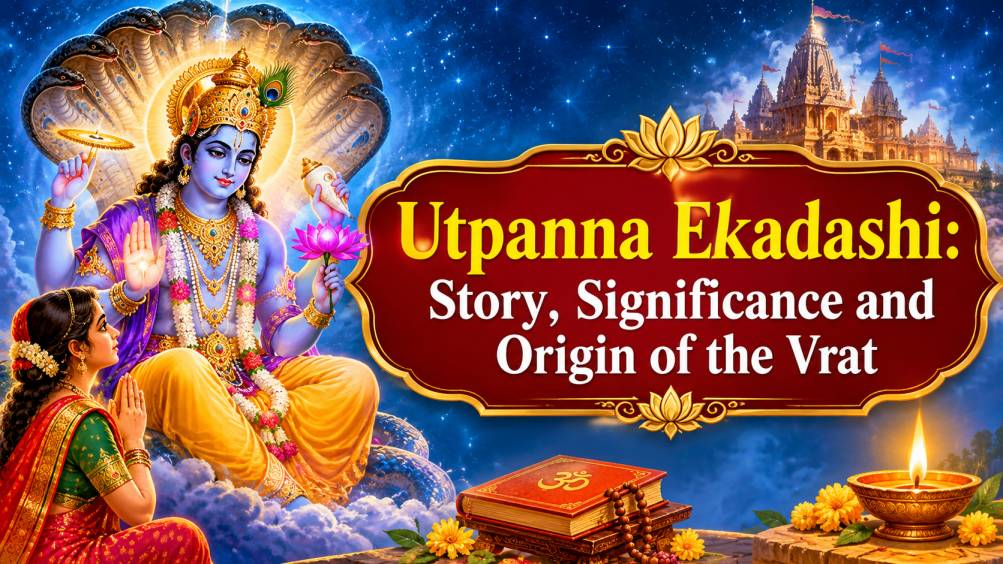
Utpanna Ekadashi holds a special place in Hindu religious traditions because it is associated with the origin of the Ekadashi Vrat. Observed on the eleventh lunar day (Ekadashi Tithi) of Krishna Paksha in the month of Margashirsha according to the Purnimanta calendar, this sacred occasion commemorates the manifestation of Goddess Ekadashi from Lord Vishnu.
The word Utpanna means born, originated or manifested. According to Puranic traditions, Goddess Ekadashi appeared to defeat the demon Mura and protect Lord Vishnu. Her appearance established the spiritual importance of observing Ekadashi fasting.
Beyond its religious significance, Utpanna Ekadashi represents self-discipline, devotion, control over desires and the importance of spiritual awareness in everyday life.
1. Why Is Utpanna Ekadashi Considered the Beginning of Ekadashi Vrat?
Utpanna Ekadashi is considered the origin of the Ekadashi fasting tradition because it commemorates the birth of Goddess Ekadashi, the divine feminine energy associated with Lord Vishnu.
According to the traditional Utpanna Ekadashi Vrat Katha, Lord Krishna explains to Yudhishthira how Goddess Ekadashi manifested and received a special blessing from Lord Vishnu.
The significance of this occasion is based on three important beliefs:
- Origin of Ekadashi Devi: The goddess manifested from Lord Vishnu’s divine energy on the eleventh lunar day.
- Establishment of the Vrat: Lord Vishnu granted her the boon that devotees observing Ekadashi with devotion would receive spiritual merit.
- Beginning of regular observance: Devotees consider this an auspicious occasion to take a sankalp (religious resolution) to observe Ekadashi fasting regularly.
Therefore, Utpanna Ekadashi is not simply another fasting day. It represents the beginning of the sacred tradition associated with the Ekadashi Tithi.
2. The Story of Utpanna Ekadashi: Birth of Goddess Ekadashi
The story of Utpanna Ekadashi is traditionally associated with the Padma Purana and Bhavishyottara Purana accounts of Ekadashi Mahatmya. Details may vary between traditional versions.
The Demon Mura and His Growing Power
According to the popular legend, during Satya Yuga, a powerful demon named Mura became increasingly destructive. Through his strength, he defeated Indra and other celestial beings and occupied their positions.
Unable to defeat him, the gods approached Lord Shiva for help. Lord Shiva directed them towards Lord Vishnu, who agreed to fight the demon and restore balance.
A fierce battle followed between Lord Vishnu and Mura. Despite using his divine weapons and extraordinary powers, Vishnu could not immediately defeat the demon.
The Manifestation of Goddess Ekadashi
After the prolonged battle, Lord Vishnu entered a cave to rest. Mura followed him, intending to attack him while he was sleeping.
At that moment, a radiant female divine power emerged from Lord Vishnu’s body. She confronted the demon and defeated him through her extraordinary spiritual strength.
When Lord Vishnu awakened, he discovered that Mura had been destroyed. He asked the divine woman about her identity and learned that she had manifested from his own energy to protect him.
The Blessing Granted by Lord Vishnu
Pleased with her courage and devotion, Lord Vishnu offered her a boon.
The goddess requested that devotees who observed fasting on her sacred day with sincerity should receive spiritual merit and liberation from negative karmic influences.
Lord Vishnu accepted her request and named her Ekadashi because she had manifested on the eleventh lunar day.
This event became associated with the origin of the Ekadashi Vrat, while the corresponding observance became known as Utpanna Ekadashi.
3. Religious and Spiritual Significance of Utpanna Ekadashi
Utpanna Ekadashi carries several important spiritual meanings in Hindu tradition.
Connection with Lord Vishnu
Ekadashi is particularly associated with Lord Vishnu, the preserver of the universe. Devotees worship Vishnu and Goddess Ekadashi to seek spiritual progress, peace and divine blessings.
Importance of Self-Control
Fasting is not limited to avoiding food. It also encourages devotees to control unnecessary desires, anger, greed and negative thoughts.
The observance promotes:
- Mental discipline and patience.
- Reduced attachment to material pleasures.
- Regular prayer and meditation.
- Compassion towards other living beings.
- Greater awareness of personal actions.
Significance of the Eleventh Lunar Day
In Vedic timekeeping, a Tithi represents the angular separation between the Sun and Moon. Ekadashi occurs when this separation reaches the eleventh lunar interval in either fortnight.
There are generally two Ekadashis in each lunar month:
- Shukla Paksha Ekadashi, during the waxing Moon.
- Krishna Paksha Ekadashi, during the waning Moon.
Both are considered important for Vishnu worship.
4. Astrological Perspective of Utpanna Ekadashi
Although Utpanna Ekadashi is primarily a religious observance, its timing is connected with the Hindu lunar calendar and traditional Panchang calculations.
Relationship Between Moon and Mind
In Vedic astrology, the Moon represents the mind, emotions, mental stability and habits. Ekadashi occurs during a particular phase of the lunar cycle.
From a traditional spiritual perspective, observing a fast on this day encourages mental discipline and emotional balance.
However, there is no universal astrological rule that Utpanna Ekadashi produces a particular planetary yoga or guarantees changes in an individual’s horoscope.
Is Utpanna Ekadashi Beneficial for Every Zodiac Sign?
The spiritual observance is open to devotees irrespective of their zodiac sign or ascendant.
People interested in astrology may use the occasion to develop positive habits and strengthen their spiritual routine.
The following practices can be meaningful:
- Aries: Practise patience and control impulsive reactions.
- Taurus: Reduce unnecessary material attachments.
- Gemini: Focus on meditation and positive communication.
- Cancer: Develop emotional balance through prayer.
- Leo: Practise humility and selfless service.
- Virgo: Avoid excessive criticism and overthinking.
- Libra: Maintain harmony in relationships.
- Scorpio: Work towards controlling anger and intense emotions.
- Sagittarius: Strengthen spiritual learning and discipline.
- Capricorn: Balance professional responsibilities with spiritual activities.
- Aquarius: Practise compassion and social responsibility.
- Pisces: Focus on devotion, meditation and self-reflection.
These are general reflective suggestions rather than fixed astrological predictions.
5. Utpanna Ekadashi Puja Vidhi and Practical Remedies
Devotees can observe Utpanna Ekadashi through simple religious practices according to their family traditions.
Puja Vidhi
- Wake up early, take a bath and wear clean clothes.
- Take a sankalp to observe the Ekadashi Vrat.
- Worship Lord Vishnu and Goddess Ekadashi.
- Offer Tulsi leaves, flowers, incense and a diya.
- Recite Vishnu Sahasranama or chant the mantra Om Namo Bhagavate Vasudevaya.
- Read or listen to the Utpanna Ekadashi Vrat Katha.
- Spend time in prayer, meditation and charitable activities.
- Break the fast on Dwadashi during the prescribed Parana Muhurat.
Simple Spiritual Remedies
The following practices are traditionally associated with Vishnu worship:
- Offer Tulsi leaves to Lord Vishnu during puja.
- Chant Vishnu mantras with concentration.
- Donate food or essential items to people in need.
- Avoid arguments, dishonesty and harmful behaviour.
- Practise gratitude and forgiveness.
These practices should be understood as devotional disciplines rather than guaranteed solutions to planetary problems.
Important Fasting Considerations
Depending on family and regional traditions, devotees may observe a Nirjala fast, consume fruits and milk, or follow a more moderate fasting routine.
Grains and pulses are generally avoided.
People with medical conditions, pregnant women, elderly devotees and those taking regular medication should avoid extreme fasting. A suitable dietary approach should take priority over strict observance.
6. When Should Devotees Begin Regular Ekadashi Fasting?
Utpanna Ekadashi is traditionally considered an auspicious day to begin regular Ekadashi Vrat.
Devotees who wish to establish a spiritual routine may take a sankalp on this occasion and continue observing both Krishna Paksha and Shukla Paksha Ekadashis.
However, it is not compulsory to begin fasting only on Utpanna Ekadashi. People can start their observance on another Ekadashi according to their faith, health and family traditions.
The central purpose is to develop consistency, devotion and self-discipline rather than follow fasting rituals mechanically.
Conclusion
Utpanna Ekadashi is considered the beginning of Ekadashi Vrat because it commemorates the manifestation of Goddess Ekadashi from Lord Vishnu’s divine energy. The story of her victory over the demon Mura highlights the importance of courage, discipline and the protection of righteousness.
For devotees, this occasion offers an opportunity to begin or renew their spiritual commitments through fasting, Vishnu worship, meditation and charity.
Its deeper message extends beyond religious rituals: controlling desires, practising compassion and developing a disciplined mind can bring meaningful improvements to everyday life. Observing Utpanna Ekadashi with sincerity and understanding makes the occasion spiritually significant.
Frequently Asked Questions (FAQs)
1. Why is Utpanna Ekadashi considered the first Ekadashi?
Utpanna Ekadashi is considered the origin of the Ekadashi Vrat because it commemorates the manifestation of Goddess Ekadashi.
According to Puranic tradition, Lord Vishnu granted her a boon that devotees observing the eleventh lunar day with devotion would receive spiritual merit.
Related practices:
- Read the Utpanna Ekadashi Vrat Katha.
- Worship Lord Vishnu.
- Take a sankalp to observe Ekadashi regularly.
2. Who was Goddess Ekadashi?
Goddess Ekadashi is a divine feminine power who manifested from Lord Vishnu to defeat the demon Mura.
She represents spiritual strength, purity, self-control and protection from negative influences. Her appearance is celebrated on Utpanna Ekadashi.
Devotional practices:
- Chant Vishnu mantras.
- Offer Tulsi leaves during worship.
- Practise meditation and self-discipline.
3. What is the story behind Utpanna Ekadashi?
The Utpanna Ekadashi story describes how Goddess Ekadashi emerged from Lord Vishnu’s body and defeated the demon Mura when he attempted to attack Vishnu during his rest.
Pleased with her courage, Lord Vishnu granted her a boon connected with the spiritual benefits of Ekadashi fasting. This is why the day is associated with the origin of the vrat.
Tip: Devotees can read or listen to the traditional vrat katha during their puja.
4. Can someone start Ekadashi fasting from Utpanna Ekadashi?
Yes, Utpanna Ekadashi is traditionally regarded as an auspicious occasion to begin regular Ekadashi fasting.
Devotees can take a sankalp to observe the fast twice every lunar month, subject to their health and personal circumstances.
Suggested practices:
- Begin with a manageable fasting routine.
- Avoid grains and pulses according to tradition.
- Maintain regularity in prayer and devotion.
5. Which God should be worshipped on Utpanna Ekadashi?
Lord Vishnu is the principal deity worshipped on Utpanna Ekadashi, along with Goddess Ekadashi.
Devotees offer Tulsi leaves, flowers, incense and lamps while remembering Vishnu through prayers and devotional chants.
Popular mantra:
Om Namo Bhagavate Vasudevaya.
Chanting this mantra with faith and concentration is a common devotional practice.
6. What should devotees avoid during Utpanna Ekadashi?
Devotees traditionally avoid grains, pulses, alcohol and non-vegetarian food during Ekadashi observance.
They also try to avoid anger, dishonesty, arguments and harmful behaviour because the vrat emphasises mental and spiritual purity.
Helpful guidelines:
- Eat according to your chosen fasting tradition.
- Avoid unnecessary conflicts.
- Spend time in prayer and charitable activities.
7. When should the Utpanna Ekadashi fast be broken?
The Utpanna Ekadashi fast is traditionally broken on the following Dwadashi Tithi during the prescribed Parana Muhurat.
The exact Parana timing depends on the local Panchang, sunrise and the duration of the relevant Tithis. Devotees should consult a reliable city-specific Panchang rather than follow a fixed time every year.