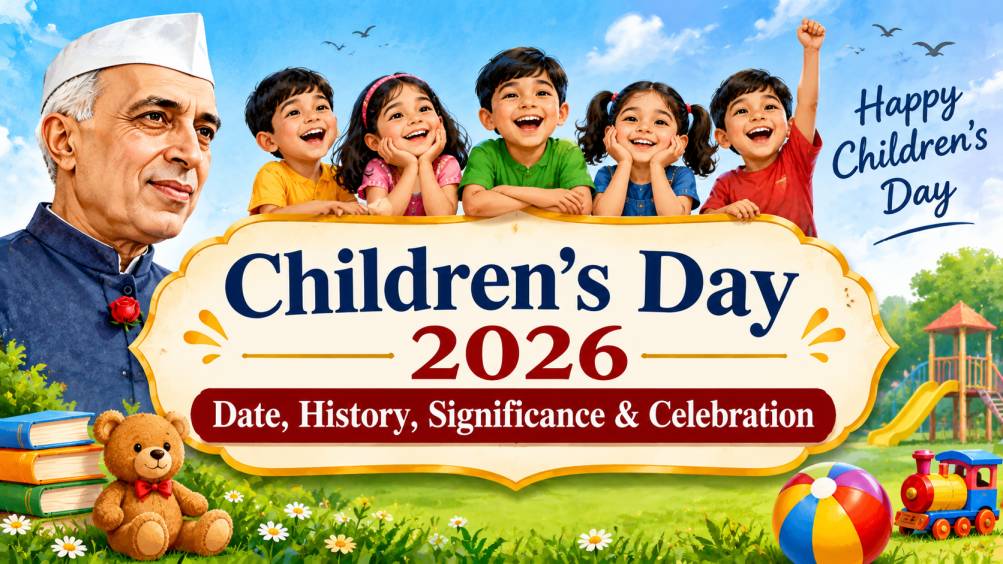
Children’s Day is a special occasion dedicated to celebrating childhood, education, happiness and the rights of children. In India, Children’s Day 2026 will be celebrated on Saturday, 14 November 2026, marking the birth anniversary of India’s first Prime Minister, Pandit Jawaharlal Nehru, who was popularly known as Chacha Nehru because of his affection for children.
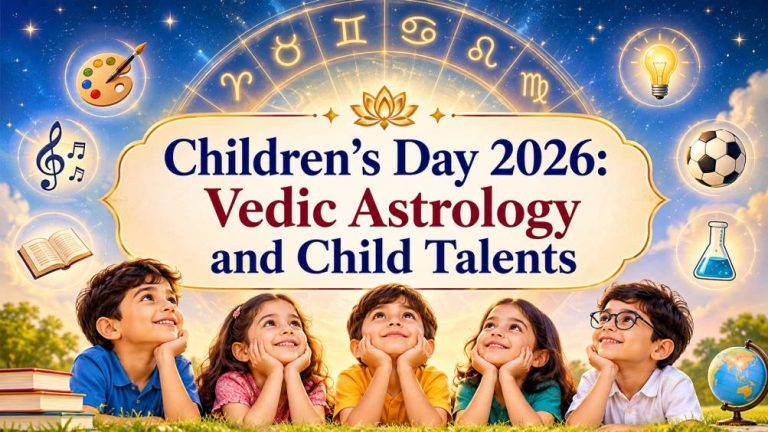
The day highlights the importance of providing every child with a safe environment, quality education, good health and opportunities to grow. From a Vedic astrology perspective, childhood development is traditionally associated with the Moon, Mercury, Jupiter and the fifth house of a birth chart. These astrological associations offer a cultural perspective on learning, creativity and emotional development, while a child’s real-life growth depends on care, education and a supportive environment.
Children’s Day 2026: Date and Important Details
14 November 2026 – Saturday
| Particular | Details |
| Occasion | Children’s Day |
| Date | 14 November 2026 |
| Day | Saturday |
| Celebrated in | India |
| Associated personality | Jawaharlal Nehru |
| Popular name | Bal Diwas |
| Main focus | Children’s rights, education and welfare |
Children’s Day is celebrated every year on 14 November in India. Schools, educational institutions and community organisations arrange activities to recognise children’s talents and promote their overall development.
Unlike festivals based on the Hindu lunar calendar, Children’s Day follows a fixed date in the Gregorian calendar.
History of Children’s Day in India
Why Is 14 November Celebrated as Children’s Day?
India celebrates Children’s Day on 14 November to honour the birth anniversary of Jawaharlal Nehru.
He was born on 14 November 1889 in Allahabad, now known as Prayagraj, Uttar Pradesh. After India’s independence, he became the country’s first Prime Minister and served from 1947 until 1964.
Nehru believed that children were essential to India’s future development. He supported education, scientific thinking, healthcare and opportunities for young people.
His affection for children earned him the popular name Chacha Nehru.
When Did India Start Celebrating Children’s Day on 14 November?
Before Nehru’s death in 1964, India observed Children’s Day on 20 November, which is also recognised internationally as World Children’s Day.
Following his death on 27 May 1964, his birthday was chosen as India’s National Children’s Day to honour his contribution and affection towards children.
Since then, 14 November has been observed as Bal Diwas across the country.
Significance of Children’s Day in India
Children’s Day is more than a celebration involving games, performances and school programmes. It reminds society of its responsibility to protect children’s rights and support their physical, emotional, intellectual and social development.
1. Importance of Education
Education helps children develop knowledge, confidence and independent thinking. Children’s Day encourages parents, teachers and institutions to make learning accessible to every child.
2. Awareness About Children’s Rights
Every child deserves basic rights, including:
- Access to quality education.
- Proper nutrition and healthcare.
- Protection from abuse and exploitation.
- Equal opportunities without discrimination.
- Freedom to express thoughts and opinions.
3. Encouraging Creativity and Talent
Children have different abilities and interests. Some enjoy sports, while others prefer music, science, art, writing or technology.
Children’s Day encourages schools to provide opportunities for students to discover their interests and build confidence.
4. Building a Better Future
Children represent the future of society. Investing in their education, health and emotional well-being contributes to a more informed, responsible and capable generation.
Children’s Day Celebrations in India
Children’s Day is celebrated with enthusiasm in schools, colleges and community organisations across India.
How Is Children’s Day Celebrated?
Common activities include:
- Cultural programmes: Children participate in dance, music, drama and singing competitions.
- Art and drawing competitions: Students express their creativity through paintings and craft activities.
- Sports activities: Schools organise games, races and outdoor competitions.
- Special assemblies: Teachers discuss children’s rights, education and the importance of childhood.
- Gifts and sweets: Students receive small gifts, chocolates and appreciation from teachers.
- Social welfare activities: Organisations arrange educational support, food distribution and awareness programmes for underprivileged children.
The objective is to make children feel valued while reminding adults of their responsibility towards their development.
Children’s Day 2026 and Its Connection with Vedic Astrology
Although Children’s Day is not an astrological festival, Vedic astrology offers interesting traditional perspectives on childhood, education, intelligence and personality development.
In a birth chart (Kundli), certain planets and houses are traditionally associated with different aspects of a child’s development.
1. Fifth House: Children, Intelligence and Creativity
The fifth house, also called Putra Bhava or Vidya Bhava, is traditionally associated with children, intelligence, creativity, learning and academic interests.
Astrologers examine this house to understand themes related to:
- Learning abilities and intellectual development.
- Creativity and artistic interests.
- Interest in education and knowledge.
- Children and parenting-related matters.
However, a single house cannot determine a child’s future. A complete birth chart requires consideration of the fifth house lord, planetary aspects and other relevant factors.
2. Jupiter: Wisdom and Knowledge
Jupiter (Guru or Brihaspati) represents wisdom, higher knowledge, guidance and traditional education in Vedic astrology.
Its influence is traditionally examined when studying a person’s interest in learning, moral values and intellectual growth.
Parents can connect this symbolism with practical activities such as:
- Encouraging children to read books.
- Teaching honesty and kindness.
- Supporting curiosity and independent thinking.
- Providing opportunities to explore different subjects.
3. Mercury: Intelligence and Communication
Mercury (Budh) is associated with communication, reasoning, memory, analytical abilities and learning.
In traditional astrology, Mercury is examined to understand how a person processes information and expresses ideas.
Activities that encourage Mercury-related qualities include:
- Reading and storytelling.
- Mathematics and puzzles.
- Writing and public speaking.
- Learning new languages.
- Participating in quizzes and debates.
4. Moon: Emotional Development and Mental Peace
The Moon (Chandra) represents emotions, mental well-being, sensitivity and the mind in Vedic astrology.
A child’s emotional environment plays an important role in developing confidence and healthy relationships.
Parents can support emotional development by:
- Spending quality time with children.
- Listening patiently to their concerns.
- Encouraging open communication.
- Maintaining a supportive home environment.
- Avoiding unnecessary academic pressure.
These traditional planetary associations are cultural interpretations, not scientifically established methods of measuring intelligence or predicting a child’s development.
Practical Remedies and Positive Habits for Children
Children’s Day can be an opportunity to introduce meaningful habits inspired by traditional values and everyday learning.
1. Encourage Learning and Knowledge
Instead of focusing only on academic marks, encourage children to develop a genuine interest in learning.
Reading books, exploring science and asking questions can improve curiosity and independent thinking.
2. Practise Saraswati Vandana
Goddess Saraswati is traditionally worshipped as the deity of knowledge, music, wisdom and learning.
Families who follow this tradition may offer prayers or chant:
ॐ ऐं सरस्वत्यै नमः।
This mantra is traditionally associated with seeking blessings for knowledge and wisdom.
3. Encourage Creativity
Allow children to explore their interests through painting, music, dance, sports and other activities.
Creative activities can help develop confidence, problem-solving skills and self-expression.
4. Teach Kindness and Charity
Children can learn the importance of compassion through simple activities such as donating books, sharing stationery and helping classmates.
5. Support Emotional and Physical Well-being
A healthy routine should include adequate sleep, nutritious food, outdoor activities, family interaction and limited screen time.
Why Children’s Day Is Important in Modern India
In today’s digital environment, children face new opportunities as well as challenges. Online learning, social media, academic competition and changing lifestyles influence their daily experiences.
Children’s Day reminds families and institutions to focus on issues such as:
- Digital safety and responsible internet use.
- Mental health and emotional support.
- Equal access to education.
- Prevention of child labour and exploitation.
- Protection against bullying and abuse.
- Opportunities for children with disabilities.
Child protection is also supported by Indian laws and policies, including the Right to Education Act and the Protection of Children from Sexual Offences (POCSO) Act. UNICEF India highlights the importance of protecting children from violence, abuse and exploitation.
Conclusion
Children’s Day 2026, celebrated on 14 November, is a reminder that children deserve love, education, protection and equal opportunities. The occasion honours Jawaharlal Nehru’s association with children’s welfare while encouraging society to invest in the next generation.
From a Vedic astrology perspective, the fifth house, Jupiter, Mercury and Moon are traditionally associated with different aspects of childhood, learning and emotional development. However, a child’s future is shaped by much more than astrological interpretations. Education, family support, healthy habits and positive experiences are equally important.
This Children’s Day, take time to appreciate children’s individuality, encourage their dreams and create an environment where every child feels safe, confident and valued.
Frequently Asked Questions (FAQs)
1. When is Children’s Day in India in 2026?
Children’s Day in India will be celebrated on Saturday, 14 November 2026.
The occasion marks the birth anniversary of Pandit Jawaharlal Nehru, India’s first Prime Minister. Schools and educational institutions organise cultural programmes and activities to celebrate children.
Ways to celebrate:
- Organise creative activities.
- Give books and educational gifts.
- Spend quality time with children.
2. Why is Children’s Day celebrated on 14 November?
India celebrates Children’s Day on 14 November to honour Jawaharlal Nehru’s birthday and his affection for children.
Popularly known as Chacha Nehru, he believed that children played an important role in shaping India’s future. His birthday became associated with National Children’s Day after his death in 1964.
Ministry of Culture, Government of India+1
Key points:
- Nehru was born on 14 November 1889.
- He was India’s first Prime Minister.
- His legacy is associated with children’s education and welfare.
3. What is the difference between Children’s Day and World Children’s Day?
India celebrates National Children’s Day on 14 November, while World Children’s Day is observed internationally on 20 November.
World Children’s Day promotes awareness of children’s rights, welfare and the United Nations Convention on the Rights of the Child.
Remember:
- 14 November: Children’s Day in India.
- 20 November: World Children’s Day.
4. What is the astrological significance of Children’s Day?
In Vedic astrology, the fifth house, Jupiter, Mercury and Moon are traditionally associated with children, education, intelligence and emotional development.
Astrologers study these planetary influences as part of a complete birth chart rather than relying on one planet or house.
Traditional associations:
- Fifth house: Children and creativity.
- Jupiter: Wisdom and knowledge.
- Mercury: Communication and intelligence.
- Moon: Emotions and mental well-being.
5. Which planet represents education in Vedic astrology?
Mercury and Jupiter are two important planetary significators traditionally associated with education and knowledge.
Mercury represents reasoning, communication and analytical abilities, while Jupiter represents wisdom, higher learning and guidance.
Traditional practices:
- Worship Goddess Saraswati.
- Encourage reading and learning.
- Chant the Saraswati mantra.
- Develop curiosity through educational activities.
6. How can parents celebrate Children’s Day at home?
Parents can celebrate Children’s Day by spending quality time with their children, appreciating their interests and encouraging their creativity.
Simple family activities can make the occasion meaningful without requiring expensive gifts or celebrations.
Ideas include:
- Organise a family game night.
- Read a story together.
- Prepare a favourite meal.
- Visit a park or museum.
- Encourage children to share their dreams.
7. What is the significance of Chacha Nehru on Children’s Day?
Chacha Nehru is the affectionate name given to Jawaharlal Nehru because of his association with children and his belief in their potential.
His birthday is celebrated as Children’s Day in India to remember his contribution and highlight the importance of children’s education, development and welfare.
Key message: Children are not just the future of the country; they deserve opportunities, protection and respect in the present.