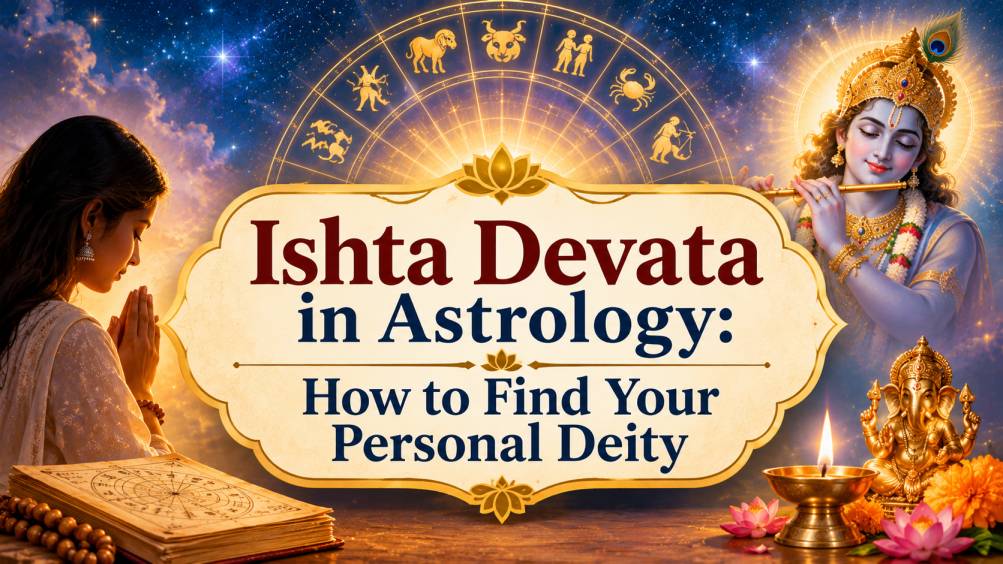
In Vedic astrology, Ishta Devata refers to the personal deity or divine form through which an individual experiences spiritual connection and devotion. The concept is particularly important in Jaimini astrology and is associated with the soul’s spiritual journey, inner peace and liberation (Moksha).
Unlike general worship based on family traditions or personal beliefs, Ishta Devata identification through astrology involves examining specific planetary placements in the birth chart, especially the Atmakaraka and Navamsa (D9) chart. Understanding your Ishta Devata can provide a traditional framework for choosing a form of worship, developing a regular spiritual routine and strengthening self-awareness. However, it is a spiritual concept rather than a guaranteed method of predicting success or removing life’s difficulties.
What Is Ishta Devata in Vedic Astrology?
The Sanskrit term Ishta Devata combines two words: Ishta, meaning desired or preferred, and Devata, meaning deity.
In Vedic astrology, Ishta Devata represents the divine form associated with an individual’s spiritual development and liberation. It is traditionally studied through Jaimini astrology and the concept of Karakamsha.
The Ishta Devata is believed to guide a person towards:
- Spiritual awareness and self-realisation.
- Inner peace and emotional stability.
- Devotion and discipline.
- Understanding life’s deeper purpose.
- Progress towards Moksha or liberation.
It is important to understand that Ishta Devata is different from a Kuldevata or family deity. A Kuldevata is traditionally worshipped by a family or lineage, whereas Ishta Devata is associated with an individual’s personal spiritual path.
How to Find Your Ishta Devata Through Astrology?
Finding your Ishta Devata requires an understanding of the Atmakaraka, Navamsa chart and Karakamsha.
Step 1: Identify Your Atmakaraka Planet
Atmakaraka is the planet with the highest degree within its zodiac sign among the seven classical planets in the commonly used Jaimini seven-karaka system.
The seven planets considered are:
- Sun
- Moon
- Mars
- Mercury
- Jupiter
- Venus
- Saturn
This planet is traditionally known as the soul significator.
Step 2: Prepare Your Navamsa Chart (D9)
The Navamsa chart is an important divisional chart in Vedic astrology.
Locate your Atmakaraka planet in the D9 chart and identify the zodiac sign it occupies.
This sign is known as Karakamsha.
Step 3: Examine the 12th House from Karakamsha
In the Jaimini method commonly used for identifying Ishta Devata, astrologers examine the 12th house from Karakamsha in the Navamsa chart.
The planet occupying this house is considered an important indicator of the personal deity.
If the house is empty, astrologers may examine its lord and other relevant planetary influences.
Step 4: Identify the Associated Deity
Traditional Jaimini interpretations associate different planets with particular divine forms.
The exact deity may vary according to the astrological tradition and interpretative method being followed. Therefore, the result should not be treated as a universally fixed identification.
Which Planet Indicates Which Ishta Devata?
Traditional astrological interpretations connect planets with different forms of divine worship.
The following associations are commonly used as symbolic guidance:
1. Sun (Surya)
The Sun represents authority, vitality, confidence and spiritual illumination.
Surya worship is traditionally associated with discipline, self-awareness and clarity.
Suggested practice: Offer water to the rising Sun and chant Om Suryaya Namah.
2. Moon (Chandra)
The Moon represents emotions, mental peace, nurturing and sensitivity.
Its association with devotional practices may encourage emotional balance and calmness.
Suggested practice: Chant Om Som Somaya Namah and practise meditation.
3. Mars (Mangal)
Mars represents courage, strength, action and determination.
Its spiritual associations are often connected with Hanuman and Kartikeya.
Suggested practice: Recite Hanuman Chalisa and practise self-discipline.
4. Mercury (Budh)
Mercury represents intelligence, communication, learning and analytical ability.
It is traditionally connected with Vishnu-related worship in certain planetary deity associations.
Suggested practice: Chant Om Namo Bhagavate Vasudevaya and practise truthful communication.
5. Jupiter (Guru)
Jupiter represents wisdom, knowledge, spirituality and ethical values.
It is traditionally associated with divine teachers and Vishnu-related forms.
Suggested practice: Study spiritual literature and show respect towards teachers.
6. Venus (Shukra)
Venus represents love, harmony, beauty and material comforts.
Its traditional spiritual associations may include Lakshmi and other forms of divine feminine energy.
Suggested practice: Worship Goddess Lakshmi and practise kindness and generosity.
7. Saturn (Shani)
Saturn represents karma, discipline, responsibility and patience.
Its spiritual associations may include Shiva and other forms connected with detachment and discipline.
Suggested practice: Chant Om Namah Shivaya and help people in need.
Note: These are broad planetary-deity associations, not a definitive Ishta Devata calculation. The deity should be identified through the relevant Karakamsha method and the tradition followed by the astrologer.
Importance of the 12th House in Finding Ishta Devata
The 12th house is traditionally associated with Moksha, spiritual liberation, meditation, solitude and detachment from material attachments.
In Jaimini astrology, the 12th house from Karakamsha is particularly important when examining Ishta Devata.
Astrologers consider:
- The planet occupying the 12th house from Karakamsha.
- The house lord if the house is unoccupied.
- Planetary conjunctions and influences.
- The overall condition of Atmakaraka.
- Other spiritual indicators in the birth chart.
This analysis is intended to understand spiritual inclinations rather than predict a person’s religious beliefs or future experiences.
Ishta Devata and Your Spiritual Life
Understanding your Ishta Devata can help you create a more meaningful devotional routine.
For example:
- Daily Prayer: Choose a form of worship that encourages consistency and devotion.
- Mantra Chanting: Recite a traditional mantra associated with your chosen deity.
- Meditation: Spend 10–15 minutes practising meditation and observing your thoughts.
- Charity: Help people through food donations, education support or community service.
- Self-Reflection: Develop qualities such as patience, compassion, honesty and humility.
These practices can support personal well-being and spiritual discipline, regardless of astrological beliefs.
Ishta Devata vs Kuldevata vs Graha Devata
These three concepts have different meanings in Hindu spiritual traditions.
| Concept | Meaning |
| Ishta Devata | Personal deity associated with spiritual development |
| Kuldevata | Traditional family or lineage deity |
| Graha Devata | Divine form associated with a particular planet |
A person may worship all three according to their family customs, spiritual preferences and astrological traditions.
There is no requirement to abandon family worship after identifying an Ishta Devata through astrology.
Practical Tips for Connecting with Your Ishta Devata
You do not need complicated rituals to develop a spiritual connection.
Follow these simple practices:
- Maintain a clean and peaceful prayer space.
- Offer prayers regularly.
- Learn the significance of your chosen deity.
- Chant a mantra with concentration.
- Practise kindness and honesty.
- Follow family traditions respectfully.
- Avoid treating spiritual remedies as guaranteed solutions to problems.
Conclusion
Ishta Devata is an important spiritual concept in Jaimini Vedic astrology that connects the individual’s soul journey with a personal form of divine worship. By examining the Atmakaraka, Navamsa chart, Karakamsha and the 12th house from Karakamsha, astrologers traditionally identify indicators associated with a person’s Ishta Devata.
Understanding this concept can help individuals develop a consistent spiritual routine, practise meditation and cultivate positive qualities such as patience, compassion and devotion. However, astrology should be approached as a traditional interpretative system rather than an absolute authority on spiritual beliefs.
Ultimately, the purpose of identifying your Ishta Devata is not simply to know which deity to worship, but to develop a deeper connection with spirituality and bring greater awareness into everyday life.
FAQs: Ishta Devata in Astrology
1. What is Ishta Devata in Vedic astrology?
Ishta Devata is the personal deity traditionally associated with an individual’s spiritual development and journey towards Moksha.
In Jaimini astrology, it is identified by examining the Atmakaraka, Karakamsha and 12th house from Karakamsha in the Navamsa chart.
Important concepts:
- Atmakaraka
- Navamsa chart (D9)
- Karakamsha
- 12th house from Karakamsha
2. How can I find my Ishta Devata using my Kundli?
You can identify your Ishta Devata by locating your Atmakaraka in the Navamsa chart and examining the 12th house from its Karakamsha sign.
The planet occupying that house is traditionally considered an important indicator. If it is empty, the house lord and other relevant factors are examined.
You need:
- Accurate birth date.
- Birth time.
- Birthplace.
- D1 and D9 birth charts.
3. Which house is important for finding Ishta Devata?
The 12th house from Karakamsha in the Navamsa chart is particularly important for identifying Ishta Devata.
This house is associated with Moksha, spirituality, meditation and liberation in traditional astrology.
For analysis:
- Identify Atmakaraka.
- Find Karakamsha in D9.
- Examine its 12th house.
- Check planetary occupancy and the house lord.
4. Is Ishta Devata the same as Kuldevata?
No, Ishta Devata and Kuldevata represent different concepts in Hindu traditions.
Ishta Devata is associated with an individual’s personal spiritual path, whereas Kuldevata is the deity traditionally worshipped by a family or lineage.
Remember:
- Ishta Devata relates to personal spiritual devotion.
- Kuldevata relates to family traditions.
- Both can be worshipped together.
5. Can I worship my Ishta Devata every day?
Yes, you can worship your Ishta Devata daily through simple prayers, mantra chanting and meditation.
Consistency and sincere devotion are generally considered more important than elaborate rituals.
Suggested routine:
- Light a diya safely.
- Chant your chosen mantra.
- Offer flowers if appropriate.
- Spend a few minutes in meditation.
6. What if the 12th house from Karakamsha is empty?
An empty 12th house from Karakamsha does not mean that a person has no Ishta Devata.
In such cases, astrologers examine the lord of that house and its planetary associations to understand the traditional spiritual indicators.
Consider these factors:
- The 12th house lord.
- Its zodiac sign and placement.
- Planetary aspects.
- The overall D9 chart.
7. Can Ishta Devata be identified through the Moon sign?
No, the Moon sign alone is not sufficient to identify Ishta Devata through the traditional Jaimini method.
The calculation primarily involves Atmakaraka, Karakamsha and the 12th house from Karakamsha in the Navamsa chart.
Your Moon sign may provide additional information about emotional and devotional tendencies.
8. Does worshipping Ishta Devata remove planetary doshas?
Worshipping Ishta Devata is traditionally considered a way to develop devotion, inner strength and spiritual awareness, but it does not guarantee the removal of planetary doshas.
Astrological interpretations and spiritual remedies should be approached thoughtfully rather than as guaranteed solutions.
Helpful practices:
- Maintain regular prayers.
- Chant traditional mantras.
- Practise charity.
- Develop patience and compassion.
- Seek a complete Kundli analysis for specific astrological concerns.