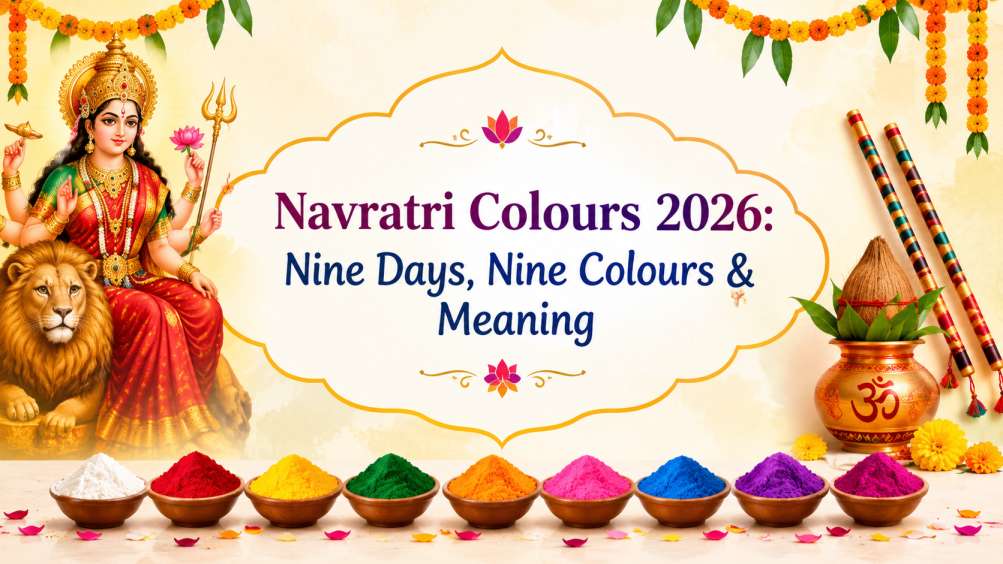
Shardiya Navratri is one of the most significant festivals dedicated to Goddess Durga and the nine forms of Shakti. In 2026, Shardiya Navratri begins on October 11, 2026, and the nine-day celebration continues through October 19, followed by Vijayadashami on October 20. The popular tradition of wearing a particular colour each day adds a visual and cultural dimension to the festival.
The Navratri colours 2026 are orange, white, red, royal blue, yellow, green, grey, purple and peacock green. The sequence is connected primarily with the weekday on which Navratri begins, rather than being a universal rule directly prescribed for each form of Navadurga. Traditional weekday associations with the Navagrahas provide an astrological framework for understanding these colours.
Navratri Colours 2026: Nine Days, Nine Colours
| Day | Date | Colour | Traditional Meaning |
| Day 1 | October 11 | Orange | Energy, warmth and enthusiasm |
| Day 2 | October 12 | White | Purity, peace and calm |
| Day 3 | October 13 | Red | Strength, passion and vitality |
| Day 4 | October 14 | Royal Blue | Stability, richness and tranquillity |
| Day 5 | October 15 | Yellow | Optimism, learning and joy |
| Day 6 | October 16 | Green | Growth, harmony and new beginnings |
| Day 7 | October 17 | Grey | Balance, grounding and emotional steadiness |
| Day 8 | October 18 | Purple | Grandeur, dignity and transformation |
| Day 9 | October 19 | Peacock Green | Freshness, individuality and compassion |
Day-Wise Navratri Colours and Their Meaning
Day 1 – Orange: Shailputri
October 11, 2026
Orange represents enthusiasm, warmth and active energy. The first day is associated with Goddess Shailputri, marking the beginning of the Navratri spiritual journey.
From a practical perspective, orange can serve as a reminder to begin new tasks with confidence while maintaining discipline.
Simple practice: Wear orange or include an orange flower or cloth in your puja space.
Day 2 – White: Brahmacharini
October 12, 2026
White is traditionally associated with purity, peace and inner calm. Goddess Brahmacharini represents devotion, discipline and spiritual perseverance.
This makes the day suitable for reducing distractions and creating time for prayer, meditation or quiet reflection.
Simple practice: Spend a few minutes in silent meditation or recite a Durga mantra.
Day 3 – Red: Chandraghanta
October 13, 2026
Red symbolises vitality, courage and passion. It is also a familiar colour in Shakti worship and is frequently seen in offerings and devotional decorations.
The day is associated with Goddess Chandraghanta, whose symbolism combines courage with protection.
Simple practice: Use red flowers in worship and focus on completing one important pending task.
Day 4 – Royal Blue: Kushmanda
October 14, 2026
Royal blue is linked with depth, tranquillity and a sense of stability. The fourth day honours Goddess Kushmanda.
For modern life, the colour can be treated as a reminder to remain composed while handling responsibilities, rather than reacting impulsively.
Simple practice: Wear royal blue and spend some time organising finances, work or household priorities.
Day 5 – Yellow: Skandamata
October 15, 2026
Yellow is associated with optimism, warmth and learning. The fifth day is dedicated to Goddess Skandamata.
The connection with Thursday also gives this colour an interesting astrological dimension because Thursday is traditionally associated with Jupiter (Guru), which is linked in Jyotish with wisdom, knowledge and guidance.
Simple practice: Read a spiritual text, learn something useful or offer yellow flowers or fruits.
Day 6 – Green: Katyayani
October 16, 2026
Green represents growth, nature, harmony and renewal. Goddess Katyayani is worshipped on the sixth day.
Green can be especially meaningful for people focusing on personal development, healthier routines or fresh beginnings.
Simple practice: Spend time in nature, care for a plant or begin one constructive habit.
Day 7 – Grey: Kalaratri
October 17, 2026
Grey represents balance and groundedness. The seventh day is associated with Goddess Kalaratri, whose traditional symbolism relates to confronting darkness and overcoming fear.
Rather than treating the colour as a prediction of events, it can be understood as a reminder to maintain emotional balance during difficult situations.
Simple practice: Avoid unnecessary arguments and consciously pause before making an emotional decision.
Day 8 – Purple: Mahagauri
October 18, 2026
Purple carries associations of dignity, depth and transformation. The eighth day is associated with Goddess Mahagauri.
It can be used as a symbolic reminder to review personal priorities and release habits that no longer serve you.
Simple practice: Declutter one small area of your home and spend time in prayer or introspection.
Day 9 – Peacock Green: Siddhidatri
October 19, 2026
Peacock green combines the visual qualities of blue and green and is associated with freshness, individuality and compassion. The ninth day honours Goddess Siddhidatri.
The colour provides a fitting symbolic conclusion to the nine-day journey by bringing together calmness, growth and self-expression.
Simple practice: Express gratitude and identify three positive lessons from the past year.
The Astrological Connection Behind Navratri Colours
One important point is that Navratri colours are not simply zodiac colours. The popular nine-colour sequence is determined by the weekday on which Navratri begins, with traditional planetary associations of the weekdays providing an astrological framework.
For example:
- Sunday – Sun: vitality and confidence
- Monday – Moon: emotions and peace
- Tuesday – Mars: courage and action
- Wednesday – Mercury: communication and intellect
- Thursday – Jupiter: wisdom and learning
- Friday – Venus: harmony and aesthetics
- Saturday – Saturn: discipline and grounding
This is why the first colour changes from year to year. In 2026, Navratri begins on Sunday, resulting in orange as Day 1.
How to Use Navratri Colours in Daily Life
Following the colour tradition does not have to mean buying nine new outfits. You can incorporate the daily colour through:
- Clothing or accessories
- Dupatta, scarf or jewellery
- Flowers used in puja
- A small decorative item
- Diary or workspace elements
- Food presentation or home décor
The more meaningful practice is to connect the colour with a positive intention, prayer or disciplined action.
Practical Navratri Remedies
Simple devotional practices can make the festival more personally meaningful:
- Light a diya during your daily prayer routine.
- Keep your puja area clean and organised.
- Offer fresh flowers according to your family tradition.
- Recite “Om Dum Durgayai Namah” with a calm and focused mind.
- Practise kindness, self-control and gratitude.
- Avoid treating colours or rituals as guarantees of specific outcomes.
For personalised astrological remedies, the complete birth chart, planetary strengths and individual circumstances should be considered rather than relying only on the colour of the day.
Conclusion
The Navratri colours 2026 offer a simple way to connect everyday life with the symbolism of Shakti worship. From orange on Day 1 to peacock green on Day 9, each colour provides an opportunity to reflect on qualities such as energy, peace, courage, knowledge, growth and balance.
The tradition is primarily cultural and devotional, while its weekday and planetary associations provide an additional Jyotish perspective. Rather than viewing a colour as a guarantee of luck or a specific result, use it as a daily reminder of a positive quality or intention.
Navratri becomes more meaningful when rituals are combined with awareness, discipline, gratitude and practical action.
FAQs
1. What are the Navratri colours for 2026?
The nine Navratri colours for 2026 are orange, white, red, royal blue, yellow, green, grey, purple and peacock green.
These colours correspond to the nine days beginning October 11, 2026. The sequence is based on the weekday cycle used for the Navratri colour tradition.
Related tip: Use the colour through clothing, flowers or a small accessory rather than treating it as a compulsory ritual.
2. When does Shardiya Navratri 2026 begin?
Shardiya Navratri begins on October 11, 2026, with Ghatasthapana and Shailputri Puja.
The nine-day observance continues through October 19, while Vijayadashami falls on October 20.
Related tip: Check your local Panchang for the exact puja timings because Muhurta can vary by location.
3. Why do Navratri colours change every year?
The first Navratri colour is determined by the weekday on which Navratri begins, after which the remaining colours follow the established sequence.
This is why the colour assigned to a particular Navratri day can differ from one year to another.
Related tip: Check the annual Navratri calendar rather than relying on a previous year’s colour list.
4. Are Navratri colours connected with the Navagrahas?
Yes, the weekday-based Navratri colour tradition has a traditional astrological connection with the planets associated with the seven weekdays.
However, this should not be confused with a rule that each person must wear a particular colour according to their zodiac sign or birth chart.
Related tip: For personalised colour recommendations, consider the complete horoscope rather than Sun sign alone.
5. Which colour should I wear during Navratri?
You can traditionally wear the colour assigned to that day’s Navratri calendar, but there is no need to treat it as a compulsory requirement.
The practice is primarily devotional and cultural, particularly popular in parts of Maharashtra and Gujarat.
Related tip: If you cannot wear the colour, incorporate it through a flower, accessory or decoration and focus on the day’s spiritual theme.