Sharad Navratri 2026 will be observed from 11 October to 19 October 2026, followed by Vijayadashami or Dussehra on 20 October 2026. The festival is dedicated to the worship of the nine forms of Goddess Durga, collectively known as Navadurga.
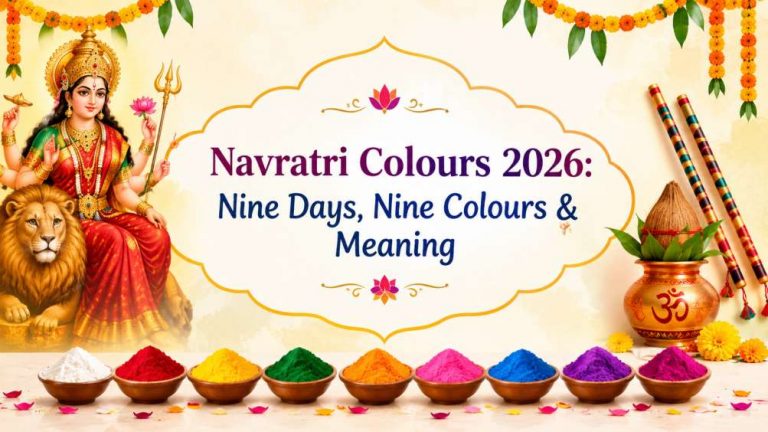
One popular tradition during Navratri is wearing a different colour on each of the nine days. For 2026, the widely followed sequence is orange, white, red, royal blue, yellow, green, grey, purple and peacock green.
These colours are meaningful cultural symbols, but the nine-colour dress tradition is not a strict scriptural requirement. The sequence is commonly connected with the weekday on which Navratri begins and is especially popular in places such as Maharashtra and Gujarat.
Sharad Navratri Colours 2026: Day-Wise List
Because Navratri begins on a Sunday in 2026, the commonly published colour sequence starts with orange.
| Day | Date | Colour | Associated Devi |
| Day 1 | 11 October | Orange | Maa Shailputri |
| Day 2 | 12 October | White | Maa Brahmacharini |
| Day 3 | 13 October | Red | Maa Chandraghanta |
| Day 4 | 14 October | Royal Blue | Maa Kushmanda |
| Day 5 | 15 October | Yellow | Maa Skandamata |
| Day 6 | 16 October | Green | Maa Katyayani |
| Day 7 | 17 October | Grey | Maa Kalaratri |
| Day 8 | 18 October | Purple | Maa Mahagauri |
| Day 9 | 19 October | Peacock Green | Maa Siddhidatri |
This nine-day sequence is reported by major Panchang and festival calendars for Sharad Navratri 2026.
Note: Colour traditions can vary between regions, communities and family traditions. If your family or local temple follows a different colour sequence, that custom can be followed respectfully.
Day 1: Orange – 11 October
Orange is the Navratri colour for Sunday, 11 October 2026. It is commonly associated with warmth, enthusiasm, energy and optimism.
The first day honours Maa Shailputri, traditionally regarded as the first form of Navadurga.
Traditional significance
Orange can represent:
- Energy and enthusiasm
- Warmth
- Spiritual motivation
- A positive beginning
From a practical perspective, orange can be incorporated through clothing, a dupatta, scarf, jewellery or home decoration.
Day 2: White – 12 October
White is associated with purity, peace and simplicity. Day 2 is traditionally dedicated to Maa Brahmacharini, a form associated with devotion, discipline and spiritual practice.
Simple practice
Use the day for quiet prayer, meditation or maintaining a disciplined routine. The emphasis can be on mental calm rather than treating the colour as a guaranteed remedy.
Day 3: Red – 13 October
Red is one of the most recognisable colours associated with Goddess worship. It can symbolise strength, vitality, passion and active energy.
Day 3 is associated with Maa Chandraghanta.
Red can be incorporated through:
- Sarees or ethnic wear
- Dupattas
- Bangles
- Flowers
- Puja decorations
Day 4: Royal Blue – 14 October
Royal blue is the colour associated with Day 4 and Maa Kushmanda in the commonly followed 2026 colour calendar. It is traditionally interpreted through themes such as depth, stability, richness and calmness.
For everyday observance, a royal-blue outfit or a small decorative element can be enough; elaborate arrangements are not necessary.
Day 5: Yellow – 15 October
Yellow represents brightness, optimism and joy in popular Navratri colour interpretations. Day 5 honours Maa Skandamata.
Yellow is also traditionally connected with Guru or Jupiter (Brihaspati) in weekday-based Jyotish symbolism because Thursday is associated with Jupiter.
This provides an interesting connection between festival colour customs and traditional planetary associations, although wearing yellow should not be presented as a guaranteed method of strengthening Jupiter.
Day 6: Green – 16 October
Green is commonly associated with nature, growth, freshness and balance. Day 6 is dedicated to Maa Katyayani.
Green can be used in:
- Clothing
- Rangoli
- Puja decorations
- Flowers and leaves
- Festive accessories
A practical interpretation is to use the day as an opportunity to reflect on growth, health and personal balance.
Day 7: Grey – 17 October
Grey is the colour for Day 7, associated with Maa Kalaratri. It is often interpreted as representing balance, steadiness and a grounded approach.
Rather than viewing grey as negative, it can be understood symbolically as a reminder of stability and composure.
Saturday is traditionally associated with Shani (Saturn) in Jyotish, which adds another layer of cultural symbolism to the day’s colour.
Day 8: Purple – 18 October
Purple is associated with Day 8 and Maa Mahagauri. Popular interpretations connect purple with dignity, spirituality, creativity and refinement.
This day can be observed through prayer, meditation, charitable activities or participation in Ashtami traditions according to family customs.
Day 9: Peacock Green – 19 October
The final colour is peacock green, associated with Day 9 and Maa Siddhidatri in the commonly followed 2026 list. It combines the visual qualities of blue and green and is often interpreted through ideas such as uniqueness, freshness and harmony.
The day can be used for gratitude, prayer and reflection before Vijayadashami.
Why Do Navratri Colours Change Every Year?
The nine Navratri colours are not permanently fixed to the same calendar dates.
A popular convention determines the first colour according to the weekday on which Sharad Navratri begins, after which the sequence progresses through the established colour cycle. Since the opening weekday changes from year to year, the nine-colour sequence can change as well.
In 2026, Navratri begins on Sunday, which is why the sequence starts with orange.
Connection With Vedic Astrology
Traditional weekday associations include:
- Sunday — Sun (Surya)
- Monday — Moon (Chandra)
- Tuesday — Mars (Mangal)
- Wednesday — Mercury (Budha)
- Thursday — Jupiter (Guru)
- Friday — Venus (Shukra)
- Saturday — Saturn (Shani)
The colour tradition is therefore sometimes explained through the symbolic relationship between weekdays, planets and colours. However, these associations are part of traditional Jyotish and cultural practice rather than scientifically established effects.
Simple Navratri Remedies and Practices
If you follow traditional spiritual practices, Navratri can be used for simple, meaningful observances.
- Light a diya during your regular evening prayer.
- Recite “ॐ दुं दुर्गायै नमः” if it is part of your established practice.
- Visit a Devi temple according to your family tradition.
- Donate food, clothes or useful items.
- Practise meditation or quiet reflection.
- Maintain a disciplined routine during the nine days.
- Wear the day’s colour if you enjoy participating in the cultural tradition.
These practices are best understood as forms of devotion, discipline and reflection rather than guaranteed solutions to personal or planetary problems.
Real-Life Relevance of the Nine Colours
The Navratri colour tradition also has a strong social and cultural role. In cities across India, people coordinate outfits for Garba, Dandiya, Durga Puja gatherings, office celebrations and family events.
Following the colour of the day can be a simple way to participate without requiring elaborate religious rituals. At the same time, people who do not follow the colour tradition can participate in Navratri celebrations without any concern that they are violating a mandatory religious rule.
Conclusion
Sharad Navratri colours 2026 offer a simple way to connect festive clothing with the nine-day worship of Navadurga. From orange on 11 October to peacock green on 19 October, each colour carries a popular symbolic meaning and can be incorporated into clothing, decorations or everyday celebrations.
The colour sequence is a widely followed cultural convention rather than a compulsory religious rule, and regional traditions may differ. From a Jyotish perspective, the connection between weekdays, planetary symbolism and colours provides additional cultural context, but it should not be treated as a guaranteed astrological remedy.
Whether you observe Navratri through puja, fasting, Garba, family traditions or simply mindful reflection, the nine days can be an opportunity to celebrate devotion, community and personal discipline.
FAQs
1. What are the nine colours of Navratri 2026?
The nine widely followed Navratri colours for 2026 are orange, white, red, royal blue, yellow, green, grey, purple and peacock green.
They correspond to the nine days from 11 October through 19 October 2026. Since Navratri begins on Sunday in 2026, orange is the first colour.
Quick list:
- Day 1 — Orange
- Day 2 — White
- Day 3 — Red
- Day 4 — Royal Blue
- Day 5 — Yellow
- Day 6 — Green
- Day 7 — Grey
- Day 8 — Purple
- Day 9 — Peacock Green
2. Why do Navratri colours change every year?
The popular colour sequence changes because the first colour is linked to the weekday on which Navratri begins.
The nine-day festival covers more days than there are weekdays, so the colour cycle is adapted to the starting weekday. This is why an old Navratri colour chart should not automatically be reused for another year.
Tip: Always check the current year’s calendar before planning your Navratri outfits.
3. Is wearing the Navratri colour compulsory?
No, wearing the designated Navratri colour is a popular cultural tradition rather than a compulsory religious requirement.
Many people enjoy wearing the day’s colour for Garba, Dandiya, office celebrations or family gatherings, particularly in Maharashtra and Gujarat.
You can also participate by:
- Using the colour in a dupatta or accessory.
- Decorating your puja space with that shade.
- Creating a colour-themed rangoli.
- Simply observing your family’s traditional practices.
4. What is the astrological significance of Navratri colours?
The colours can be interpreted through traditional associations between weekdays, planets and symbolic qualities, but these associations are not scientifically established effects.
For example, Thursday is traditionally associated with Jupiter and yellow, while Monday is associated with the Moon and white. Such connections provide cultural context for the colour tradition.
For a balanced approach:
- Treat colours as symbolic.
- Avoid making guaranteed predictions from them.
- Combine spiritual practices with practical action.
- Follow your family’s established tradition where applicable.
5. Which colour should I wear on Navratri Day 1 in 2026?
The widely followed colour for Day 1, Sunday, 11 October 2026, is orange.
Day 1 is traditionally associated with Maa Shailputri, the first form of Navadurga. Orange can be incorporated into your outfit, accessories or festive decorations.
Simple options include:
- Orange saree or kurta
- Orange dupatta
- Orange bangles
- Orange flowers
- Small orange elements in home décor
6. Can Navratri colours be used as astrological remedies?
They can be used as part of a traditional spiritual practice, but wearing a colour alone should not be presented as a guaranteed astrological remedy.
In Jyotish, remedies are generally considered within the broader context of a person’s birth chart rather than solely from a festival colour. Prayer, charity, discipline and mindful conduct can also be meaningful parts of traditional observance.
A practical approach is to:
- Wear the colour if it has personal or cultural meaning.
- Maintain regular prayer or meditation.
- Practise charity or seva.
- Avoid making important decisions solely on the basis of a colour.