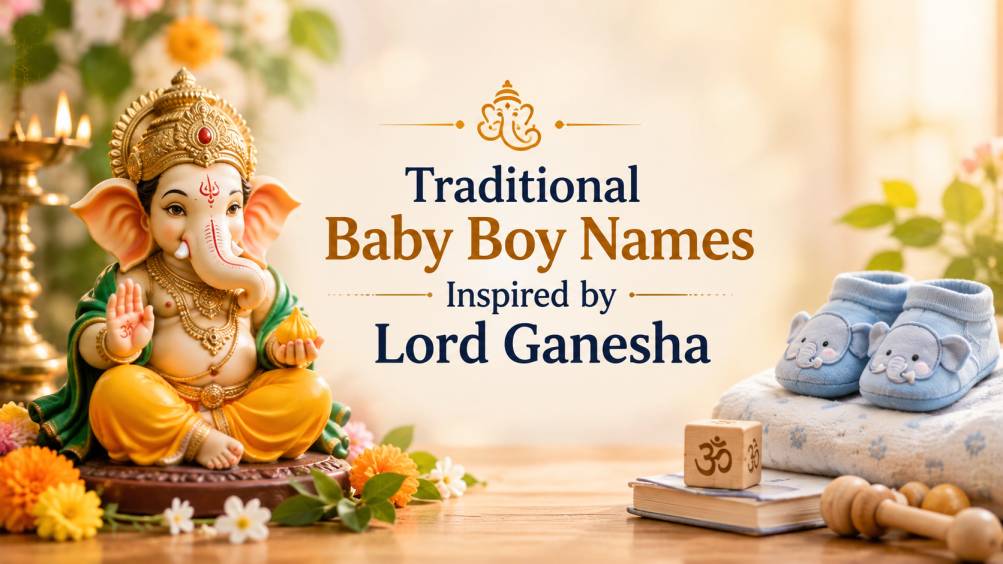
Choosing a name for a baby boy is a meaningful tradition in Indian families. Many parents look for names that reflect wisdom, courage, good fortune, and spiritual values. Lord Ganesha-inspired baby names are especially popular because Ganesha is traditionally revered as the remover of obstacles, the lord of beginnings, and a symbol of knowledge and discernment.
In Hindu tradition, Lord Ganesha is associated with Buddhi (intellect), Siddhi (accomplishment), and auspicious beginnings. His many names, found in devotional literature and Sanskrit traditions, offer parents a rich collection of meaningful names for their children.
From familiar names such as Ganesh and Vinayak to less common choices such as Ekadant and Sumukh, traditional Ganesha names combine cultural heritage with enduring meaning. This guide explores their meanings, astrological naming considerations, and practical ways to choose a suitable name for your baby boy.
Traditional Lord Ganesha Names and Their Meanings
Lord Ganesha is known by many names, each highlighting a different attribute, form, or symbolic quality. The following names are rooted in Sanskrit and Hindu devotional traditions.
- Ganesh (गणेश)
Meaning: Lord of the Ganas or divine attendants.
Ganesh is one of the most widely recognized names of Lord Ganesha. It represents leadership, wisdom, and the ability to guide others. It is a simple, traditional name that remains suitable across generations.
- Vinayak (विनायक)
Meaning: The supreme guide or distinguished leader.
Vinayak is a traditional name associated with Lord Ganesha. It conveys independence, guidance, and responsibility. Families seeking a classic Sanskrit name with a strong cultural identity may consider this choice.
- Vighnesh (विघ्नेश)
Meaning: Lord of obstacles.
Vighnesh refers to Ganesha as the deity traditionally invoked before important undertakings. The name symbolizes perseverance, thoughtful action, and the hope of overcoming difficulties.
- Ekadant (एकदन्त)
Meaning: The one-tusked Lord.
Ekadant is a well-known epithet of Ganesha. His single tusk is often interpreted symbolically as a reminder of determination, sacrifice, and the ability to remain focused on a meaningful purpose.
- Gajanan (गजानन)
Meaning: One who has the face of an elephant.
Gajanan combines Gaja (elephant) and Anana (face). The name reflects Ganesha’s distinctive form and is traditionally associated with wisdom, strength, and dignity.
- Sumukh (सुमुख)
Meaning: One with a beautiful or auspicious face.
Sumukh is a gentle and elegant Sanskrit name associated with Ganesha. It suggests pleasantness, kindness, and an approachable nature, making it a meaningful choice for a baby boy.
- Lambodar (लम्बोदर)
Meaning: The one with a large or pendulous belly.
Lambodar is a traditional name of Ganesha. His rounded form is interpreted in devotional symbolism as representing the capacity to contain experiences, knowledge, and the diversity of life.
- Heramb (हेरम्ब)
Meaning: A protective or compassionate form of Ganesha.
Heramb is a less common traditional name found in Ganesha devotional traditions. It is associated with protection and benevolence and may appeal to parents looking for a distinctive Sanskrit name.
- Dwij (द्विज)
Meaning: Twice-born.
Dwij is an epithet associated with Ganesha in traditional lists of his names. In Sanskrit usage, it can refer to a second birth, especially through learning or spiritual initiation. It is a short name with philosophical depth.
- Siddhivinayak (सिद्धिविनायक)
Meaning: Vinayak associated with accomplishment or fulfillment.
Siddhivinayak is a revered name of Ganesha, especially familiar through the famous Siddhivinayak temple in Mumbai. The name expresses devotion, achievement, and the completion of meaningful efforts.
More Traditional Ganesha Names for Baby Boys
Parents who want additional options can explore these names and their commonly understood meanings.
|
Name
|
Meaning or association
|
| — | — |
|
Ganapati (गणपति)
|
Lord of the Ganas
|
|
Gajanana (गजानन)
|
Elephant-faced Lord
|
|
Vighnaraj (विघ्नराज)
|
King or master of obstacles
|
|
Vighnaharta (विघ्नहर्ता)
|
Remover of obstacles
|
|
Bhalachandra (भालचन्द्र)
|
One who bears the moon on the forehead
|
|
Kapil (कपिल)
|
A traditional epithet of Ganesha
|
|
Akhuratha (आखुरथ)
|
One whose vehicle is a mouse
|
|
Mangal Murti (मंगलमूर्ति)
|
Embodiment of auspiciousness
|
|
Dhूम्रकेतु (धूम्रकेतु)
|
A traditional Ganesha epithet
|
|
Dhumravarna (धूम्रवर्ण)
|
One associated with a smoky or ash-coloured form
|
|
Avighna (अविघ्न)
|
Without obstacles; unobstructed
|
|
Modakpriya (मोदकप्रिय)
|
One who is fond of modak
|
Note: Spellings and meanings can vary between Sanskrit texts, regional traditions, and modern naming references. Parents may wish to verify the Sanskrit form and pronunciation before finalizing a name.
Astrological Significance of Ganesha-Inspired Baby Names
In Hindu families, baby naming may be connected with Vedic astrology, Nakshatra, Rashi, and Namkaran Sanskar. Traditional naming practices often use the baby’s birth star and its recommended syllables to select an appropriate starting sound.
1. Nakshatra-Based Naming
The 27 Nakshatras in Jyotish are traditionally associated with particular syllables. After a baby’s birth, a family priest or astrologer may calculate the Janma Nakshatra using the date, time, and place of birth.
The resulting syllables can help narrow down suitable names. For example, a family may wish to select a Ganesha-inspired name that begins with a syllable recommended for the baby’s Nakshatra.
However, not every traditional Ganesha name will match every Nakshatra. A name should be chosen according to the actual birth details rather than by assuming that all devotional names are astrologically suitable.
2. Rashi and the Starting Letter
Some families also consider the baby’s Janma Rashi, or Moon sign, when selecting a name. Different naming traditions use different syllable systems, so the recommended starting sound may vary.
Parents can consider the following steps:
- Calculate the baby’s birth chart using accurate birth details.
- Identify the Janma Nakshatra and Pada.
- Check the traditionally recommended naming syllables.
- Explore Ganesha names that begin with those sounds.
- Confirm the meaning, pronunciation, and spelling of the chosen name.
Astrology offers a cultural framework for naming, but there is no established scientific evidence that a particular name determines a child’s personality, fortune, or future achievements.
Practical Tips for Choosing a Traditional Baby Boy Name
A meaningful name should work well in both family and everyday settings. Consider these practical points before making a final decision.
Check the Meaning and Pronunciation
Some Sanskrit names have multiple spellings in English. For example, Ekadant and Ekadanta may both appear in naming references. Choose a spelling that preserves the intended meaning and is easy for family members to pronounce.
Consider Cultural and Regional Usage
Names such as Ganesh, Vinayak, and Gajanan are familiar across many Indian communities. Other names may be more common in specific regions or devotional traditions. Family heritage, language, and pronunciation preferences can all be useful considerations.
Explore the Namkaran Tradition
Namkaran Sanskar is traditionally performed as part of Hindu family customs surrounding a child’s naming. The ceremony may include prayers, blessings, and the formal announcement of the baby’s name. Practices differ across communities, so families can follow their own customs.
Optional Devotional Practices
Families who wish to connect the name with Ganesha devotion may consider simple, non-compulsory practices:
- Recite “Om Gam Ganapataye Namah” during personal prayer.
- Offer flowers or a modak during a family Ganesha puja.
- Read a short story about Ganesha’s wisdom and compassion.
- Teach children the values of patience, learning, kindness, and responsibility.
These practices are expressions of faith and family tradition. They should not be treated as guarantees of particular outcomes.
Conclusion
Traditional baby boy names inspired by Lord Ganesha offer a meaningful connection to Sanskrit language, Hindu culture, and devotional heritage. Names such as Vinayak, Gajanan, Ekadant, Sumukh, and Siddhivinayak each carry a distinct association with Ganesha’s form or qualities.
For families following Vedic naming customs, the baby’s Nakshatra, Rashi, and recommended starting syllable may help guide the selection. At the same time, meaning, pronunciation, family preferences, and everyday usability remain important practical considerations.
A name can become a lasting reminder of the values parents hope to share with their child. Whether you choose a familiar name or a less common Sanskrit epithet, the most meaningful choice is one that your family understands, respects, and can use with affection.
Frequently Asked Questions
1. What are some traditional baby boy names inspired by Lord Ganesha?
Some traditional names include Ganesh, Vinayak, Gajanan, Ekadant, Sumukh, Vighnesh, Lambodar, and Siddhivinayak.
These names are drawn from the many names and epithets associated with Lord Ganesha in Hindu devotional traditions. Each name highlights a particular form, attribute, or symbolic association.
Related tips:
- Choose a name with a clear meaning.
- Check the original Sanskrit spelling.
- Consider family and regional pronunciation.
2. Which Ganesha name means remover of obstacles?
Vighnaharta is commonly understood as “remover of obstacles” and is a popular devotional name for Lord Ganesha.
The name reflects the traditional practice of invoking Ganesha before beginning important activities. It expresses a spiritual hope for clarity and the ability to face difficulties.
Related practices:
- Begin important family occasions with a Ganesha prayer.
- Teach children the value of patience and perseverance.
- Use the name as a reminder of thoughtful problem-solving.
3. Can I choose a Lord Ganesha name according to my baby’s Nakshatra?
Yes, families following Vedic naming customs can select a Ganesha-inspired name that begins with a syllable traditionally recommended for the baby’s Nakshatra.
The baby’s birth date, exact birth time, and birthplace are generally used to calculate the Janma Nakshatra and Pada. An astrologer or family priest can help identify the traditional naming syllables.
Related tips:
- Obtain accurate birth details.
- Confirm the Nakshatra and Pada.
- Match the recommended syllable with a meaningful Ganesha name.
4. What is the meaning of the name Vinayak?
Vinayak is a traditional name of Lord Ganesha that is commonly associated with a distinguished guide or leader.
The name has Sanskrit roots and is widely used in India. It conveys an association with guidance, responsibility, and Ganesha’s revered role in Hindu tradition.
Naming tips:
- Consider whether the pronunciation suits your family language.
- Check the preferred English spelling.
- Explore related names such as Ganapati and Vighnesh.
5. Is Siddhivinayak a suitable traditional name for a baby boy?
Siddhivinayak is a traditional Ganesha-inspired name associated with accomplishment, fulfillment, and the revered form of Vinayak.
It is also strongly associated with the Siddhivinayak temple in Mumbai, making it familiar to many Indian families. Parents may choose it for its devotional and cultural significance.
Related considerations:
- Decide whether a longer name suits your family.
- Consider a shorter everyday form only if its meaning remains clear.
- Verify the preferred spelling before official registration.
6. Does a Ganesha-inspired name influence a child’s future?
A devotional name can express family values, cultural identity, and spiritual hopes, but there is no established scientific evidence that it determines a child’s future, personality, or success.
In Hindu tradition, names may carry symbolic and devotional significance. A child’s development is also shaped by education, relationships, environment, opportunities, and individual choices.
Practical approach:
- Choose a name for its meaning and cultural relevance.
- Encourage values such as kindness, learning, and resilience.
- Treat astrology and devotional naming as cultural or spiritual practices rather than guarantees.
7. What mantra is traditionally associated with Lord Ganesha?
“Om Gam Ganapataye Namah” is a widely used Ganesha mantra in Hindu devotional practice.
The mantra is traditionally recited as an invocation to Lord Ganesha. Families may include it in prayer or puja according to their own beliefs and customs.
Simple devotional options:
- Recite the mantra during a family prayer.
- Learn about Ganesha’s stories and symbolism.
- Observe Ganesha Chaturthi according to local family traditions.