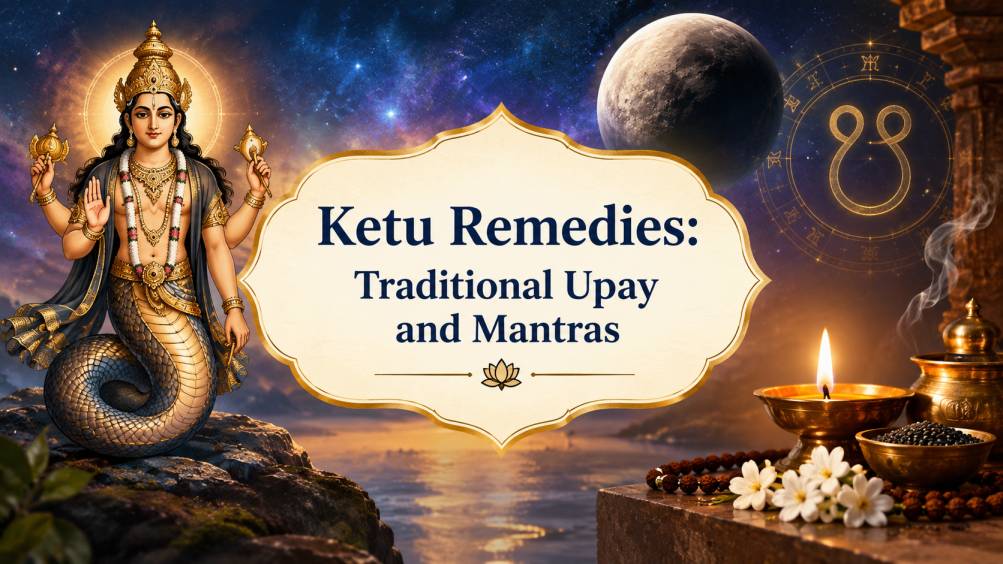
In Vedic astrology, Ketu is one of the two lunar nodes and is traditionally classified as a shadow planet or Chhaya Graha. While Rahu is associated with worldly desires and expansion, Ketu is often linked with detachment, spirituality, intuition, introspection, liberation, and inward focus.
Ketu’s influence is interpreted through its zodiac sign, house, nakshatra, planetary aspects, conjunctions, and the dasha or antardasha operating in a birth chart. It is therefore not accurate to label Ketu as simply good or bad.
When Ketu is considered challenging in a horoscope, traditional Ketu remedies and upay may be recommended to encourage clarity, discipline, spiritual awareness, and emotional steadiness. These remedies are best viewed as cultural and spiritual practices rather than guaranteed methods for changing life outcomes.
What Does Ketu Represent in Vedic Astrology?
Ketu represents the South Lunar Node, the point opposite Rahu. Traditional Jyotish associates it with experiences that encourage withdrawal from excessive attachment and greater introspection.
Its symbolism includes:
- Spirituality and meditation
- Detachment from material concerns
- Intuition and introspection
- Research and investigation
- Unconventional experiences
- Past patterns and karmic symbolism
- Sudden separation or change
- Interest in mysticism and occult subjects
Ketu can sometimes indicate a tendency to lose interest in areas that once seemed important. At the same time, this symbolism may encourage deeper learning and self-awareness.
Ketu and the Houses
The house occupied by Ketu indicates the area of life where its themes may become prominent.
For example:
- 1st house: Identity, self-image, and personal direction
- 4th house: Home, emotional security, and inner peace
- 5th house: Creativity, education, children, and intuition
- 8th house: Research, transformation, hidden subjects, and uncertainty
- 9th house: Spirituality, higher learning, beliefs, and teachers
- 12th house: Solitude, meditation, foreign environments, and spiritual withdrawal
These are broad interpretations. A complete Kundli should always be assessed before drawing conclusions about Ketu’s influence.
When Are Ketu Remedies Considered?
Astrologers may consider traditional remedies when Ketu is associated with difficult planetary combinations, challenging houses, or a period in which Ketu’s themes become particularly prominent.
Possible experiences traditionally associated with a difficult Ketu influence include:
- Feeling directionless
- Excessive detachment
- Difficulty concentrating
- Sudden changes in priorities
- Isolation or withdrawal
- Lack of satisfaction despite achievements
- Strong attraction toward spiritual or occult subjects
These experiences can have many psychological, social, and practical causes. They should not automatically be attributed to Ketu.
Traditional Ketu Remedies and Upay
1. Chant a Ketu Mantra
One commonly used Ketu mantra is:
“Om Sram Shreem Shraum Sah Ketave Namah.”
Mantra chanting is traditionally practised as a form of focused prayer and meditation. The objective is not to treat the mantra as a guaranteed solution but to develop regularity, concentration, and spiritual reflection.
A simpler form often used in devotional practice is:
“Om Ketave Namah.”
Choose one practice that fits your personal tradition instead of performing many remedies simultaneously.
2. Worship Lord Ganesha
Ketu is traditionally associated with spiritual insight, and many Jyotish traditions recommend Ganesha worship for Ketu-related concerns.
A familiar mantra is:
“Om Gan Ganapataye Namah.”
It may be incorporated into regular prayer or meditation.
3. Practise Charity
Charity is a recurring element in traditional planetary remedies. Rather than focusing only on specific objects, the underlying principle can be approached through practical generosity.
Consider donating:
- Food
- Blankets or clothing
- Educational materials
- Essential household supplies
- Financial assistance to someone genuinely in need
Charity can have value independently of astrology by strengthening compassion and community support.
4. Develop a Meditation Practice
Ketu’s traditional symbolism makes meditation particularly relevant.
Start with 5–10 minutes of quiet breathing or mindfulness. There is no requirement to follow a complicated spiritual routine.
A simple practice can involve:
- Sitting comfortably.
- Observing the breath.
- Reducing distractions.
- Returning attention to the breath whenever the mind wanders.
- Ending with a few moments of quiet reflection.
The purpose is to develop awareness rather than escape everyday responsibilities.
Ketu Remedies for Different Life Areas
Career and Professional Direction
Ketu’s influence can traditionally be associated with unconventional careers, research, technology, spiritual fields, and work requiring specialised knowledge.
If you feel professionally disconnected, combine spiritual practices with practical career planning.
- Review your skills.
- Identify what genuinely interests you.
- Seek professional feedback.
- Avoid quitting impulsively.
- Set measurable career goals.
Relationships and Emotional Balance
Ketu can symbolically represent detachment. When this theme becomes excessive, communication may become more important than ritual remedies.
Try to:
- Express feelings clearly.
- Avoid unnecessary isolation.
- Respect personal boundaries.
- Discuss expectations openly.
- Spend meaningful time with family.
Spiritual Growth
For people interested in spirituality, Ketu remedies can become an opportunity for deeper self-reflection.
Reading traditional texts, meditation, seva, yoga, and maintaining a simple daily prayer routine may be more sustainable than searching for a single powerful remedy.
Should You Wear Cat’s Eye for Ketu?
Cat’s Eye (Lehsunia) is traditionally associated with Ketu in Jyotish. However, it should not be worn simply because Ketu appears in a birth chart.
A traditional gemstone recommendation considers:
- Ketu’s house and zodiac sign
- Planetary aspects
- Conjunctions
- Functional role in the horoscope
- Current Mahadasha or Antardasha
- Overall chart strength
Because gemstones are traditionally believed to strengthen planetary symbolism, they should be considered only after analysing the complete Kundli.
Practical Ketu Upay for Everyday Life
The most useful approach is to combine traditional practices with sensible habits:
- Maintain a regular sleep schedule.
- Spend some time away from unnecessary digital distractions.
- Practise meditation or prayer.
- Help others through practical charity.
- Avoid impulsive decisions.
- Keep important responsibilities organised.
- Make time for family and social connections.
- Learn to distinguish healthy detachment from avoidance.
Conclusion
Ketu remedies traditionally focus on detachment, spiritual awareness, introspection, and clarity rather than material expansion. Mantra chanting, Ganesha worship, meditation, charity, and disciplined daily habits are among the commonly practised Ketu upay.
Ketu should not automatically be treated as a negative planetary influence. Its symbolism can also relate to research, intuition, spirituality, specialised knowledge, and the ability to step back from unnecessary attachments.
The most balanced approach is to understand Ketu within the complete birth chart and use traditional remedies as tools for reflection and discipline. Practical action remains equally important. A simple, consistent practice is generally more meaningful than relying on dramatic claims about instant results.
FAQs
1. What is the most common Ketu remedy?
Mantra chanting, meditation, Ganesha worship, charity, and spiritual practices are among the commonly recommended Ketu remedies.
Traditional Jyotish does not require everyone to follow the same remedy. The appropriate approach depends on Ketu’s placement and its relationship with other planets in the birth chart.
Simple practices include:
- Chant “Om Ketave Namah.”
- Practise meditation.
- Donate useful items.
- Maintain a disciplined routine.
2. Which mantra is used for Ketu?
“Om Sram Shreem Shraum Sah Ketave Namah” is a commonly cited Ketu mantra in traditional Jyotish practice.
Another simple devotional form is “Om Ketave Namah.” Regularity and focused attention are generally more useful than performing complicated rituals without understanding their purpose.
Tip: Choose a mantra practice that is comfortable and consistent with your spiritual tradition.
3. Is Ganesha worship a Ketu remedy?
Yes, Ganesha worship is traditionally used as one of the spiritual practices associated with Ketu remedies.
Lord Ganesha is widely worshipped before important activities and is associated with wisdom and overcoming obstacles. A simple prayer can therefore be incorporated into a Ketu-related spiritual routine.
Suggested practice:
- Light a diya safely.
- Offer flowers according to your tradition.
- Chant “Om Gan Ganapataye Namah.”
- Spend a few minutes in quiet reflection.
4. Is Cat’s Eye gemstone suitable for everyone with Ketu?
No, Cat’s Eye or Lehsunia should traditionally be considered only after examining the complete birth chart.
Ketu’s house, sign, aspects, conjunctions, and current dasha can all affect the traditional interpretation. Wearing a gemstone without considering these factors may not be appropriate.
Before considering Cat’s Eye:
- Analyse the complete Kundli.
- Examine Ketu’s planetary relationships.
- Consider the current dasha.
- Consult a knowledgeable Jyotish practitioner.
5. Can Ketu remedies remove Ketu Dosha?
Traditional remedies are intended to provide spiritual support and balance, but they should not be described as guaranteed methods for removing a planetary influence.
The term “Ketu Dosha” can refer to different chart conditions depending on the astrologer’s system. A complete horoscope analysis is therefore more useful than relying on a generic remedy.
Helpful approach:
- Understand the actual planetary combination.
- Follow a simple remedy consistently.
- Combine spiritual practice with practical action.
- Avoid fear-based predictions.
6. Which day is associated with Ketu remedies?
Different Jyotish traditions associate Ketu remedies with different days, so there is no single universally applicable day or time.
Some practitioners connect Ketu practices with spiritual observances, meditation, Ganesha worship, or specific devotional traditions. The exact timing is less important than following a consistent and personally meaningful practice.
For everyday practice: A regular meditation or prayer routine can be maintained without restricting it to a particular clock time in IST.