
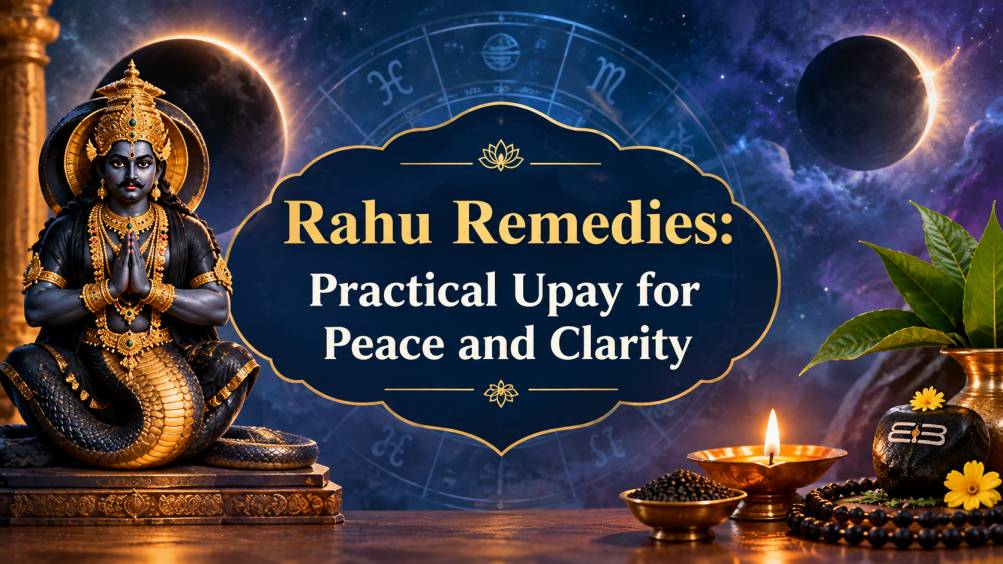
In Vedic astrology, Rahu is one of the two lunar nodes and is traditionally associated with ambition, desires, uncertainty, unconventional thinking, foreign connections, and sudden changes. Unlike physical planets, Rahu is a mathematical point where the Moon’s orbit intersects the ecliptic.
In a birth chart, Rahu’s influence is interpreted according to its zodiac sign, house, nakshatra, planetary associations, and dasha period. A strongly emphasised Rahu is not necessarily negative. It can correspond symbolically with innovation, technology, research, unusual career paths, and the desire to explore unfamiliar areas.
When Rahu is traditionally considered challenging, practitioners may recommend Rahu remedies or Rahu upay to encourage steadiness, clarity, discipline, and emotional balance. These practices should be viewed as supportive spiritual traditions rather than guaranteed solutions.
What Does Rahu Represent in Vedic Astrology?
Rahu is known as the North Lunar Node and is considered a shadow planet (Chhaya Graha) in Jyotish.
Its symbolism includes:
- Strong desires and material ambitions
- Attraction toward unfamiliar experiences
- Foreign cultures and places
- Technology and modern innovation
- Unconventional thinking
- Sudden changes and unexpected developments
- Confusion or overthinking when poorly integrated
- Desire for recognition and influence
Rahu is often described as amplifying the qualities of the house and sign it occupies. Its results can therefore differ considerably between two birth charts.
Rahu and the Houses
The house occupied by Rahu can indicate the life area where its themes become more noticeable.
For example:
- 1st house: Identity, appearance, self-image, and personal direction
- 5th house: Creativity, learning, speculation, and intellectual interests
- 7th house: Partnerships, relationships, and public interactions
- 10th house: Career, reputation, authority, and professional ambitions
- 11th house: Networks, gains, social circles, and aspirations
These are broad traditional interpretations. A complete horoscope requires consideration of the entire chart rather than Rahu alone.
Common Signs of a Challenging Rahu Influence
Astrology texts and practitioners associate certain experiences with difficult Rahu periods, although these experiences can also have many ordinary causes.
Examples may include:
- Persistent overthinking
- Difficulty maintaining focus
- Excessive attachment to outcomes
- Confusion about career direction
- Sudden changes in plans
- Obsession with status or recognition
- Irregular routines
- Attraction to risky shortcuts
These should not automatically be attributed to Rahu. Personal circumstances, stress, environment, and decision-making also matter.
Practical Rahu Remedies and Upay
Traditional Rahu remedies generally emphasise discipline, prayer, charity, humility, and reducing unnecessary excess.
1. Chant a Rahu Mantra
A commonly used mantra is:
“Om Bhram Bhreem Bhraum Sah Rahave Namah.”
It may be recited according to one’s spiritual practice. There is no universally established requirement that it must be repeated at a particular clock time.
Some traditions also associate Rahu worship with Durga and recitation of Durga-related prayers.
2. Practise Charity
Charity is an important element of many traditional planetary remedies.
Depending on your circumstances, consider donating:
- Black or dark-coloured clothing
- Sesame seeds
- Food
- Essential household items
- Financial assistance to people in genuine need
The practical value of charity is not dependent on astrology. Helping others can itself encourage generosity and social responsibility.
3. Create a More Structured Routine
Rahu is traditionally associated with restlessness and excessive desire. A structured daily routine can provide a practical counterbalance.
Try to maintain consistent:
- Sleeping and waking times
- Work schedules
- Meals
- Exercise
- Screen usage
- Personal finances
This is particularly useful for people who find themselves constantly switching between tasks or chasing short-term distractions.
4. Reduce Digital Overload
Rahu’s traditional association with technology makes digital habits especially relevant in modern life.
Consider:
- Limiting unnecessary social media use
- Turning off non-essential notifications
- Avoiding excessive late-night scrolling
- Taking regular screen breaks
- Checking information before believing or sharing it
These are practical habits rather than astrological cures, but they can support the clarity that Rahu remedies traditionally aim to encourage.
5. Avoid Shortcuts and Impulsive Decisions
Rahu is often associated with strong ambition and unconventional methods. A useful practical upay is to slow down major decisions.
Before making an important choice, ask:
- Is the information verified?
- What are the risks?
- Am I acting because of pressure or fear?
- Is there a simpler alternative?
- Can I afford the potential loss?
This approach is particularly relevant to investments, business decisions, career changes, and online opportunities.
Rahu Remedies According to Life Areas
Different Rahu placements may bring attention to different parts of life.
Career and Business
If Rahu is emphasised around the 10th house or career-related combinations, traditional astrology may connect it with ambition, technology, foreign companies, unconventional professions, or sudden professional changes.
Practical remedies include maintaining transparent business records, avoiding unethical shortcuts, and building skills consistently.
Relationships
Rahu’s influence on the 7th house is traditionally associated with unusual relationship experiences or strong attraction.
Rather than relying only on remedies, focus on:
- Clear communication
- Realistic expectations
- Financial transparency
- Respect for boundaries
- Taking time before major commitments
Financial Matters
Rahu can symbolically represent strong material desires. When financial decisions become emotionally driven, disciplined budgeting becomes particularly important.
Avoid making investment decisions solely because of astrological predictions.
Should You Wear a Hessonite Gemstone for Rahu?
Hessonite garnet, traditionally known as Gomed, is associated with Rahu in Jyotish.
However, gemstones are traditionally prescribed after examining the complete birth chart, including Rahu’s house, sign, dignity, aspects, conjunctions, and dasha. Wearing a gemstone solely because Rahu appears prominent is not advisable.
Anyone considering a gemstone should first consult a qualified Jyotish practitioner and understand the traditional reasoning behind the recommendation.
Conclusion
Rahu remedies are traditionally intended to bring greater discipline, awareness, and balance to areas associated with desire, uncertainty, ambition, and sudden change. Simple practices such as mantra recitation, charity, responsible decision-making, digital moderation, and maintaining a stable routine can be approached without excessive superstition.
Rahu is not automatically a negative influence. In Jyotish, its symbolism can also relate to innovation, research, technology, foreign connections, and unconventional achievements. The interpretation depends on the complete birth chart.
Rather than looking for a single powerful Rahu upay, use traditional remedies as opportunities for self-reflection while combining them with practical actions and informed choices.
FAQs
1. What is the most common Rahu remedy?
Mantra chanting, charity, disciplined routines, and reducing impulsive behaviour are among the commonly practised Rahu remedies.
Traditional Jyotish places importance on remedies suited to the individual’s horoscope rather than assuming that one method works for everyone.
Simple practices:
- Chant a traditional Rahu mantra.
- Donate according to your means.
- Maintain a consistent routine.
- Avoid unnecessary risks and shortcuts.
2. Which mantra is used for Rahu?
A commonly used Rahu mantra is “Om Bhram Bhreem Bhraum Sah Rahave Namah.”
The mantra is traditionally used as part of Rahu-related spiritual practice. People may incorporate it into meditation or prayer according to their personal tradition.
Tip: Focus on regular and mindful practice rather than treating mantra repetition as a guaranteed solution.
3. Can Rahu remedies reduce confusion and overthinking?
Traditional Rahu remedies are intended to support clarity and balance, while practical habits can directly help manage distraction and overthinking.
Rahu is symbolically associated with uncertainty and excessive desire in Jyotish. Creating boundaries around technology, sleep, work, and decision-making can provide a useful practical foundation.
Helpful habits:
- Reduce unnecessary screen time.
- Keep a written task list.
- Verify information before acting.
- Avoid making major decisions impulsively.
4. Is Gomed suitable for everyone with Rahu problems?
No, Gomed or hessonite should traditionally be recommended only after examining the complete birth chart.
Rahu’s sign, house, planetary relationships, aspects, and dasha can all influence how it is interpreted. Therefore, choosing a gemstone based only on a general zodiac sign or a single placement can be misleading.
Before wearing Gomed:
- Analyse the complete Kundli.
- Examine Rahu’s house and sign.
- Consider current dasha and planetary relationships.
- Seek guidance from a knowledgeable Jyotish practitioner.
5. Which day is associated with Rahu remedies?
Saturday is commonly associated with several Rahu-related practices, although traditions differ regarding the specific day and timing of remedies.
Some practitioners also connect Rahu worship with specific prayers to Goddess Durga. There is no single universally applicable timing for every remedy.
Practical approach: Follow the tradition you are comfortable with and prioritise consistency over complicated rituals.
6. Can Rahu remedies guarantee career or financial success?
No, astrology-based remedies cannot guarantee career growth, wealth, or a specific life outcome.
Rahu may traditionally be connected with ambition, professional visibility, technology, and unconventional opportunities, but real-world results depend on skills, decisions, circumstances, and effort.
For practical balance:
- Build relevant skills.
- Keep financial records.
- Research opportunities carefully.
- Avoid speculative shortcuts.
- Review major decisions objectively.